Self Defense (Not)!

Natural AggressionOf course, self-defense is not a traditional Chinese idea, village defense perhaps, crop defense probably, and family defense sure thing-- but the idea that I might need to learn self-defense to dispatch bullies or muggers, not so likely.

After all, when I was ten years old I knew what every Chinese merchant also knew; if you want to deal with bandits you're better off having a large number of armed guards, or even better, getting the government or an army to protect the roads or even hunt the bandits down with overwhelming force of numbers.

I knew that bullies who resist trickery, slight of hand, and psychic intimidation, can be dealt with by enlisting the overwhelming force of a bigger friend, a tougher friend, a group of friends, or just adults who wield punishments more severe and longer lasting than fisticuffs.

I did not begin studying martial arts because I wanted to be able to defend myself, quite to the contrary. I took up the arts because I had a huge amount of natural aggression. I'm talking about explosive aggression that by ten I had already learned I needed to tame. At ten I knew that to be accepted by the adult world I needed to suppress my own spontaneous desire to smash and bash!

No, I started studying martial arts so that I would have a place to explode, a place where it was safe to be aggressive because I would be in the company of people who could defend themselves from ME!

Hat tip: This came up because I was ranting over at formosaneijia


Link: Scientific American:  This kind of research is pure evil because if there is a genetic cause for my aggression and they find it, there will be a push to make sure people like me are not born in the first place!

Milking it

I was performing Wuhudao (five tiger sword), a classic Northern Shaolin form for some first graders the other day. We had a conversation I've had many times with many different groups of kids.

I perform, I bow, the kids clap, "Are there any questions?"

First kid, "Can that sword kill someone?"

Me, "As you can see if you look closely if isn't sharpened." I bring it over for the students to inspect.

Second kid, "Was it sharpened when you first got it?"

Me, "No, it is an authentically weighted practice sword, for training gongfu. It was never sharp."

Third kid, "Could that sword kill somebody?"

Me, "Hhhmmm"

First kid again, "But could that sword be used to kill someone?"

Me, " I think you guys are asking the wrong question."

Another kid, "Would that sword be able to kill someone?"

Me, "Of course this sword could be used to kill someone, but so could a glass of milk. A glass of milk in the wrong hands could become a deadly weapon."

First kid again, "I want to get a sword!"Buffy

Absent

Yes it is YellowI've been absent from my blogging duties far too much the last two weeks.  Here's why:
I'm working on some other writing for a book on Daoism and those deadlines are coming up.

I just went to LA for a Paulie Zink Monkey style gongfu workshop this weekend.   I drove a sporty yellow rent-a-car, met some nice people, experienced some great weather with pollution enhanced sunsets, and did a lot of monkey style.  I'm been walking on my fists, rolling, jumping, hopping, grabbing, kicking and shreeking in the lowest of the low, low stances.  These stances are what they call "under the table."Low Stances

Throughout the workshop I was a bad student.  I tried to stay consistent with my theories of not stretching or building muscle.  (Hey, monkeys don't do that stuff!) The results are good so far, no pain, but I've been tired.  I have that "so tired" feeling it is as if each individual cell in my body is uniquely tired.

My half-wife has been moving her acupuncture business to a bigger, brighter, better location.  Everyday is a new exciting drama.  I've been helping with everything I can.  She in exchange has been keeping a journal of every time I say something about how my body hurts.  This came about after she told me I was becoming like a hypochondriac because I report the tiniest little change or weirdness in my body.  I protested that I hardly ever complain, so she decided to keep a record of my complaints.  Now I just come home and say, "Get your book out!"

Two weekends ago I did a George Xu workshop in the middle of a rain and windstorm.  It was outdoors under a small outdoor sheltered area in front of an elementary school.  We had to make sure people were being pushed into the wall because if they were pushed the other way they would have fallen out into the rain and down a bunch of stairs.  I really prefer the warm weather practice, but it wouldn't be gongfu if preferences mattered.

Next week I'm planning on doing a Body Mind Centering workshop on ligaments.
Oh, and I have a full teaching schedule... but don't worry, blogging is my fate.

The Quest for Power (Part 3)

ox powerIn the two previous posts, I wrote that the quest for power is born when our survival feels threatened and arises from qi deficiency which creates conflicting emotions. I also wrote about how the quest for power begets sacrifice.

In the Chinese martial arts we have the expression "Ox power" to describe simple muscular strength. Generally speaking, the first stage of martial training is to get rid of ox power and replace it with "muscle tendon lengthening power" and (depending on the focus of the school) fighting technique.

This process can be generalized for all pursuits of power. All power is preliminary. Give up a low position in the government in order to take on a higher one. If your climb up the corporate ladder is obstructed it may be time to start your own company.
We don't get new power without letting go of old ideas about power. Following this observation to its logical conclusion or extreme, letting go of all ideas of power will open up the biggest possibilities. All the Daoist classics say in one way or another, if you want strength cultivate weakness.

The quest for power is a natural out growth of fear. Fear can arise with or without apparent cause. The brilliance of Daoist thought in this regard is the recognition that there are physiological processes which bring about the experience of fear and the feeling that our survival is threatened.

Daoist practices often explore power from the point of view of what is being sacrificed. Instead of seeking to harness fear for the accumulation of power, these practices teach our bodies how fear arises and how it takes hold. These practices do not eliminate fear. They simply teach our bodies that there is an option to let go of fear when it does arise.

For instance, the Daoist Calendar can be understood as a tool for observing and resolving the fear that arises from not being able to control or predict the future.

Obviously there is no 'One Right Way' of dealing with the fear of not knowing what is coming next! The term "Orthodox Daoism" Zhengyidao- literally means: The One True Way; however, what the term really refers to is an orthodox set of experiments that have been tried and tested over many years. Just because they are orthodox, doesn't mean they will work for you, but the only way to know for sure is to test them yourself.

Internal martial arts clearly have some Daoist origins. It is fair to say they are Daoist inspired to the extent that they treat power as a physiological experiment which over time exchanges power for casual potency and transforms fear into naturalness (ziran). That being said, Martial Arts are not Orthodox Daoist practices because they contain so many potencial pitfalls. Once you have accumulated power, it is often hard to give it up because it seems like you have a "leg up" on everyone around you.


What makes a specific approach to meditation or ritual Zhengyi (Orthodox) is that it has proven over the centuries to be a more direct route to simplicity.

Screaming KungfuTeaching 6 and 7 year olds is a process of getting them to give up screaming and crying for more sophisticated forms of power, like carefully chosen words. Of course they could learn to use their crying in increasingly more manipulative ways, or they could just keep developing their screaming power and it might someday become formidable. One of the nice things about teaching kids is that they haven't developed Ox Power yet, so I don't have to un-teach it. That step can be skipped.

Acquiring each new type of power requires letting go of the previous type of power that worked for you. The type of power we use is part of our story. It is wrapped up in our identity and our body image. In a sense, our Power Body, is our system for storing fear. Letting go of a big fear requires a big commitment, but letting go of a small fear can be more difficult because it isn't obvious what triggers it, how it is stored, or where it came from in the first place.

This is how it works: Bad choices can be overcome by new better choices. Old ghostly decisions, the ones you aren't even aware you made a commitment too, are much harder to change.

Where does the quest for power ultimately lead? Death. People often set up their deaths so that they will continue to accumulate power after they are dead. (The biggest part of Fengshui is not how to arrange your freaking living room! It is trying to limit the negative influences your ancestors have already put in motion!)

The idea behind using Eunuchs in the royal courts was that they wouldn't be constantly using their position to try and install their offspring into positions of power. The irony is that having no balls turned them into ego maniacs that wanted power just for themselves.

As far as accumulating power while we are still alive, the Chinese pinnacle of power has always been to become the emperor. The job of emperor is considered the most potent job there is. The traditional Chinese ideal is that the country is being well run when the emperor has nothing to do. Similarly in Chinese medicine, the heart only has a job when the other organs are out of whack. If the emperor or the heart is actively trying to accomplish something, everybody is in trouble.

The Quest for Power (Part 2)

The Orthodox Daoist take on the quest for power that I related in the previous post likely grew out of a context in which Shamanic and Trance-medium practices were the dominant form of religious expression.

Shaman and mediums use a long list of techniques to reach an altered state which takes them on a journey, or entices a deity to take over their body. Dancing frenetically or for a very long time, altered breathing patterns, chanting and singing, drinking or taking drugs, fasting or eating extreme foods, staying outdoors in bad weather; these are all used by Shaman and Mediums to enter altered states of consciousness, often to the point of passing out.

Shaman and Mediums come back from these performance "trips" with special knowledge, and often special powers which appear to be conferred on them through these experiences.

Orthodox Daoists came to view these practices as journeys toward death. These practices deplete qi, and tend to dramatically shorten life-span. The quest for this type of power entails giving up a part of yourself, a self-sacrifice in exchange for power.

Orthodox Daoists then began to see parallel characteristics in all quests for power. Power begets sacrifice.

A great deal of exercise is framed as a quest for power, they tell you to give up something now for a super body in the future. Push yourself through the difficulty and the pain, put your money down, and you will be rewarded with beauty, recovered youth, or superior abilities.

Often times, quests for power are remedies for the side effects of other quests for power. Working too hard at a job 60 hours a week? Try yoga! That back hurting from the long commute and the all the time in front of the computer? Join our fitness club and we'll not only fix your back, we'll even improve your sex life!

This happens to be the way people are, so the first covenant of Orthodox Daoism is to not get in the way of peoples pursuit of power unless it involves the direct taking of life (blood sacrifice).

Daoism does not reject the pursuit of power. The first line of the Daodejing, (sometimes translated "The Way of Power") suggests that we can have an experience which is unmediated by words, ideas, images, or metaphors. Like power, words are not rejected.

Recognition of the mechanism by which words define and limit our experience does not stop us from appreciating them. The mechanism by which we accumulate power is a fascinating part of human experience, even though it limits our experience and has a tendency to shorten our lives. We have the option of putting on those "power" shoes or going barefoot.

The Quest for Power (Part 1)

The quest for power in the martial arts is a strange one. From an Orthodox Daoist point of view, the quest for power arises from inappropriate conduct.

Some of the most common forms of inappropriate conduct are arguing with someone who isn't interested in learning, pushing yourself to physical exhaustion, drinking too much, or over eating. All of these actions result in loss of qi, they create a deficiency. Historically, starving may have been the most common cause of qi deficiency.

Qi deficiency simply leads to conflicting emotions. Of course this is a natural process, so for instance, if you get in a bad argument and then you go home and take a bath and go straight to bed, you will completely recover. The problems arise when your conflicting emotions combine with someone else's, and it's already past midnight and you have a meeting early in the morning, so you don't have time to replenish your qi.

After a few days of this people start thinking about how they can get more power. Deep conflicting emotions probably arise from fear of death. I think the quest for power is part of our hard wiring. It is triggered when our survival feels threatened, and it arises so that we will be able to survive extreme hardship.

Butterflies or Six Inch Knives?

One of the basic ideas of internal martial arts is that joints can open and close (kaihe). I talked about this in these two posts from last September. Joint Pulsing 1 and Joint Pulsing 2.
The elbow, like all joints, opens and closes quite easily.   In order to think about something it really helps to have words and metaphors which describe it.  Since the elbow is something we rarely talk about, we also rarely think about it, and so for most people the opening and closing of the elbow joint is a completely unconscious process.

When I gained awareness of my elbows opening and closing my martial arts power tripled.  Now you might think I'm exaggerating, you wouldn't be the first, but honestly--before I had this awareness life was gray, after gaining this awareness opponents started flying off of my arms.

Here are two ways to practice that may help you gain awareness of your elbows:
First imagine that you have butterflies on your elbows, happy, light, delicate and beautiful.  Practice moving about, do the form, even gentle push-hands, with out knocking the butterflies off your elbows.

Second, imagine you have six inch long double edged knives projecting out of your elbows; happy, light, sharp, and beautiful.  Go straight to push hands and imagine you are joyfully cutting your way through your opponent.  Be generous with your cutting techniques.

Here is a link to an article I just re-wrote about wearing Compression Straps on your elbows.  

Monkey Swings

BaihuiLast month I was at a family gathering and there was a five month old girl who was crying. Her aunt, who has several wild children of her own, tried rocking her and then bouncing her, but the baby was still crying. Then with a big grin she announced, "We are going to have to try Monkey Swings." I can now verify from my observations that monkey swings are an effective crying control mechanism.

The standard Taijiquan, Xingyi and Bagua zhang instructions tell us to lift up our heads from the Baihui point on the very top of the head. Some Shaolin and meditation schools say to lift from a point a little further back so that the chin comes in slightly. Further, I have heard lift from the roof of the mouth, lift from the base of the skull and even lift from a point in the air about one foot above your head.Monkey Swing 2

All of these instructions are useful gates. It is vitally important to develop awareness of head position, centerline, dingjin (upward power), and zhengqi (upright, self-correcting vigor). However, I think these instructions alone will not produce a high quality final product.

I've now spent way too much time looking at baby pictures on google images, I may need some time to recover my manliness. Unfortunately I could not find a single picture of a monkey swing so I'll have to describe it. Here is how you do a Monkey SwingTM:
While sitting down place the baby on its back in your lap with the its feet facing you. Take hold of an ankle and a wrist in each of your hands. Then lift up and swing the baby's bottom toward your face and then it's head out and away, using your forearms as the pivot. Continue swinging until the desired results are achieved.

BabyAs you are imaging this, you might think that the baby's head would flop backwards like that of the child on the swing above. But it didn't. The baby's head stayed right in line with its torso. This was a five month old I was watching, a younger baby probably would have had a floppy head. An older child would certainly be able to do this, but in most cases it would be obvious that they were using voluntary neck muscles.
The baby I watched did all this automatically. Her head was inside her dantian!

The highest level martial artists put their head inside their dantian.

Here is:
A baby development site.

Slow Down?

You would think, that Taijiquan being known almost universally as the "slow motion" martial art, that actual taijiquan push-hands practitioners would consider slowing-down a self-evident method. But most don't.

I could make a long list of all the reasons for practicing Taijiquan slowly, but I'm not going to do that. I'm just going to talk about one reason.

There are probably a hundred ways of practicing push-hands. Judging from Youtube videos, most people use push-hands to practice applications. I think that's fine, but applications can just as easily be taught as a separate subject. Push-hands is better understood as a competition.Yun Yin Sen

There are many continuous linking set routines in push-hands, the main purpose of which is to make sure both people have continuous power (jin) while moving through various ranges of movement. When one person's power is broken they lose; however, if their partner compensates for them, then the routine can continue repeating itself. If either person is trying to win, it is not possible to do a continuous linking routine because as soon as one person's power is broken, the other must act.

In spontaneous push-hands, there is no routine, just a set of rules or parameters. The two most common rules are no punching and no moving your feet.

Anyway, last year I took a workshop with Master Yun Yin Sen and George Xu together. At one point about 6 of us were taking turns pushing hands with Yun Yin Sen. These were all people who had being practicing for years. He was pushing with each person for about 20 seconds and then he would push them out and call for the next one. But when I pushed with him he never tried to push me out. Like 5 minutes past and I started to feel guilty that I was monopolizing him so I just stepped out. Then everybody got another 20 second turn and it was my turn again. The same thing happened.  We pushed for about 5 minutes until I gave up, in order to give someone else a chance.

What was happening? Every time my fellow students got in a tight spot, they tried to get out of it by adding something; either speed, technique, power or aggression. Every time I got in a tight spot I simply slowed down. Master Yun Yin Sen would always respond by also slowing down and giving me a way out. We could practice forever like that.

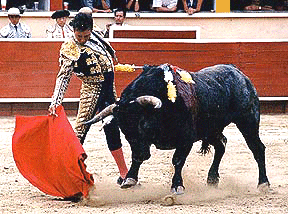
bull fighterEven if you are practicing with a superior opponent who wants to beat you, still the appropriate response when you get in a losing situation is to slow down and give all your attention to understanding/feeling what your opponent is doing.

I don't think I need to point out that this might be a good strategy for living, in general. When things are challenging or full of conflict sometimes it is a good strategy to slow down. Obviously that doesn't hold when you're crossing the street and the light changes color.

If any of my readers have ever tried bullfighting, I'd be curious to know if they think slowing down could be a good strategy there.

Shaped by the Sea

The way martial traditions are shaped by the environment is an interesting topic at many levels. In a hundred years Californian martial arts will have been re-formed by and for people who spend lot's of time in cars, drinking coffee, and typing on computers.

Southern Shaolin, like Choy Li Fut, seems like it was formed by people familiar with fighting in confined spaced, narrow corridors, and tight corners.

Northern Shaolin, on the other hand, seems like it was formed for wide open fields of battle, spear training particularly.

Liuhe (Six Harmonies) style of Xingyi seems like it might have developed on narrow rice paddy pathways.

Baguazhang is harder to place, but from my experience walking in the mountains, I would say there is a strong case to be made that carrying something around on narrow or steep mountain ledges is a likely possible origin.

Taijiquan comes out of the water.

Willem de ThouarsYears ago I had the opportunity to meet Willem de Thouars who, as a child in Indonesia, studied Silat. After achieving a significant level of martial skill at an early age, his family told him to ask the Chinese people living down the road if they would teach him.

The man he ended up studying with eventually taught him Baguazhang, Taijiquan and other arts. The teacher's first condition for allowing young Willem to become a student was for him to go to the river and jump off of the bridge onto the slippery floating logs that were part of a local logging operation and balance there. He said it took a long time to learn and it was very brutal.

(If you are not going to try this method yourself, at least think about what it would feel like. How relaxed do your legs need to be? How much mobility do you need in your torso?)

If you've watched all my Youtube videos you know that I have a little experience fighting on fishing boats in Alaska. The first couple of times I went to sea, I got seasick, but with a little coaching I learned. To avoid seasickness first you have to keep your eyes gazing out on the horizon. Looking at the boat or the water will make you sick. This is very simular to the kind of vision we use in Taijiquan, we soften our focus and gaze way off into the distance.
The second part of not getting seasick is just relaxation. If you try to "hold" your balance, or "hold" your internal organs in place, you will vomit. You have to just let your whole body move around on its own. Trust the rolling of the sea-- again, very simular to taijiquan practice.
We worked 20 hour shifts on one of the worst fishing boat in the fleet (worst because the skipper's brain wasn't equipt with the re-evaluation process). All the guys got sore knees, except yours truly.

The secret to my knees not hurting like everyone else's was that I was rolling my dantian and keeping my knees bent the whole time I was on the boat. At that time, when I wasn't working 20 hours, I was doing about 4 hours a day of Chen Style Taijiquan Chansijin (silk reeling exercises).

When I came back to San Francisco my teacher at the time said to my fellow students (probably hoping another student would use his words as an excuse to challenge me to a fight), "You all have been practicing here with me all Summer, the Priest (that's what he liked to call me) has been away in Alaska and he has progressed more than any of you have." (Yikes, competitiveness encouraged.)Stern Oar River Boat

The last thing I want to say about water is that if you've ever poled a boat through the water or used a Chinese style stern oar, you might have noticed that it is a lot like the Taijiquan movement, "Grasp the Birds Tail."

Oh, O.K., one more thing. If the founders of Taijiquan were actually fisherman, then it would explain how the modern day practitioners' picked up the habit of exaggerating (the size of the fish that got away).