Summer Training Camp

George Xu just put up new information about the Summer Camp he co-teaches every year with a different Chinese Martial Arts Master. The Camp is held in the woods in a place called La Honda, near Santa Cruz California. Here is the scoop on his co-teacher this year:
Master Yu Chen Yong Born in 1943 Tian Jing, China. Started his training as a wrestler in 1953 then moved to Tai Ji in 1957 with famous Master Wu and Master Niu. He also studied Ba Gua with famous Master such as Gao Yi Sheng and Yang Ban Hou large frame Tai Ji with Master Niu Lian Yuan and Zhao Bao Style Tai Ji with Master Hou and Master Yue. One of his teacher is the very famous master Han Mu Xia whom defeated the Russia champion wrestler in 1930, which he then went on to win 10 gold metal from 10 different countries. The metals are now in the China National Historical Museum. In 2000, the master performance in Tian Jing master Yu got 1st place for the title of "best Master performance". In 2005, Master Yu acquired famous master Zhao Bao Tai Ji title from Wu Dang Mountain.

Master Yu will be teaching all his secrets in this year's summer camp in California

Keep Your Fingers Straight

I have a friend of a friend who, last I checked, has been studying Shaolin and Taijiquan with the same teacher for nearly 20 years. This friend is convinced he is becoming the greatest of fighters. This particular teacher claims an important lineage and has both nurturing qualities and a fierce temper.Ju Ming Single Whip

There is a shadow side to the previous discussion about metaphorically passing through difficult gates or crossing over bridges of unnecessary practice.  That shadow is the sometimes desperate pathos of the student-teacher relationship.

Perhaps if you are a teacher you've thought to yourself, "Why are so many of my students lesbian vegetarians? Is it something about me?" Perhaps if you are a student you've wondered, "Why do I keep accidentally calling my gongfu teacher MOM instead of shirfu? He doesn't look or act anything like my mom!"

When I think about it, I doubt that the younger me would have studied martial arts at all if my teachers had been the sort of people that expect me to call them "Master."Ju Ming Single Whip

There are many teachers out there that make good second mommies or daddies. In the South Asian traditions they just go right ahead and call the teacher some version of Ma, or Dada.

I find it hard to resist having a little laugh at this phenomenon, but in all honesty I have great respect for people who provide this kind of support to the emotionally needy. I have known a great many people who have attached themselves to a teacher who really cared about them, and through that particular type of intimacy made disciplined and rewarding changes in their lives.

Some people need a fierce father figure in order to thrive. Others need a nurturing mother figure to give them the confidence to face decisions the rest of us see as routine. I'm rarely fierce or nurturing, so students that come to me looking for those qualities tend not to hang around.Ju Ming Single Whip

But we digress. I have this friend of a friend I mentioned at the begining. The teacher he studies with has been very exacting and demanding and has truly nurtured him in a way that brings out his better qualities. As far as martial arts goes, he gets posture corrections and that is it! He has gotten one Taijiquan instruction in 20 years, the same one over and over, "Keep your fingers straight." He keeps expecting that some day he is going to get to learn push-hands, and many other secrets too.Ju Ming Single Whip

It would all be sad and pathetic if not for two factors. The posture corrections are good, so his Shaolin and Taijiquan forms, which he practices without fail everyday, are pristine. The second factor is almost funny. The instruction, "Keep your fingers straight," is wrong by most accounts. But because he believes in it and practices it so diligently--because he uses it as a measure of everything he does-- he has actually made it mean something true. Every millimeter of his body movement is calibrated to "keep the fingers straight," what ever that even means.Ju Ming Single Whip

He has no knowledge of functionality or applications, no subtle power or push-hands experience. But I have to admit, his form looks good!

And on that note, here is a quote from Henry David Thoreau, (from memory of course)
Why are we in such desperate haste to succeed, and in such desperate enterprises?  If a man does not keep pace with his companions, perhaps if is because he hears the beat of a different drummer, let each step to the beat which he hears, however measured, or far away...

1000 Times a Day!

Mountain BridgeI heard a story about a guy who wanted to study martial arts from a Master who lived up in the Mountains in Taiwan.

Just getting to the cave where this guy taught his few dedicated students was a dangerious rocky slippery climb. He found the Master teaching outdoors and went up and begged the Master to teach him. The master shouted some garbled expletives and signaled for him to put his arm out so he could show him some technique. Upon making contact the student was promptly thrown to the ground. Disgusted, the Master shouted, "WHY ARE YOU SO WEAK?"

The student jumped to his feet and again begged the Master to teach him, and again the Master shouted, "WHY ARE YOU SO WEAK?" And then he shouted at all of his students, "WHY ARE YOU ALL SO WEAK?"

No one had an answer but the student again begged to be taught. The Master then sank down in to a horse stance, stretched his arms out to the sides and began opening and closing his hands, stretching his fingers wide apart and then squeezing them into fists in rapid succession. He then said, "Go away and do this 1000 times a day for a month. If you come back in a month and you haven't done what Sifu has told you, SIFU WILL KNOW, AND SIFU WILL KILL YOU!"

The master then moaned, "Why are you soooooo weak? Get out of here!"

A month later the student came back, having done what he was told and began his studies.

I wrote a great post (if I do say so myself) about the difference between Gates and Bridges just before Thanksgiving. I'm linking to it now because I'm not sure anyone saw it then, and because Formosa Neijia had a funny link that is related.

Journal of Asian Martial Arts

Zhang DaolingI was excited to see Douglas Wile, one of the heavies in terms of martial arts scholarship, writing an article in the Journal of Asian Martial Arts.

Fifteen years ago when this magazine first came out I was ecstatic. Imagine a martial arts magazine which insists on footnotes and bibliographies in every article! I thought it was a dream come true after years of wishing I was still 10 years old so I could appreciate martial arts writing.

The current addition has 13 contributors. There are two without degrees, two have M.A.'s, one has an M.S., one is an Acupuncturist (M.A.), and eight have Ph.D.'s. Wow, and still most of the writing leaves me wishing for younger days. To be fair, most academic writing is genetically predestined to be boring. At least this stuff is mostly written by people involved in the arts, not by "objective outsiders."

I guess I am a child of the Internet, because I'm finding it harder and harder to read full length books and articles. I still love old media, but it takes so long to get to the point. I mean this stuff should have one of those "Don't operate heavy machinery" warning labels. Again, to be fair, I'm addicted to pithy blog posts and I needed to catch up on some sleep.
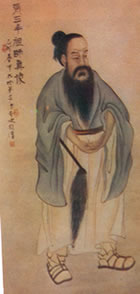
Zhang SanfengDouglas Wile's article is called "Taijiquan and Daoism; From Religion to Martial Art--and Martial Art to Religion." To really do it justice I would have to read the whole thing again. Honestly, I'm in one of those deep practice phases where a few hours of profound internal training makes me want to sleep-- y'all will have to settle for my vague dream like memories.

The gist of Wile's article is that facts about Taijiquan prior to 1900 are really hard to come by but that hasn't stopped lineage holders and historians from freely making sh-t up and pretending it's factual.

One can easily understand why a lineage holder would want to make stuff up. It makes them seem like they have the only key to the chest of treasures while at the same time allowing them the (false) modesty of claiming that their teacher's teacher's teacher was like, dude, really, really good.

It's harder to understand why historians would make stuff up. In America if we catch a historian making stuff up, we use their books for compost. But then again, the various "wings" of the Communists and the Nationalists, were in a propaganda war to prove that only their (death cult) ideologies and allegiances would make Chinese people better and stronger.

Even though Wile spends a lot of time explaining what all these 20th Century scholars thought, I have the feeling he would agree with me when I say, taijiquan has picked up so much baggage we ought to throw out all the books and start over.

Wile dances around the question: Why in light of so little direct evidence for Taijiquan's Daoist roots, are there so many people trying to prove a connection? He writes about Taijiquan's "inventor," the magical dreamer Daoist immortal Zhang Sanfeng:
For sheer contentiousness, the Zhang Sanfeng case can only be compared to issues of racism, sexism, abortion and homosexuality in American culture. At the dawn of the 21st century, the pendulum has once again swung towards the myth-makers. Western practitioners of taijiquan, with their monotheistic, atheistic, or "only begotten son" backgrounds are apt to view Zhang Sanfeng as simply an historical figure with some innocent Daoist embellishments. They are not likely to understand China's culture wars, polytheism, or embodied immortality..."

In summary, his point is that Taijiquan never really had much to do with Daoism, until 20th century people started mixing in a lot of Neidan (inner alchemy), TCM jargon, some quotes from the Daodejing and the Zhuangzi, and claims about health. Oh yeah, and some stories. And then a bunch of fake modern scholars said none of that is true-- but what they said wasn't true either (so there!). Now that running a business isn't banned in China, there is this new feel good, feel strong, feel Chinese, feel Taijiquan-is-part-of-Daoism, marketing ethos. No real content.

And Wile gets kind of mad about it,
"Daoist Chauvinism should never be underestimated, and we need only remind ourselves that some Daoist apologists have claimed that Buddhism sprang from seeds planted by Laozi when he rode westwards on his ox."

True LoveThem's figtin' words. Bumper stickers have all but disappeared from San Francisco (which I attribute to uniformity of thought); however, I spotted one today. It read, "Lighten Up!"

For the record, those Daoist "apologists," were not writing history, they were writing secret scripture. The name Laozi means "old seed," but if we are talking about the Santianneijing (3rd Century), then it was Laojun (the inspiration behind the Daodejing) which actually incarnated as the Buddha so that the western barbarians would have their own version of "The Way," and would thus have their own home grown basis for mutual cooperation and understanding. Never mind, that's an argument for another day.

I respect Wile's contribution to understanding the history of Taijiquan, I thank him for letting us know it's all a bunch of lies!

My argument with him is this: Orthodox Daoism never claimed Taijiquan as a Daoist art and I doubt it ever will. Monastic Daoism has of late decided that Taijiquan is part of its shtick. Since the 1980's is has also decided that gongfu movies are part of its shtick, big whoop. Monastic Daoism never really had a central authority, from the sidelines it kinda seems like Buddhism with a little inner alchemy for the "we must appear to be loyal Chinese" set. All this means very little.

If you want to know what the origins of Taijiquan are, you are going to have to soften your definitions, and blur your categories. Taijiquan only came into being because it was able to obscure it's origins in religion, popular culture, and secret societies. By the start of the 20th century participation in trance cults or exorcistic and processional dance, was considered politically dangerious and ideologically backwards. That's why they invented and then tried to tack on the suspicious label, "purely philosophical" Daoism.

Likewise, some combination of fear, modernity, and ideology led people to strip down their communal ritual performance traditions into pure "Martial Arts."

People over here were arguing about why they took the Fajing (power issuing?) out of Yang and Wu styles of Taijiquan. I'll tell you why. Fajing is a way to strike terror into your audience, a way to let people know the god has taken possession of the dancer.

Now, if you'll excuse me, I'm going to go put the Fajing back in my form!

Happy New Year

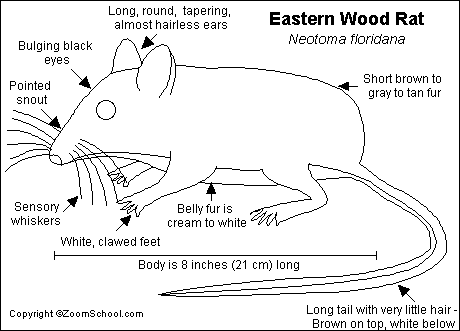
rat in holeWell after making it through that very twisty tail of the pig, I'm already enjoying the soft sensitive pillow nose of the rat! (Because I live in a Chinese city, I only had one class this morning and I spent the rest of the day in bed.)
Gong Hay Fat Choi (which means: Congratulations, Get Rich!)

Here is my prognostication:

Rats are the smartest of the twelve animals. They like to tear and chew things into tiny pieces and put them in piles. If you haven't throw it away already, you might as well wait until the ox year. Rats are not actually good organizers, but they save everything and know how to find it again by sheer mental prowess.

So it's a great year for beginning a course of study, for taking exams, and in depth research, starting a collection, or adding a room onto your house (for storage).

After the pig, and the snake, the rat is the most sexy year. This being an Earth Rat year it is good for partnerships, nesting, and babies. Rats like company so it's a good year for people in businesses that thrive on social activity.zodiac Chinese

If you are a tiger, be particularly careful of over-eating, rats make easy meals but too much of a good thing will lead to lethargy by the summer months.

If you are a dragon it could be a tough year, get people to help you with the small stuff, the normally grand plans of the dragon are likely to get bogged down in minutiae. Ditto for the horse.

It's a good year for monkeys, rabbits and oxen.

The nose and whiskers of the rat are extremely sensitive, so the first part of the year is great for planning and seeking out new solutions to old problems. Look for new sources of income and new markets.

The rat year is great for experiments. Heightened sensitivity makes intuition more reliable. And even if you botch things up rats are always good at getting out of a corner or squeezing through a tight spot.

Start preparing now for next Winter. It's likely to be a long, tough one where things (like the rat's tail) get strung out. If you get a chance to finish projects in October or November, take it and then go into retreat, otherwise you may find yourself working on the never ending project--lingering into the ox year.

The key to a good rat year is knowing that rats are very flexible about what they eat, as long as they don't bite off more than they can chew.rat

Continuum

bodies and cultureI'm old enough, and was born in the right place, to remember the real New Age. The basis of the New Age movement was the hippy idea that we could change the metaphors we live by. If we changed the games children played from competitive ones to cooperative ones, and we change the stories--the mythologies-- our society perpetuates, we could bring about a new way of being, a New Age. Frankly, it was a fun time to be a kid, even if putting my Cheerios underneath a pyramid didn't really change the taste and even the most cooperative game can be made competitive if there are enough eight-year-old-boy hormones to go around.

Super New Age BabeThat experience was still not enough to stop me from cringing at the New Age bravado apparent in these videos and web-links about the bodywork system known as Continuum. (I recommend watching the "research" video first.)

Still, I think it is one of the cooler bodywork ideas out there. They take the Chinese ideas of huntun (totally undifferentiated chaos) or hunyuan (original chaos?) and really make them tangible. And while I doubt I'll ever say it quite like Emilie Conrad, I find myself agreeing with most of what she says about fear, change and the nature of human movement. (Her book.)

In the mood?

My g-friend and I were talking about going to a party tomorrow. She described her busy schedule and then said, "I want to go, but I don't know if I'll be in the mood."

A few years ago I was doing a lot of ceramics in my free time (instead of blogging). At one point I was working at a local community college with a guy that was really into Song (900-1200CE)and Ming (1300-1600CE) Dynasty glazes. These glazes are really cool, many of them were developed to represent cosmological principles and to demonstrate different stages of the elixir practice (jindan). Glowing translucent celadons, jun-ware that turns from green to purple, a transparent black that reveals hidden patterns when put in direct sunlight.

The glazes were easy to make but hard to fire. In order to get the correct reduction of oxygen, he had to get the kiln very hot over a day and then add too much gas so that it would start to smoke and the temperature would stall and after severalJun ware hours start to fall. It was a really finicky process. If he didn't add enough gas, the temperature would keep climbing, and if he added too much if would fall too fast. Both scenarios would ruin the glaze. To make it work he had to watch and continually adjust the process for many hours. And it's not like he could just look at a thermostat, the critical issue was how hot the clay was. When the temperature was rising he could look at clay cones which are pre-formulated to melt at specific temperatures, but that didn't work when the temperature was falling or stalling.
Celadon Wine/tea cup--Song DynastyBasically there was a lot of guess work, and he would get really frustrated when he guessed wrong. (It didn't help his liver or his mind-set that he had a habit of running out for fried chicken in the middle of the process.)

So I did a little reading and I realized that kiln firing in China was always done according to the Daoist Calendar. The design of the Daoist Calender makes it easy to calculate an auspicious or an inauspicious day for firing a kiln. So I said to this guy, "The people who invented these cool glazes you are into always used astrological and calendrical calculations to decide when to fire their kilns. Maybe they knew something you don't know? Maybe it would make things easier?"

His frustrated response was, "That's all hokum!"Tong Shu

Wouldn't it be great if you could look ahead on your calender and predict whether you would be in the mood for a hair cut? a movie? doing research? washing the car? or going out to a party? Well, you're dreaming. The future is unknowable.

The Daoist calender doesn't predict anything. It is just a bunch of time (rhythmic) cycles that overlap. Each day (or segment) of each cycle has a lists of activities which are auspicious or inauspicious. Some of these cycles or patterns have a logic to them-- not everyday is a good day to clean the house, eat vegetarian, or work in the garden, but such days should come with some rhythmic regularity.

Why should I care? There are lots of reasons to care. Every time you schedule something in your calendar or decide whether to do it or not, you have to ask your self, "Am I going to want to do that on that day?" "Why not pick the day before, or the day after?" "Will I want to rest or party?" Often there is no rational way to make such a decision. So we make the decision irrationally, or emotionally, or by some strange fleeting quirk.

The Daoist calender externalizes our irrationality. The practice of following the calendar
points out just how irrational we are, but it also allows us to distance ourselves from it so we can be more comfortable with the way we are. More self-respecting of our own rhythmically irrational nature.

If the calender says it's a good day to party, we party, if not we're in bed by 9. No more wishy-washy maybe I'll see how I feel kind of dates. From the moment you discover the Daoist calender, your commitments will be clear, strong and unselfconsciously irrational!

Of course when it comes to gongfu practice never forget, one day missed is ten days lost!

Demons with Six Packs

Why do Chinese demons have muscles?

I train a fair bit everyday, and the constant challenge for me is to not build muscle. That's because my body builds muscle very easily and quickly, and that muscle would restrict my circulation and inhibit whole-body integration.

A few winters ago I fell on the ice while trying out snow boarding for the first time. Actually, I fell four times on my back on the ice in one day. The next day my whole body was ripped. I had muscles everywhere, my arms, my neck, my butt, I even had a six-pack. Muscles hurt! Of course if you have them all the time you just become numb and insensitive, so they appear to stop hurting.

I prefer to leave my muscles in a "potencial state." They pop up if I'm in an accident or I work too hard or something but otherwise they are just relaxed and active.

Pain becomes chronic pain, then it becomes tension, then numbness, then strength and then stiffness.

Aggression and inappropriate conduct often result from trying to impose ones fear or fantasy on the situation at hand. This often leads to emotional pain which, if left unresolved, becomes chronic pain which likewise is stored in the muscles. Pent-up tension gets stored in the shape, quality, and movement patterns of the muscles.

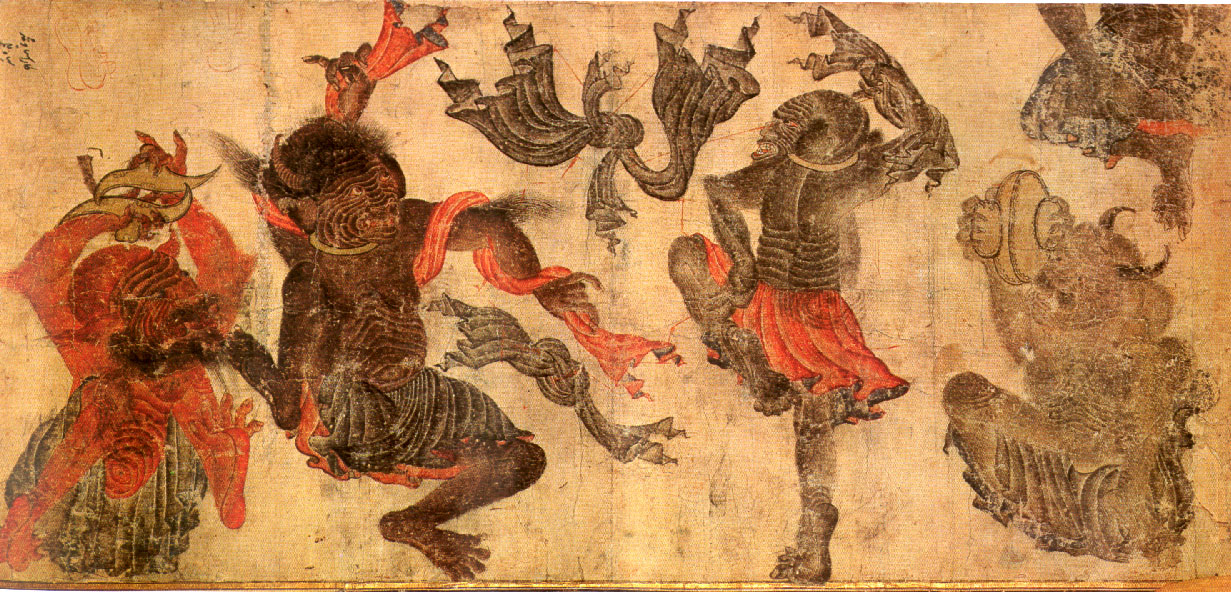
A Chinese demon is unresolved emotional turmoil that becomes so intense, so physically overwhelming that a person no longer sees what's in front of them.  They become so inappropriate that at the moment of death they don't even notice they died, and so continue to torment the living with their unresolved emotional distress.

Check out the six-packs on these guys!  And here too! Six Pack Demons!

Moral Superiority

No, don't worry this post is not about all those Aikido hotties who believe they can whoop your butt with out even hurting you!

There is a more pernicious vibe that has been eating me: People who claim that a teacher who doesn't charge a fee to students is somehow superior to those who do charge.

In Europe this idea is historically inseparable from hatred of Jews. A Jew, by definition, lacked virtue. The European definition of a noble gentleman was of course predicated first on being born to a father and mother of noble birth. But that title could be revoked if you failed to protect the honor of your women or your name. Opening a store or pedaling goods was a quick way to lose your nobility.

The word luxury has come to mean something nice that isn't cheap, but it used to be a sin. To commit the sin of luxury was to have objects or products and services that were reserved for people of a higher class.

Offering a service for free meant you were avoiding the taint of money. Aristocrats controlled everything, land, church, food. Aristocrats did not concern themselves with money, that was the way of peasants and merchants who coveted the luxuries of a life they were excluded from at birth.

In the Middle-east, prices are still set by complex family tribal relationships, anyone outside of that system lacks virtue, and automatically gets a higher price. To offer services for free in this context would simply mean that you are accumulating social obligations in a society where those obligations trump money.

China was somewhere in between. A system of merit existed by which individuals could take an exam and gain a rank in the government or the army. People were also promoted within this system on the basis of their competence. Of course there was nepotism and corruption, but the basic idea was to promote a person because he was the best person for the job.

This existed simultaneously with big family networks. Chinese power can be viewed as multiple overlapping and concentric rings of family influence, each of which makes alliances with other circles of power, the government simply being the biggest most powerful family.

I'm not exactly sure why a certain strain of traditional Chinese thought has felt merchants, and itinerant performers were people of lower virtue. Perhaps it is an extension of the Confucian precept against calculating your advantage over others? More likely it is just a fear of people who are more worldly, people who have a drive to seek their fortune outside of the often stifling confines of village life.

Now add to this that the Communists made a totalitarian state religion out of hating independent business people. After all, business people travel and have a way of undermining the status quo by creating alternate sources of authority.

Doctors in Communist China in the 1980's had to see everyone for free. Gordon Xu (George Xu's brother) worked in a Hospital. He would arrive at 8 am and wasn't allowed to leave until everyone waiting in line had been seen. Most days that was after 8 pm, about 80 patients a day. The state paid him a small salary for his service.
There is no virtue in not charging a fee. If you want to reward low income students who demonstrate merit by giving them free lessons, that's great. But that's because you want to have great students, not because you are doing some great deed for society. Not charging money is often a way of creating social obligation, which has its own value. If you are already rich and don't charge, so what, it means nothing. If you are low income yourself and you don't charge, so what, it just means you don't need the money.

If honor and virtue are diminished by charging money, then they are things not worth having.

The Death Penalty for Qigong?

Here is an article my readers might enjoy.
The long-named Columbia University Chinese Student and Scholars Association: United for China's Peaceful Rising (CUCSSA) has taken the stance, as of a few weeks ago, that "Anyone who offends China will be executed no matter how far away they are!" and said so on their website for all to see. That's what 'peaceful rising' means in Mandarin, right? Someone translate for me.