Vulnerability

Up-Close-RockI've been sitting on this blog post for a while. It relates both to Sgt. Rory's workshop last weekend and the Tabby Cat push-hands debate, but it is more deeply about how and why I train.

We fight because we are vulnerable.  A little kid can say he wants to kill me but I have no reason at all to fight until I'm vulnerable or someone I care about is vulnerable.  It's a minimum requirement.

When animal predators attack they do so in ways that minimize their own vulnerability.  When human predators attack they usually do the same thing.  A victim may never have the chance to see their attacker, or may only see them as disarmingly charming and friendly in those seconds before the attack.

Here is how a lot of martial artists think:  I have great structure.  Once I have engaged with a threat I will avoid direct structural force against force contact with the threat until I have acquired a superior position.  At that point I will unleash all of my force, weight and structure where the threat is most vulnerable.

Martial games like Mixed Martial Arts, Push-hands, or Boxing all function by limiting both competitor's vulnerabilities.  The game then becomes:  How can I create a situation where I can exploit a limited subset of my opponent's vulnerabilities before she can exploit mine.  The goal is dominance, when that is achieved the game is over.  Which is why it is relatively safe.

When we train games we are training to ignore some of our vulnerabilities.  This explains why Tabby Cat was accused of ignoring the vulnerability of his head and why he countered that push-hands as a game ignores the extreme vulnerability created by close physical proximity, fixed positioning of the feet, and many other "rules."

To paraphrase the Tai Chi Classics:  Because I understand my own vulnerabilities, I understand my opponent's as well.  To the degree that my opponent does not understand his own vulnerabilities, I am totally free to act.

So a little re-framing is in order.

The history of warfare begins with attack and then run, followed shortly by attack from a distance with rocks and then run.  The next step in evolution was fortification which protected vulnerabilities while simultaneously allowing for counter attack.  This works great in the short term but in the long term people with time to plan will overcome your fortifications.  The next step was mobile forts, namely tanks and airplanes.  Then we got nukes and now we are back to fighting with our hearts and minds against terrorist insurgencies.

030624-F-8833H-050It is very logical to begin martial arts training with simple attack, defend and escape ideas.  Then to move on to structure training both as "fortification" and to improve power generation.  Next one needs to understand how good structure is broken, so more power training along with targeting and angles--like siege warfare.  After that it's important to make our forts mobile, and either tougher like tanks, or freer like airplanes.  Whether by conditioning (tanks) or sensitivity (airplanes) we avoid metal (think: structure) against metal confrontation until we have maneuvered into the superior position.

All fine and necessary.  But in the end it still comes down to working with vulnerabilities.  To really put vulnerability at the center of your training, to take it all the way--you need to get weaker.  This is not a good strategy for a nation on the edge of survival.  But for an already confident powerful nation it makes sense to train for attacks based on putting ourselves in the most vulnerable situations.  That's what we are doing of course, planning for systematic terrorist attacks, biological, germ, computer, etc...

The most thorough way to learn about our vulnerabilities is to cultivate weakness.

What did I say?  I said that martial artists usually train the best techniques, from the best positions, with the best possible structure.  Fine.  Go do that for as long as it takes you to see that no matter how good you get at it,  your vulnerabilities still don't go away.  Then start training without structure, from the worst possible positions, and with spacial awareness instead of technique.

The illusion that we have direct conscious control over our bodies is an enormous source of pain, aggression, and defensiveness.  When that civilizing pretense is dropped, the body follows the spacial mind without inhibition.

Am I Dead Yet Sgt. Miller?

2255612Saturday morning I crossed the bridge to the bad part of Oakland.  The workshop took place in the clubhouse of the notorious East Bay Rats Motorcycle Gang Club.  It’s a block from a small park, which is an open drug market for addicts.  (My Mom lives nearby!)  The clubhouse is a little bigger than my living room, with a bar and a roll-up door to a small yard, but my living room doesn’t have a dirty concrete floor, a motorcycle in the middle of the room, or sharp edges and protruding things everywhere.  And my living room certainly doesn’t have  a motor-ski-plow-sculpture!  The yard had a lot of beer cans, dirt, some broken glass, trash cans, things for grilling meat, tools, and a beat-up all-weather boxing ring.  Twenty men and women showed up for the two day workshop.  Objectively speaking, there was enough room in there to teach Tai Chi to 4 people.  The stage was set for Sgt. Rory Miller's workshop.  (I reviewed his wonderful book Meditations on Violence here.)

Back in the days when I led adventure ropes courses, we would try to create a feeling of maximum risk with minimum actual risk.  At Rory's workshop, right from the get go everything felt risky.  He started off with a safety talk and then had us work with partners doing action exchange drills.  This is a slow motion practice in which one person begins an attack and the other fights back, but the moment of initiative consciously switches back and forth between the two fighters so that if one of them stops, all action stops.

The fact that the space felt so risky helped keep us non-competitive, which was essential for what he was trying to teach.
Sgt. Rory MillerSgt. Rory Miller

You know you are dealing with a great teacher if you experience the stuff you practice everyday failing, and yet you leave feeling elated!  My fighting system is based on not stopping at all, I try to fight like a waterfall.  So it’s not surprising that everything I do can fail if it is squeezed into an action exchange drill.  It was a great way to practice because it forced us to release more efficient whole-body violence into shorter and shorter periods of time.  It also allowed people with very little martial arts experience an opportunity to recover against people with a lot.  The exercise is also designed to insure that no one gets injured, while insuring that everyone feels pain, discomfort, disorientation and emotional boundary violations.  I got my nuts squeezed about twenty times.  I had people's fingers on my eyeballs over a hundred times.  We gradually built a lot of trust.

I’m so full of energy today it’s hard to write.  Hormone surges all day long especially during the scenario role-plays on the second day have left me a bit wired-up.  While I really enjoyed my failures, I left feeling that my training is superb.  My stuff transferred well to fighting in confined space and rolling on the concrete. The BJJ-Mixed Martial Arts people, by the way, had a lot of un-training to do.

2307392553_2882869aa9Back in my twenties I did a lot of two person forearm and shin conditioning.  After a while it became really addictive, I just craved that rough contact, it was getting me high.  This morning when I went to do my practice I was craving that rough contact again.  I never realized this before now, but I think this type of conditioning training is really a way to practice bringing on and dealing with the hormone surge.  My morning classes for the last 3 or 4 years have had about 5 minutes of gentle external arm and leg conditioning.  But I think my internal practice is giving me another kind of really effective conditioning.  My body is primed to instantly pump up when I get the hormone surge.  Today I have that Arnold Schwarzenegger feeling in my body.  Not stiff--just pumped.  I’m sure it will go away in a day or two if I don’t feed it.  But it’s an important lesson about how the body works.

The familiarity with real violence that Rory brings is chilling.  One thing I realized is that George Xu trained me in vigilante violence, which in a dark kind of way is great because it includes many different types of violence-- Self-defense, domination, monkey dance, group monkey dance, police work, and surprise attack. Rory demands that we refocus our training on what is legal and ethical.  He also recommends that we stop training things which may be ethical but would be too much of an emotional identity destroying act for us to pull off (I guess some people have a problem with blood and guts).  What’s legal and ethical is usually clear in retrospect (not always), but rarely easy to act on in the moment.  Which is why training scenarios are essential.  Deciding what acts would be identity destroying is very personal.  I'm not sure where my limits are, all the encounters with violence I can remember have had at least some identity destroying power.

Reflecting on my training with George Xu I see that legitimate self-defense has always been a component of it, but it was part of a larger subject of vigilantism.  For instance I remember getting in George Xu’s head and practicing scenarios in which I was the aggressor with a knife fighting against another aggressor with a knife in which the goal was to incapacitate but not kill (terratorial dueling?).  Rory’s workshop brought up a lot of weird stuff like that.  For everyone I think.  But my somewhat rambling point here is that in order to make what I do fit the self-defense model I have to make a slight mental-emotional adjustment.  It’s an adjustment I made intellectually long ago, but I hadn’t fully considered how imperative it is that I actually change the way I train.

Because boxing is designed purely as a display of dominance it has very little resemblance to asocial surprise attacks or self-defense.  A boxer would have to make big adjustments to actually train for self-defense.  What I do most of the time is close to what Rory is teaching, but I do sometimes think in terms of dominance.  I'll imagine a monkey dance in which I approach a fight eye to eye, attacking straight-on like a rutting buck in order to assert dominance.  This is what he is training us not to do.  Fortunately I'm quite talented at a more Rory-esque self-defense style of training like getting behind someone and throwing them head first into a wall with pictures of guys with tattoos on it.

Readers are probably mocking me, "Ah what a fine ethical distinction."

Rory had us play so many cool scenarios.  He was wearing full body armor and a helmet.  The climax for me was when he came in from the back shooting his gun.  I looked up to see that he had already shot me and I froze as he shot me again and then shot the person next to me.  People near the door, after fumbling with the lock, opened it and started to run, but Rory entered and fired into the space the way a person experienced in killing everyone would do it.  I must have been one of the first to break my freeze because I remember beginning to run the five paces towards him and then the next thing I remember I had him pinned with my hand wrapped around his larynx, one knee on his xiphoid process, the other knee on his arm, and my left hand holding his gun hand flat on the ground.  During the debrief he said I was the hero who took a lot of lead (bullets).  The day before we were talking about how police assess whether people are lying or not, and he said he doesn’t believe it when people say they don’t remember what happened.  But between the time I started running and the moment I was on top of him positioning my knee on his xiphoid process-- I don’t remember what happened.  It is particularly interesting because I’m really good at recreating detailed two person movement sequences that happen spontaneously with my students in class.

He told me later that I scared him.  That coming from Rory felt a little like I accidentally won a gold medal at the Olympics or something.

My biggest criticism is that there were no undead in the scenarios.  Zombies next time!
The biggest surprise was how totally awesome the other people at the workshop were.  It was really fun hanging out talking afterwards.  New friends!  New ideas!  New inspiration! (More to come.)

Kong Ling - Empty and Alive

Over at millionaire genius Tabby Cat we have a little piece I can riff on.  Anyone who has ever done push hands with a Cheng Manqing lineage person has probably encountered the "why do I need to defend my head defense."  It is so weird, they never admit that they are making a mistake.  But Tabby does something interesting.  He claims that the difference in push hands methods is an indicator of a difference in the fruition that each person is seeking.

Here is what Tabby says the purpose of push hands is:
The Push Hands Drill of Tai Ji Quan is a diagnostic practice to identify tension in oneself and a partner and a developmental practice to foster skill in the application of internal energy to such identified tense zones to move the partner's entire body with a light physical touch.

He contrasts that with many other schools who teach push hands as a safe way to approach combat skills development.  He then points out the flaw of the combat approach by saying that the observable fruition does not support it's stated purpose.  For example, defending a position in fixed step push hands (the way many people do) simply doesn't work in combat.

He is using the observed fruition to examine the method.  What he should be doing is using the observed fruition to examine the view which inspired the method.  All views produce an experience.  Tabby Cat has made his view known on his blog countless times, he believes the human race is doomed and therefore he has chosen to become a cat.

For me, views always come first.  My view of push hands is that it is a game designed to get us to drop our aggression.  As the first Chapter of the Daodejing explains, when you drop your aggression the order of the cosmos reveals itself (note: there is no "it" or "self", the use of language creates some limits here).  One might ask, "After I have seen the order of the cosmos, why would I want to do push hands again?"  And the answer is that the order of the cosmos reveals itself differently each time.  Experiencing the order of the cosmos is not an advantage, it doesn't make us superior or more powerful, it is simply a moment of inspiration.

Can you use this 'order of the cosmos' inspiration to fight?  Of course you can.  It would be a very mundane usage by society's standards, but the cosmos doesn't care.

Now let's go back and analyze the method.  The method of push hands is to meet your opponent hand to hand while maintaining, embodying and expressing kong lingKong means emptiness and ling means liveliness.  What I gather from Tabby's description is that his recent push hands partner (lets call him Mr. Pause) was ling but not kong.  I surmise this because Mr. Pause declared he could knock Tabby upside the head if he wanted to (a demonstration of ling), yet he was losing the matches because Tabby could feel Mr. Pause's tension and up root him demonstrating that Mr. Pause was not kong (empty).

Tabby on the other hand must be kong (empty) but not ling (lively) because he only feels obligated to cover his head when he is boxing.

How did it come to this?  If you are aggressive, you are going to have a strategy.  Having a strategy will occlude your ability to see the order of the cosmos.  Tabby's strategy is to be like water.  If he is like water his opponent will find nothing in him to push on, while he can simultaneously use extraordinary sensitivity skills to find a little sliver of tension in his opponent.  Once he finds that tension in his opponent he can expand condense or spiral his qi against the sliver of tension and the opponent will up root himself.  The problem with this method is that it works.  (Most martial arts methods have that problem.)  However, does it work when Tabby has his hands up at head level?  My guess is that it does not.  The test is not a quick hook punch to the head, it is a slow hook punch to the head with a soft lady-like hand.  It doesn't actually matter whether Tabby or Mr. Pause does the hook punch it's the hands going up that matters.

We already know the answer to our test because Tabby believes that boxing is a superior way to hit.  In boxing the body is like an on/off switch, it goes from dodging and weaving like water, then sudden switches on with an icy strike to the jaw.

Ali Video...

ali

Of course boxers don't protect their groin because it is illegal to strike there in the game of boxing.  So what are we doing? trading the groin for the head?  No.  All the push hands teachings about protecting the head or the groin or the space on the ground (fixed step push hands) or the center line or whatever, they are all just mind forms, all limitations, all preliminary experiments meant to show you what not to do.  Even Tabby's idea about finding tension in the opponent is just a trick to get the student to see the limitations of focused sensitivity.  OK, you found the tension in my left baby toe?  you feel it?  You got it?  Now feel this right hook on your chin, subtle huh?

If you are kong the opponent can not feel the slightest bit of tension in your body, they can only feel a big unified whole.  If you are ling you can do anything, you can punch or kick, run around like a monkey, or eat some salad.  Kong and ling are pretty easy to do separately.  In order to do them simultaneously one must have a view which matches how things actually are.  Because we humans are always wanting stuff and setting goals and confusing what we see with what we wish we saw, our view gets out of sink with the way things actually are.  There is a Starbucks on practically every corner.

It's enough to make a person wish to be a cat!

When our view is in sync with the way things are, mind and movement are in harmony.  Then qi automatically fills the space between the quiet body and the active mind.   The body is kind of like a hotdog, wrapped in mustard and lettuce which is the qi, and surrounded by a bun which is the mind .  When you want to take a bite you pick up only the bun and move it to your mouth, don't touch the hotdog or the mustard.

The active mind is not busy or distracted, it is spacially involved like a person standing on the edge of a cliff.
Like crossing a river in winter.

--Laozi

When a person is kong and ling, empty and alive, at the same time he may still sense his opponent's tension-- but he doesn't need to look for it.  He just does whatever movement he fancies and the opponent will not be able to stop him.  With kong-ling there is no impulse to defend or to root.  That doesn't mean there is no defending or dodging.  Like punching or reciting poetry--they are options.

I'm always happy to debate these things over a bowl of coffee-flavored milk in Seattle, or to test them out next time I'm in Tokyo fighting Godzilla.


Mao's Last Dancer (Review)

I just saw the movie Mao's Last Dancer. As my readers probably know, I love horror movies and kungfu movies, and scifi-action type stuff. I love the types of movies which give me that male hormone rush! Which is probably why I hate drama and romantic comedy, you know, chick flicks. My half-wife and I now joke that watching chick flicks is a form of estrogen therapy. But whatever, sometimes I give in to my weaker side.


Mao's Last Dancer gets an A grade for acting, and an A for the storyline. I spent about two years training ballet very seriously, but going to the ballet is not usually my thing; ballet is usually so focused on stimulating female hormones what am I going to do? But this movie is a true story about a great male dancer and the guy who plays him (Chi Cho) is a great dancer too. You get to see the best parts, the male parts, of classics like Swan Lake and Rite of Spring. Lots of great dancing and great choreography. So it gets an A for dance too.

The politics aren't perfect, I give it a B+, but for a non-horror movie that's high praise. I love when his mom tells the party officials to f--- off. Politically it feels honest.
Taijiquan practitioners will love the hard-ass but caring dance masters. What do they demand of their students? "Fa song" (relax!).

Alright, whatever, I cried. I sobbed. I simpered. I'm a confident macho man with a sleek hairy one pack (not a six pack), but if you have any doubts about your manhood, avoid this great movie. (Perhaps you should rent 300 instead.)

More Video Libraries

More old martial arts stuff appears on Youtube everyday. This guy has assembled another library, like this one I've posted about before. I found this wonderful bagua video of Bai Yucai. I love the way he does turns off of his front foot from the swallow swoops down pose. Don't much care for the applications and I would like to see some fast movements, but great stuff:


I also found this. I haven't written about Zhaobao style of Taijiquan before because I don't know much about it, but it has created a bit of a stir because some of the practitioners are good and because unlike Yang and Wu it does not derive directly from Chen, in fact it may be older. Zhaobao village is very close to Chen village so the controversy is really about authenticity of lineages... which are all in dispute anyway. I like his way of moving, clean and lively:

A Piece of the Puzzle

Long time readers know that I've written a fair amount about the origins of Chinese martial arts and how they changed during the 20th Century.  I reviewed the landmark book Marrow of the Nation by Andrew D. Morris back in May of 2009.  Here is a little excerpt of what I wrote:
The lineages allowed people to pretend they came from a great and pure martial line of masters dedicated to nothing but martial virtue and pure technique.  Inventing the lineages allowed people to write religion, rebellion and performance out of history. Some of the lineages may have been real, but they were not pure.  By claiming a lineage people were also renouncing the past, both real and imagined, they were saying in effect,  ‘Now THIS art, which was unfortunately secret for many generations is now totally clear and open!  Anyone with four limbs and two ears can learn it!’

There was a guy named Chu Minyi who served as a minister for the Kuomintang.  He invented something called Taijicao (Tai Chi Calisthenics) and in 1933 wrote a book called Tai Chi Calisthenics Instructions and Commands.  “Whereas traditional tai chi was simply too difficult for any but the most dedicated martial artist to master, tai chi calisthenics were pleasingly easy to learn and practice.”  They could be done in a few minutes and they used a counting formula like jumping jacks.  He also gets credit in the book for inventing the Tai Chi Ball practices.  (Hey, I didn’t write the book, but those tai chi ball exercises always looked a little too much like rhythmic gymnastics for my taste.)

Chu’s Tai Chi Calisthenics were performed on stage at the 1936 Olympics.  Fortunately or unfortunately he was a peace activist and so naturally supported the Japanese when they invaded and was later executed for treason.  But not before performing one last taijquan set in front of the firing squad.


Before reading Marrow of the Nation I had not heard of Chu Minyi.  But low and behold he has appeared on Youtube!  This stuff is mind blowing. 


His form and the push-hands are good, 'though I think it gets less lively in the later part of the form.  But the outfit is awesome!  Make sure you watch the whole thing because you see him doing Taiji ball and "stick" exercises on some weird apparatuses he invented.  This was before the invention of bungee cords or even dynamic rope so he must have done this with natural rubber.  Great stuff.  Then we see him playing tai chi hacky-sack! wow.  But what is he doing in his undies?  Grilling hotdogs maybe?

Tragic, weird and wonderful all at the same time.

When Singing is like Fighting

become-a-singerI may be having an effect on George Xu.  Recently he compared singing on a stage to fighting.  He said the first time a person goes on stage before an audience they usually hunch up their shoulders look at the ground and sing in a soft squeaky voice.  After years of training and performing when a singer goes on stage before a large audience, it just gets them excited.  The bigger the audience the more heart they put into it.  This is because they have trained their spirit/mind to match the size of the audience, a bigger audience  will automatically produce a louder voice with greater projection and grander gestures.
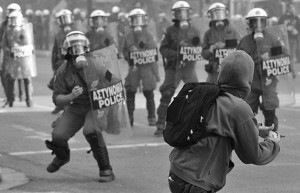
With fighting it's the same.  The beginning fighter tenses his shoulders up even before the enemy makes contact.  He shrinks and defends, he freezes and thinks of escape.  However, with experience, the fight becomes a moment of excitement.  The greater the challenge, the greater the excitement.  "Oh, look a big guy.  Great!"  "Oh, he has a knife. Even better!"  "What's this? he has a friend with an iron bar coming too?  Wow, my lucky day!"

The fighter automatically expands his spirit/mind to match the size of the challenge.  The bigger the challenge, the more power and agility the fighter will use.  It is thrilling and exhilarating.

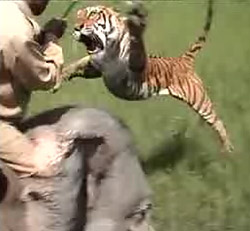
tiger-vs-elephantReaders may be thinking, "What? Is he talking to me?  I never get into actual fights so how could I learn to turn fear into excitement? And why would I?  I have a mortgage to pay!  I have to drive my kids to roller derby lessons!"
But this misses the point.  For a song to have meaning it must include its audience.  Whether we are singing to our shower head or a stadium of 10,000, the song has to be for someone (or something).  If you are singing to your lover about a bluebird you have to include both of them in the song.  You have to feel both of them viscerally.  To really get good at singing a song you have to emotionally embody it over and over.  After a time the emotions aren't surprising or overwhelming but they can still be exhilarating.  They are still real.

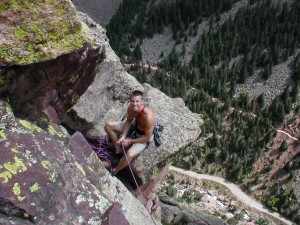
Fighting is the same.  In fact, all movement training works the same way.  If a person is running fast down a hill through the woods spontaneously dodging trees, leaping logs and avoiding pot holes, he is not going to be thinking about body alignment or ankle flexion.  That person is going to have his mind "outside" of his body.  His mind will be spatially excited and agile.  The same is true if you are training in a quiet park, a walled garden, or a serene dojo.  Or rather it should be.  The best quality movement training uses a totally quiet, relaxed body with a wildly active mind.yellow-spur-ledge

So now go back and do your cute little qigong exercises or peaceful taijiquan form and imagine you are on the edge of a thousand foot abyss.  Imagine you are surrounded by hungry tigers.  Imagine you just jumped out of an airplane and you are in free-fall.  And don't just imagine it, feel it-- be afraid, be very afraid.