Comments/Spam

Thanks to everyone who has left a comment. I don't check my spam filter very often, I guess I should. I get about 300 spams a week. 6 real comments landed in my spam folder this week. I only thought to check it because "Neijia" said he was blocked when he left a link (which is only supposed to happen if you leave multiple links). (The last line at the very bottom of that link he left was worth the whole article.)

6 real comments out of 300, that's 1 in 50, which might mean that I missed 20+ comments this Summer. Bummer.

Going with hope, instead of experience, I'm planning on a major blog software and website change in the coming weeks. I sometimes think, If only I didn't know what I wanted it would be a lot easier.

Anyway, if you leave a link and it doesn't show up, feel free to try again or to drop me an email... I do check that.

Shrinking and Expanding

© ehoyer reproduced under creative commonsShrinking and expanding, or shrinking and pouncing, is something every predator does.  If you want to develop martial arts skill you must replace bending and stretching with shrinking and expanding.

The error of bending and stretching is a human epidemic.  Not that it is a crisis or a struggle or a life and death situation, humans can freely carry on merrily bending and stretching from now until internal arts are in the Olympics (or eternity, which ever comes first).

Without shrinking and expanding it is impossible to get effortless three dimensional power; up/down, left/right, front/back, and spiral/turn.

When predators fight they always attack using whole-body shrinking and expanding.  This allows them to simultaneously strike, uproot, and rotate their prey.

Predators are also very cautious about receiving injuries.  Shrinking and expanding allows a predator to diminish the force of their prey's counter attack without reducing the force of their own attack.

Shrinking and expanding does not require strength, in fact, for the most part, strength will inhibit it.

Soy Milk with Your Coffee?

Drinking Coffee with the BossI went over to Master George Xu's house yesterday to work on a writing project.

He has always had really interesting and weird ways of saying things.  I just thought I'd share a couple with you.

We were talking about how your mind should be when you are fighting or practicing internal martial arts.  He said that your body should be unconscious like when you are watching a movie.  He sometimes uses the word subconscious instead.  Both words are from psychology, and neither one really hits the mark.  One reason it's hard to explain is that America is a "what" culture, and China is a "how" culture.  We tend to think about "what" we should do, a Chinese person tends to think about "how" it should be done.

But of course George Xu's students ask, "What do you mean?"  George's answer is a combination of mime and words, but if it was just words it would sound like this, "It's like when your boss is yelling at you.  As he glares at you, shaking and pointing the finger of his right hand, he unconsciously reaches out to the side for his cup of coffee with his left hand, finds it, picks it up, brings it to his mouth, takes a sip and puts it back down.  All this without looking left, and without a break in his tirade.---  The hand that reached for the coffee cup was unconscious, the way your whole body should be when you are fighting or training internal martial arts."

In his kitchen, yesterday, after we had a few cups of tea he started demonstrating.  While he was throwing me into the walls and various kitchen implements, he pointed out that I haven't perfected my shoulders yet.  He said, "Your shoulders should be like Soy bean milk."  He demonstrated this for me, and repeated the phrase 4 or 5 times.  I tried to feel what he was doing as he launched me into the microwave.

Back a home about six hours later, I put my feet up and closed my eyes.  Suddenly it struck me just how outrageous and yet specific the expression, "Shoulders like soy bean milk" actually is. 

Now, Get to work!

Practicing Internal Arts Will Shorten Your Life!

Continuing on the previous post "The Real Purpose of Internal Arts," I would like to say clearly for the record, Internal Martial Arts will shorten your life.

Why?  You thought they were good for your health didn't yah? Not a chance.  Yang Chenfu, the most famous Taijiquan Master of the 20th Century died at like 54.  Many Internal Masters have died in their 50's.  They were all too fat.  Many internal martial artists have died from fighting injuries and venereal diseases too.

Lets get this clear.  Practicing Internal Martial Arts does not make you a good person.  If you are a ruffian goon, you will live and die like a ruffian goon.  If you think you are practicing everyday for some future attack, to fend off some wild assailant, that view will determine the type of fruition available to you.

Even if you practice the highest level art, with the most supreme teacher, your view will still determine what results your practice produces.  The constant search for power and superiority will shut out the other types of fruition that these arts were in fact created to reveal.

The problem is that modern Masters have been cut off from their own roots, they have historic amnesia.   I know all these history book writers keep telling us that Internal Martial Arts were created by professional fighters because their jobs as bodyguards or mercenaries required it.  Poppy-cock!  It's just not possible.  Why would someone weaken themselves if they were facing actual violent adversity on a daily basis?

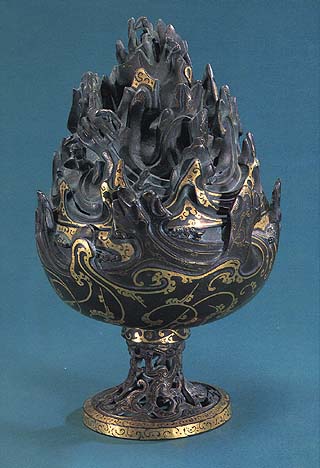
Immortal Insence BurnerNo, the Internal Martial Arts were developed by people who had already cultivated a subtle body; a weak, sensitive, feminine (yes I said that), humble, yielding,  and desireless physicality.  A body cultivated with the idea that lack of pretense is not only a moral way of being; but a moral way of moving.

This is not the morality of being good. This type of morality is based on being real.

The Daoist practice of being real produces freedom and spontaneity (ziran). The inspiration to create from that "body" has led to experiments in every walk of life. 

In every realm of living-- effortlessness, naturalness, and the complete embodiment of an animated cosmos, found a way into peoples' daily lives, into the sacred and the mundane.

If you just practice any of the Internal Martial Arts or Qigong you will probably get fat.  Why?  Because these arts were created from a "body" that was incredibly efficient.

When you begin training martial arts, especially if you start in your 20's or younger, you will automatically work hard, and over do it.  When we are young we have too much qi in our channels.  All we can really do with that extra qi is waste it.  Hopefully we blow it off in ways that won't leave a perminant mark on our bodies.

When working hard and training hard, we naturally need to eat a lot.  But if you seriously practice Internal Martial Arts or Qigong, you will become more efficient in your movement and you will have to be disciplined about eating less. If you do that, your appetite intelligence (your spleen function in Chinese Medicine) will become much more discerning. It will tell you what is good for you to eat, and how much is the appropriate portion.  You will be able to trust your appetite(s).

In addition, your digestive system itself will become more efficient over time.  Your body will extract more nutrients from less food.  If, however, you fail to regularly and consistently reassess your appetite, you will over eat-- and you will get fat.

Improved digestion and movement efficiency will happen simply from practicing any Internal Martial Arts method, it makes no difference what you think or what you believe.  But the fruition I'm calling "appetite sensitivity" will only develop if your view is that you are cultivating weakness.

Boom and bust fitness routines, like Boot Camps, are one of the worst thing a person interested in developing a subtle body could do.  Your appetite sensitivity will shrivel up and fall off.

The Real Purpose of Internal Arts

While I was locked out of my blog, Dave over at Formosa Neijia decided to block comments for a couple of posts.  If you haven't been following his blog, here is the story.  He writes mostly about Internal Martial Arts, but lately he started studying Judo and practicing vigorous fitness routines.  He got a lot of comments from people demanding that he be true to the Internal Martial Arts ethos,  that he renounce hardcore training.  I suspect he got a few nasty comments that were deleted before I had a chance to read them.

Why did he do this?  His first reason was a good one.  He wants to teach his son martial arts.  He decided, and I agree with him, that Judo is a great way to go because it gives high regard to the social aspects of martial arts.  Judo is a two person game with formal protocols which promote kindness, awareness of others, physical sensitivity, and spacial observation.   Judo does a good job of teaching respect for oneself, for other people and for the Dojo itself.   It also hooks you into a world wide community.

His second reason was that he is getting fat.  The fitness routine he is on is part of a diet.

All of this would actually be fine, but a conflict arose based on the presumption that Internal Martial Arts, on there own, were not good enough! For what you ask?  For losing weight.  For defending yourself against an assailant.  For grappling and choke-outs.  For making rock solid abs, gluts, pecks, and biceps!

Why do I care?

I see it as my duty to be a voice for Internal Arts and their Daoist roots.  I don't however, have any intention of trying to convince anybody that what they are doing is wrong.  I don't proselytize.   I just want to be a resource for people who are interested in the subject.

First things first!  Dave made the following comment in one of the blocked posts that I imagine was aimed at me, "I don’t give a damn what the TaoTeChing has to say about anything."  In that comment he is basically saying that regardless of what the Daodejing says about weakness or fighting, we sometimes need to defend ourselves, and to do that, we need the most effective body technologies available.  For the record, here is what the Daodejing actually says:

Weapons are things of ill-omen, disturbing to the spirits.


Adepts give precedent to the Left;  They cultivate calm and do not indulge in conflict.


When there is no alternative, they go to war; Give precedent to the Right and do not delight in victory.


To delight in victory means to enjoy killing others.  To enjoy killing others is to lose one's own life.


Adepts joyfully honor the Left, And only mournfully give precedent to the Right.


When you have killed, honor the dead with sorrow.  When the battle is won, perform the protocols of a funeral for the enemy.


The metaphor of left and right here deserves a little explanation.  The Dao of the Left, is Orthodox Daoism--precepts and wuwei.  The Dao of the Right means trying to become a powerful shaman, ruler, or a god, it is the path of superiority and death.  The emperors of China always had their ministers sit on the Left and their generals sit on the Right.  In war time the ministers and generals switched positions.  Thus, there is an common expression, "Always give precedent to the Left."

The chapter clearly communicates the idea that if you have no alternative, don't be wish-i-washy, go all the way to Right, as far as you can.  In other words, Kick Ass!  Then immediately go back to the Left and treat the experience as a funeral.

Free At Last!

I've been locked out of my blog for six days now.  What a nightmare.  Many new blogs to come.  I'm also switching my software to Movable print over the next few days, at least they have a support service.

It looks like it was a security issue because, several plug-ins were added that I knew nothing about.  When they were deleted, I was allowed back in.

It's a beautiful day here in San Francisco.

On/Off - Empty/Full

Everyone who has stuck their head down the well of Asian arts or religion has encountered the idea of emptiness.  There are many different terms in various Asian languages which get translated into English as "Emptiness."  If I had great language skills I would start off this post with a survey of them, but that's not my forte.

Every Taijiquan enthusiast is familiar with the phrase Taiji comes from Wuji.  Wuji being emptiness.  But there are all sorts of related ideas like formlessness, or without existence, or without substance, or non-being.

It's common for a teacher to hit you lightly and say, "You're empty here, wake up!"   Likewise, a teacher may hit you and say the opposite, "You're too full here, that makes you easy to control."  Sometimes a posture is defined by having one leg empty and one leg full.

When people first try to fight without training, they usually make themselves full in the upper front part of their body.  They come at you with both arms.  This kind of attacker is very easy to control by turning, going around their defenses, or by kicking.  As a person develops skill he will be full in one place and empty in another.  The emptiness draws an opponent in so that one's fullness can blindside them.  If I deliver a committed punch or kick to my opponent and that strike completely misses, It's likely that I've just made myself really vulnerable.

Nearly all experienced fighters, whether internal or external, boxers, wrestlers, or judoka, use a combination of empty and full.  Brazilian Capoeira has it too, they call empty and full, 'the honey and the poison.'

Chapter 11 of the Daodejing is about empty/full.  I'm really hesitant to put up a translation because the terms it uses are problematic.    It's basically a simple chapter that first describes a wheel with 30 spokes, then a clay vessel, then a house with doors and windows.  The standard translations effectively put a comma in between the word "not/empty" (wu) and the word "have/full" (you)."  (There are a number of translations that allow you to follow along with the Chinese text, which is a really big help.   If you don't have a copy to follow along with, you can just trust me on this one.) Thus the chapter is said to mean:   The hub of a wheel, the space in the vessel, and the door and window holes in a house are all empty, and yet it is these empty places which give each object it's ability to function.  Thus, it is emptiness which makes things useful. 

It's cute, but come on, it's also too obvious.  There are hints that this chapter is about something else altogether.  30 spokes could be a lunar month, a cycle of time.  Clay vessels are used in religious processions and are filled with offerings, they are left in tombs.  And a house without doors and windows, what's that?  A tomb, right?

The two oldest commentaries on this chapter, Xiang'er and He Shanggong, both talk about Daoist cultivation allowing us to see wu/you.  Perhaps wuyou is one word, meaning empty/full.  Perhaps it refers to seeing time itself, seeing each thing as having a life cycle-inception, development, decay, death/compost.

No matter how good a fighter you are today, at some point in the not too distant future, someone will be better.  The Olympics is basically a display of peaks, in which we all know the individuals competing were slower or weaker a few years back, and they'll be slower and weaker a few years hence.

But I digress.

Martial arts skills are for the most part based on being able to quickly change between being empty and being full.  Even the internal arts, like Taijiquan or Xingyi or Bagua, are essentially like boxing in this regard.  Subtler yes, but in essence they are an "on/off switch."  If you have an on/off switch, you are vulnerable.  If my "on" hits your "on," the lights go out!

But perhaps it is possible to be wuyou, that is-- empty and full at the same time, with no on/off switch.  That, by the way, is what George Xu is claiming he can do these days, and I think he's on to something!

I apologize if you thought I was going to have a definitive explanation of empty and full.  I think they are provisional terms that get used a lot of different ways depending on the particulars of the teacher and the teaching.

Appropriate Touching

When I was applying for the job of Taijiquan instructor at the American College of Traditional Chinese Medicine six years ago, they asked me to put together a curriculum for 44 hours of class (which eventually got shortened to 22 hours). So naturally I asked a group of my friends who were already acupuncturists what they thought I should include given that 44 hours is a very short time considering all the possible things I could teach under the title Taijiquan.

The answer I still remember clearly was, "Most people enter and exit acupuncture school too filled with timidity. Include as much two person engagement, joint locks, throws, and general rough-housing as you can. Students need to know, and develop confidence about, what the body can handle."

Perhaps my acupuncturist friends were teasing me. I quickly found out that with a class of about 80% women who were there to learn "alternative" medicine, not martial arts, any physical contact has the potential to be controversial. Even the appearance of roughness required a preparatory lecture and a debriefing. The amount of talking I have to do just to get people on board with the idea that gongfu and medicine are part of the same subject is a real drain on actual teaching time; But it's necessary so I do it.

Even cutting out most of the martial aspects, I still include lots of sensitivity, discovery, and body exploration exercises. There is a percentage of people who are tactile learners, they will only learn the basics if they get a chance to touch. There are also aspects of Taijiquan which simply can not be taught any other way--these transmissions must be felt.

Historically, male teachers in China were very reluctant to accept students, period! Female students usually had to be members of the family. If the Master had a wife who also trained in martial arts, then it was possible for him to accept female students because he could direct his wife to do physical corrections and give direct transmissions. There are certainly exceptions to this, like men who studied with female masters for instance! China isn't one culture, and relations between men and women and their various gender roles have been constantly changing (not necessarily progressing). But more often than not, male sifu's did not teach non-family members who were female their "indoor" secrets!

My solution to this age old problem took four years and a few anonymously delivered vague claims of impropriety. So with no more further ado, I give you the...

Class Participation Agreement


I understand that this class, Taijiquan CM555, involves the development of palpation skills and physical manipulation sensitivity.
I understand that these skills, which are of a social, physical and emotional nature, are essential to the practice of Traditional Chinese Medicine (TCM).
I will always ask and receive permission before touching anyone.
When I ask permission I will make it clear where and how I intend to make physical contact.
If I do not wish to be touched during class for ANY reason, I will say so.
I understand that I am responsible for setting my own boundaries.
I understand that I never need to give an explanation for choosing not to make physical contact.
I understand that setting boundaries is a skill just as important as developing palpation skills, and that making these choices will be considered full participation in the class.
_____________________________________________ ______________
Signature Date
____________________________________________
Full Name

The Five Healing Sounds

I recently got this interesting question from a reader.

I'm interested in the subject of voice: of resonance/vibration and its relation to Qi, chakras (is there a Traditional Chinese Medical term for energy centers?), meditation, inner insight, and states of consciousness.


Joseph F. Morales has written an excellent summary in which he compares what various modern Qi-jocks call the Five (or Six) Healing Sounds. But since none of these Qi-jocks seem to have a clue where these sounds came from or what they were originally used for, I'll take a stab at it.

The first needle an acupuncturist inserts in any treatment protocol is referred to as, "Calling the Qi to Order." This has a direct parallel in Daoist ritual. To begin (after days of preparations), the Daoshi (priest) visualizes massive demon armies in an unlimited chaotic torrent of violence. She then lets out a high pitch sound "Calling the Qi to Order." Through out the ritual there are other loud calls accompanied by ritual actions and visualizations which command the demon troops to do her bidding in the service of wuwei. [Wuwei is often translated as "not doing" or "non-aggression," even "without artifice." The term as I use it here takes on a cosmological quality. That quality is most succinctly defined as the teachings of Laojun (the iconized author of the Daodejing, Laozi).]

OperaThe so called Highest Clarity (Shangjing) Daoist movement took shape during the Tang Dynasty. One of the things it accomplished was the integration of internal alchemy with external ritual. This is a massive topic. My reason for bringing it up is to say that yes, Daoism has equivalents of the Chakras, but it also has 100,000 other things, categories, spaces, and organizations of the inner world. (I promise to pick a few to describe in future posts.)

Where did Daoism get these "Calls to Order" used in ritual? Obviously, one source would be warfare itself. A commander had to be able to make earsplitting sounds to command troops on the field. This ability in and of itself could be considered having strong Qi. If we go back to an earlier era, Shaman-Kings command troops and ruled through both their martial and spirit controlling prowess. In our era, Shaman are no longer kings (unless you count Sarah Barracuda?) but we still have people who are experts at controlling spirits. Spirit Mediums, called Wu in Chinese, also use sounds to call, to command, to signal entrance or exit of a spirit from a possessed person, and probably many other functions I don't understand.

This vocal skill has also survived and flourished in Chinese Opera, which itself follows some of the protocols of Daoist ritual and has some roots in shamanic clowning.

Thus I dare say, healing sounds have been used for a long time. Especially if you consider healing to be the banishing or rectifying of Yin Spirits. So the modern Qigong (or Qi-jock if you prefer) practice of using the five healing sounds has a wonderful historic precedent they don't really want you to understand.

Did Traditional Chinese doctors sometimes cross the lines into performance or exorcism? Yes they did. A doctor might prescribe making a forceful "HA" sound a few times a day to clear heat from the liver (Heat is the body's healthy response to decaying yin, it only becomes pathological over long periods of time.) They also might make particular sound vibrations to stimulate (move) or calm Qi within the a patient's body. (This is a highly specialized skill which a few talented people may be able to use clinically in conjunction with other methods.)

But something is missing from this discussion, big time! Singing is the most common and most potent way to use sound for healing-- And to curse someone, I might add.

One reason the Chinese invented the idea of Qi is that it separated the health giving aspects of singing from the enmity maintained by singing songs about the terrible things neighboring tribes did to your people in the past. If you want to bring a lot of very different ethnic groups together to fight for a larger nation, why not have them breathe together rather than have them sing their traditional, division creating, songs.

ShamanSo my advise to people interested in The Five Healing Sounds would be to avoid the qigong hysteria. I would also advise avoiding spirit mediums, unless you already have one in the family. If you can find a master Chinese Opera vocalist, he can to teach you how to sing from the different organs. Chinese Opera vocal training is likely to blow your mind.

If you are not in a place with Chinese Opera, a traditional African vocalist may be able to teach you the same thing. I took a class years ago from a Congolese vocalist whose first lesson was about how to sing from different organs. He said that to sing a song correctly one had to know which organ(s) it was emanating from. He also gave us visualization for the songs.

And if you don't have a traditional African vocalist nearby, perhaps you can find a Love Church in a black neighborhood! Their vocal choirs move large amounts of qi down there every Sunday.

When I studied modern dance with Sara Shelton Mann back in the early 90's, part of our warm-up was to use specific sounds to vibrate different parts of our bodies, starting with "nnngg" to vibrate the center of the head and ending with a deep "ooooo" to vibrate the tail bone. She got that material from Bonnie Bainbridge-Cohen whose workshops I took last May and June. Bonnie currently uses these vocalizations to activate specific glands and other parts of the endocrine system. Her studies were originally inspired by a 1960's understanding of Yoga and Daoism, but she has taken those ideas and made them more specific and precise than any vocalization teachings I have encountered from Asia.

Flying Fish

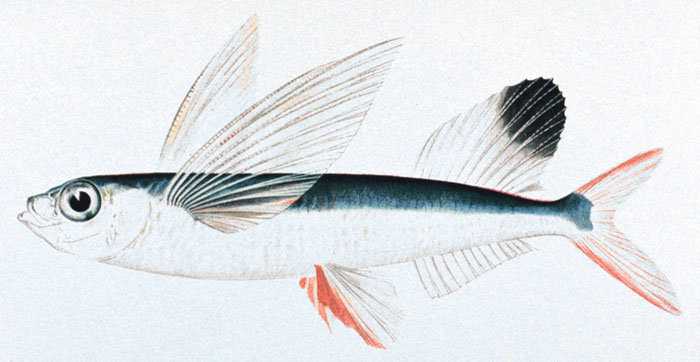
Flying FishMost people don't have a very clear sense of their spine. There are hundreds of different martial arts and qigong exercises which bring sensitivity, awareness and mobility to the spine. This material is very rich.

spineThe vast majority of this material must be taught in a small class because each person needs a fair amount of feedback and interaction with the teacher. That's why it's not very well known or understood. It's this lack of personal attention which leads people to keep doing brutish things like sit-ups.

I thought I would offer one image which my student have often found helpful.

When the arms lift in Heaven Earth style qigong (or Baguazhang circle walking or numerous other internal arts/movements I could point to) the protuberances (Spinous Process) on the spine starting in the lumbar region move upward. This is true whether you start with the arms moving to the front or to the sides.

This movement matches that of a flying fish jumping out of the water. When the fish jumps its dorsal fin (the one on its lower back) goes up and forward (towards the head). The dorsal fin on a fish is actually the spine, it is simply a spine with long spinal protuberances (Spinous Process).