
Henri Maspero, Wilhelm Reich & Katherine Dunham
/ Wow, it was fun putting those three names together.
Actually they don't fit so well together, but what they have in common is that they all crossed metaphorical bridges that make this blog possible.
Henri Maspero was the first sinologist to recognized the scope of Daoism as a religion. Of course there were a bunch of sinologists that preceded him, but I think he was the first to think about Daoism outside of a Christian framework. He was murdered by the Nazi's at Buchenwald in 1945. Scholars of comparable depth didn't surface again until the 1970's, mostly in France (probably do to his influence there), and not until the 1990's in English.
 Wilhelm Reich was a student of Sigmund Freud. He is such a weird character in history that most people are reluctant to credit him as a significant force in the development of ideas. But he is also hard to dismiss. He was the first scholar to try to prove that sex is good for you. Perhaps I should be crediting Oscar Wilde instead, or someone else who said such things but used humor as a cover. But Reich was the first person to use the expression body armor (and character armor) as a metaphor for explaining physical tension. He was the first person in Western Civilization to say that emotion can be stored in the body as tension.
 Reich is also extraordinary because he was probably the first to say that Nazi's and Communists are the same. His reason was also way ahead of his time: They both used the same repressive physicality to perpetuate fear of self-awareness; a fear which makes people want to be told what to do.
Most people agree that when Reich came to America he went off the deep end. His coolest invention in that regard was the Cloudbuster. But when you read his writings on Orgone Energy you are going to think, "Oh, he means Qi." I believe it is highly likely that Reich was reading some kind of Chinese cosmology. So in that regard he represents the very worst part of Modernity; the habit of an taking an idea from another culture and pretending like you invented it!
 Katherine Dunham was the great antidote to that lame habit of Modernity. She invented Dance Anthropology (or Ethnology if you prefer). She made the serious study of movement and physicality both central and indispensable to the process of understanding culture. Because of Katherine Dunham we can laugh at all the scholarship by stiffs who think that they understand something because they saw it or even read about it, and at the same time we can treasure the voices of those who actually join the dance.
I don't know much about the earliest film documents of martial arts, but 1936 was pretty early. Dunham caught some great stuff!
 Here is an article from
  who wrote
  Yesterday, having just gotten into my warm car after watching the latest Stephen King movie and nearly freezing to death talking to a fellow movie goer in the wind, I saw a small group of high school girls crossing the street. Very sort pants, low socks, t-shirts. One of them had big lumps of plastic wrap around her knees and ankles. I suddenly registered that they were athletes and that the plastic wrap was holding large amounts of ice on the unfortunate young womans legs.
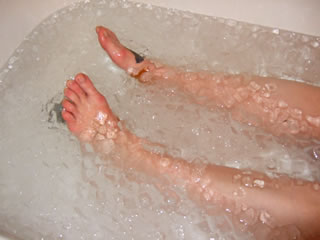 Th
Th ere are a whole bunch of theories about why ice is good, but my experience tells me that mostly it is terrible. It is better than nothing on burns, but if you have burn cream, it is better. There is no question that ice can bring down swelling after an injury. For a really bad injury I would put ice on it right away. But as part of a training ritual, it is barbaric. It develops bad, tense, stiff, muscle quality and in the long run it probably leads to arthritis.
 When I was young and road my bicycle at high speed over steep hills to all my appointments, swam in the freezing cold ocean, did kungfu and dance for 6 or even 8 hours every day, and sat still (or slept) in stupid classes at school--a nice hot bath once or twice a week was very close to Nirvana. Still, as a training method it contributed nothing. I was tired and stiff because I was training too much of the wrong thing. It would be better just to train right. Too much hot drains the qi.
 change some of your clothes.
 I've been looking for information on Daoist ritual shoes. I was sure that somewhere I'd seen special Daoist ritual shoes which are 3 inch high stilts. These shoes make it impossible to put weight on the toes or the heel since the stilt post goes down from the center of the foot. Since the base the the stilt is thicker at the bottom, kind of like a mushroom, there is a plenty of space to balance. The problem is I have been unable to find these shoes (so no picture). Did I dream them? How embarrassing.
 Dream or not, these shoes represent ultimate shamanic power. The symbolic steps Daoists take in ritual cover huge distances. They circumambulate the empire, the world, and they traverse the distances between stars in the sky.
 kidney system. The kidneys regulate fluids in the body and they also produce jing. Jing is that aspect of qi which comprises the self reproductive quality in nature, it is stored in the kidney system where it is available both for making babies and for making repairs. Jing produces new tissue when we are injured, bone, muscle, scabs, etc. It is our ancestral memory.
 I don't think there is a perfect correlation between physical rigidity and a person's inability to freely make choices based entirely on what is real. There is some correlation, but I've met some amazing people with pretty screwed up bodies. Still, sit-ups are dumb. Six-pack abdominal muscles are O.K. against a boxer with gloves on and that's it. Like the "core-strength" fad, sit-ups break the unity of a person's body, they restrict the freedom of the torso and they tighten the breath. Why choose a rigid fate?
 A person standing on two feet is an unstable structure.
 Chris at Martial Development asked people to try their hand at self-criticism. But gee, isn't calling my blog Weakness with a Twist enough for you?
 There are many Tianshi lineages but there is one individual in each generation who is the central Tianshi. This person comes from a continuous family lineage going back to Zhang Daoling. During the Dynastic eras of China the Tianshi had a palace at Dragon Tiger Mountain (Longhushan). To get a sense of the importance of the Tianshi it helps to understand that all building and construction in China has always been regulated by the government. No building was allowed to be built larger than the Emperor’s palace. We get a sense of how important the Tianshi was by noting that the Tianshi’s palace was specifically built (roughly) six feet smaller than the Imperial Palace. Needless to say, the role of Tianshi was central to the religious life of the country and the functioning of the state, and because of this, the Tianshi is sometimes called the Daoist Pope.
 On the other hand, most of the precepts have some solid reason behind them. Monastic Daoists often followed their Buddhist roots and went with vegetatianism. While hermit Daoists usually had more limited food choices, so more flexibility. However, if you have a choice and you are practicing meditation, the category of "hot" or 'heat producing" foods is to be avoided because it has a tendency to make you alternately horny and sleepy.Â