The Dao of Learning

There is a common convention of Chinese culture in which the word Dao, meaning the way, is applied to any field of study. Thus we have the Dao of archery, the Dao of writing, the Dao of mothering, and even the Dao of basketball. This expression refers to a way of knowing and embodying which is unique to each pursuit, and implies both ease and confidence. It is somewhat like saying in English, "She really has the knack of tree climbing." In addition to implying that a person is really skilled at something, it implies that the activity itself transforms the person who does it, it is not just an act of doing, it is an act of mutual self-recreation.

Truly knowing a skill, or even a subject, further implies a curriculum. Thus many books have been written describing the Dao of Archery, the Dao of making Tea, or even the best selling book The Tao of Pooh.

ZhuangziIn Japanese, which uses Chinese written characters, Dao becomes "do," in many familiar arts like Karatedo, Judo, Aikido, Budo (the warrior code), and Chado (the art of tea).
For most of the last 1500 years in China the first lessons one received when learning to write calligraphy were instructions on how to sit without obstructing circulation, how to hold and move the brush in coordination with ones breath such that the student might start discovering the Dao of writing from day one. In fact, implicit in this idea is the notion that one is learning how to embody the physicality of great public officials of the past. This is also true of all traditional subjects, music, martial arts, medicine, weaving, etc. In traditional Chinese culture the physical process of acquiring knowledge is not subordinate to knowledge itself-- How one learns is, in a sense, given priority to what one learns.
This idea is beautifully illustrated in the story of Cook Ding in the 300 Century BCE text, the Zhuangzi (Chuang Tzu). The story is an ironic tale in which Cook Ding butchers an ox in front of the king, it is the title story of the third chapter called "The Mastery of Nourishing Life." In the story, the king is amazed by the dance like beauty, grace, and ease with which Cook Ding butchers the ox. When asked, Cook Ding explains how the naturalness of his skill came about and in the end the king declares that listening to these words has taught him how to nourish life.

Daoist Art at Brown University

The website for the Haffenreffer Museum at Brown University is beautiful. They have a collection of Daoist Alter Paintings and some interesting things to say about them.


"The Marshals are guardians positioned at each wing of the altar. Their duty is to bar the way to demons and unclean malevolent influences. Marshal Chao Yuan-Shuai guards the left and Marshal Teng Yuan-Shuai guards the right. The red inscription at the top right of the painting of Marshal Teng reads “Five Thunders Flashing Lightning (lit. Electricity)�. Mien priests use the summoning of the Five Thunders magic in exorcism ceremonies. The Marshals are six in number: Marshal Ma and Marshal Chang are the two smaller figures below Marshal Chao, and Marshal K’ang and Marshal Hsin are the two figures below Marshal Teng."

Feelin' Shen

The concept of Shen has so many meanings in Chinese that it probably deserves a whole book. The shen I'm talking about here is the one that is most often translated "spirit" and is the lighter more expansive aspect of qi. (I'm not going to attempt a comprehensive definition.)

One way to explain shen is to say that it is "how we feel space." During moments of extreme fear our shen closes in on us like plastic wrap around our bodies, in English we use the term petrified to describe this feeling. Conversely, when we are in a warm safe environment with a spectacular view in all directions our shen expands way off into the distance.

(Humans are complex creatures. Some people seek out that petrified feeling, perhaps because they treasure the release which happens when the fear finally lets go and turns to exhilaration. People with agoraphobia become petrified at even the thought of wide open spaces.)

Another way to think about shen is what we sometimes call "body image," that is, the way we feel about and perceive our bodies. Skill in martial arts involves the ability to change your own body image as well as the ability to manipulate other peoples' body image. Few people could step into the ring with Mike Tyson and not feel a twinge weakness and fragility. A great fighter, just like a great actor, can make you feel like you are "king of the world" one moment and "a cockroach under a boot" the next.

I believe that hormones have a big effect on shen. How many of us have known a slender woman who once a month asks if we think she is fat? The first time this happens we laugh and say, "Yeah your a regular hippo." The second time this happens we say, "No, honey, of course not," only to be accused of being patronizing or worse. No doubt most of us have learned, through trial and error, that a failure to respond will be received as "ignoring," and that the best response is an audible but non-verbal response:
"Ahhh," can work but risks implying agreement as in, "Ahhh, I see what you mean."
"Oohhh, can also work but might be interpreted as "Oohh, interesting," which would be patronizing again.
The correct response is, "Uuuhh?" exuding slight confusion coupled with perfect acceptance of the statement.

It should be obvious at this point that shen is affected by physical training, diet and sleep. And also that it is very hard to measure analytically.

One of my students claimed not to be aware of shen for several years until we had a conversation about tension in the center of her back. She broke into a story about how when she was a little kid there was a certain place in the hallway of her house that she would pass through quickly because she always got this feeling that someone (or something) was going to stab her in the back. She overcame the fear by permanantly holding a little bit of tension in that one spot on her back. She relayed that her sister felt and did the same.

Chinese cosmology asserts that all shen experiences have a physical body component and all physical body experiences have a shen component. They are inseparable.

Are young intellectuals 'possessed'?

I couldn't resist this article from The China Post by a guy named Joe Hung.  Is it possible (with a name like that) Mr. Hung is in the wrong profession? (I think I would go with the pinyin spelling: Heng.)

Anyway, he seems to have a fantasy vision of a historical China where people were rational and mental problems didn't exist. Well, it's kind of true, nobody called them mental problems. They called them "Shen Disturbances." No society of humans has ever been rational. Most of us have moments of rational thinking.  People have built Lunar-Landers facilitated by institutions like NASA dedicated to rational thinking. But has anyone met a fully rational human being? (I'm thinking right now about a certain female astronaut who recently wore diapers on a cross-country drive.)
That's why I was shocked to learn that in Taiwan at least one out of every four university students, or young intellectuals who should belong to the class of literati in imperial China, is "depressed enough to benefit from assistance" of one kind or the other. That information was found, among other things, by a John Tung Foundation survey conducted between last May and June. An even more shocking finding was that the kinds of assistance these depressed young intellectuals are seeking include "divination" and "exorcism."

The survey shows at least 1.8 percent and a slightly lower 1.7 percent of the 6,960 respondents rely on divination and exorcism, respectively, for help in dealing with depression. Those who wish to seek counseling from school counselors account for a mere 2.3 percent, much fewer than another 3.3 percent of the students chanting sutras and/or praying for divine help. Still another 2.8 percent believe their folklore religion -- animism, or more often than not, outright superstition -- can cure their depression. Altogether, 11.9 percent of Taiwan's young intellectuals want supernatural powers to get rid of their psychiatric disorder.

Mr. Hung seems quite convinced that exorcism doesn't work, while I'm pretty sure therapy doesn't work either. Actually talisman, divination, drugs, exorcism, therapy--it all works sometimes--it can work when people actually make and follow through on new commitments. But don't be surprised to find humans dedicated to something irrational. The only people who could be surprised by that are people who aren't paying attention.

The Spinal Ligaments

Martial Development and Formosa Neijia (this too) have recently posted about the tail bone. Here is my previous post on the subject.

Chris at Martial Development makes the point that martial artists often get stuck in the idea that their tail bone should be forward. He suggests that people focus on lifting the head and just relax the tail bone.

Unfortunately martial arts also get stuck in the idea of lifting the head which can lead to stiffness or over straightening. As we used to say in the dance world, "Straight is a look, not a feeling." (Think about that one.)

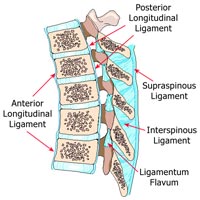
Speaking anatomically for a moment, there are four ligaments which go from the top of the spine to bottom, directly on the center-line. A ligament is a very strong flexible piece of tissue that connects bone to bone. It is not elastic! If a ligament stretches it is unlikely to stretch back. That's why all the muscles tighten up (or lock down if you prefer) around a ligament that is getting over worked.

Each ligament in the spine can be felt. And each ligament can be felt simultaneously for even tension all the way up and down the spine.

So tucking, or straightening, or lifting up can all be wrong if they slacken or tighten one group of ligaments. The spine works as a whole unit, so it is usually a mistake to try to move just one part. Each vertebral-body (bone) can tilt forward or backwards somewhat like Venetian blinds.

But at a higher level if you are thinking inside the body about the details of anatomy you are making the mistake of "letting the spirit leave the body." The same goes for lifting up the head or sinking the tail bone. The mind or the "shen" goes out in all directions, if it goes up (like a rainbow fountain) without obstruction, the spine will follow--like a hungry tiger to its prey.

The notes for the cross section above are here:
Figure 10. A sagittal view of the human thoracic spinal cord, showing the (1) intervertebral discs, (2) vertebral bodies, (3) dura, (4) epidural space, (5) spinal cord, and (6) subdural space. A thick ligament, the anterior longitudinal ligament forms the anterior border of the spinal column. The posterior longitudinal ligament form the posterior border of the vertebral bodies.

What We Like About Food

Seeing as Thanksgiving is coming up in the U.S.A., here is a post on food and culture that might reveal something about gongfu as well.

Americans are most concerned with the way food tastes in their mouth. Thus ice cream is a big hit, and over eating is funny.

Lions Head MeatballsChinese are most concerned with the way food feels once it enters their stomach. Thus the inexpensive noisy restaurant around the corner, which is always packed, is decorated with intensionally unappealing bright orange and green triangles and circles. Why waste money on decor, put your effort in to cooking.
Japanese are most concerned with food appearance and texture. Each type of food has its own rituals of presentation, and people pay close attention to how it feels in their mouth. When eggs are used in sushi they layer them, pouring the beaten eggs from up high multiple times. It doesn't effect the taste just the texture. Of course Japanese eggs also happen to be the best I've ever tasted, but that is because eggs are treated with ritual care.Kids Portion

Koreans are most concerned with survivability. For Koreans to enjoy a meal, there has to be a question in the back of their mind about whether they can actually survive it. Think live octopus! The national dish, Kimchi is huge amounts of red pepper, garlic, something dangerious like raw crab,and a little bit of cabbage--all mixed together and then left to ferment.

Gates vs. Stone Bridges

A lot of gatesA teacher's greatest dilemma is whether to teach gates or stone bridges.
Getting around a traditional Chinese city, village or home is all about going through gates. Thus "going through a gate" is a primary metaphor used to describe learning something or getting something done. It is also a primary metaphor for describing movement of qi around the body. For instance, the shoulder and the hip each have a major gate that allows qi to move between the limbs and the torso.

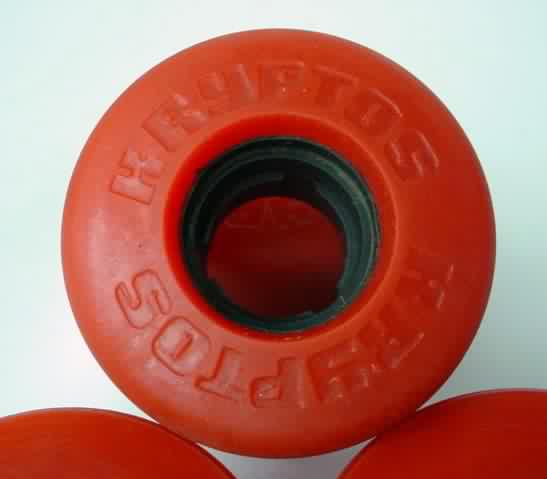
I did a lot of skateboarding in my teens. Every day I skated steep hills with (by todays standards) large 70 millimeter Kriptonics wheels. I'm what the kids today call O.G. (Old Gangster). There are very few people with this particular experience around. Downhill skiers and snowboarders have some comparable skills, so IDude!  Antiques! can at least communicate with them, but snow is softer than concrete and there aren't a lot of cars on the slopes.

Skateboarding was a gate I passed through to get to my current understanding of internal martial arts. It still informs my practice. When I heard the taijiquan saying "You must go left in order to go right" I understood it immediately, skateboarding works the same way. If you are going to make a high speed 90 degree turn into traffic you have to feel your pathway through space and along the ground before you make the actual sequence of turns that will get you into the little space between the the moving cars and the parked cars. Just turning to the right will get you squished.Home with gates

Now when I teach, I'll say something like "Do this," or "Copy me," but nine times out of ten the student doesn't quite do what I'm hoping they will do. So I'll describe what I'm doing, or let the student feel my torso moving. But often they still don't "get it." I think, o.k., if I was in their body I would just do "this" and "this" and "that other thing." From where I'm standing I can see exactly what they need to do to get to where I am. It is as if there were a stone bridge that, if they could see it, they could just walk across.

But they don't see the bridge. So I have a choice. I can either keep trying to get them to see the bridge, or I can take them through some of the gates I passed through on my way to achieving my current skill level.

I do have some memory of the hundreds of gates I passed through to get to my current skill level in internal martial arts. From a teacher's point of view, the only proven method for getting to where I am, is to pass through all the same gates I passed through. However, it isn'tChoose a Gate realistic for me to ask all my taijiquan students to take up downhill skateboarding.

What most teachers do at this point is to make up a list of gates (exercises, experiences) that will hopefully be a shorter route to excellence than the one the teacher took to get there. Some of the gates I teach are ones I passed through myself, some are gates that I think are improvements on the ones I passed through, and some are gates I put there because I'm hoping that the student might notice the stone bridge off to their left on the way through.

Every teacher, whether he is rigid, traditional, experimental, or inspired, has to decide whether to point to the stone bridge, or guide students through gates. I wish I understood this when I first started studying gongfu.

Becoming a Taijiquan Transformer

Transformer!Here is the last installment of the interview I did with George Xu where he talks about the meaning of the Taijiquan Classics, being quiet and in action, being a big meatball in the sky, and how to become a Transformer!

»»»»»»»»»»»ΨΨΨ««««««««««
Just for fun I'm posting this write-up I did for a one day class I'm going to teach to a private group at the end of the month. It's fun:
Taijiquan (also written T’ai Chi Ch’uan or just "Taichi") is one of many traditional Chinese long-life practices which explore the human relationship to nature. When taijiquan is performed daily in conjunction with a healthy diet, times of rest, and regular sleep, it becomes a stable platform for embracing simplicity in the midst of the exciting chaos of modern life.

Taijiquan is a martial art that uses our natural softness and weakness to develop flexibility and integrate the power of the whole body so that everything moves as one. The movements of taijiquan simulate a journey back to the womb, to a state of primordial animation, where we explore the very roots of aggression and how it arises in the body. Traditional Chinese cosmology posits that because all things are mutually self-re-creating, the most potent position to be in is one of interconnected non-action. This potent non-aggressive position is called wuwei

Please join Scott P. Phillips as he leads some fun simple exercises designed to improve circulation, unravel tension and leave us feeling self-possessed.

170ith Post (am I Gay or Chinese?)

This is my 170ith post. I have been writing everyday for half a year. Last month my blog averaged 900 hits per day. I took a little break over the last few days, not because I didn't have anything to write about, but because I just didn't want to sit down at the computer.


Besides being social, I've been reading papers from a recent conference on Daoism and I pulled out my video camera → so I'll have some more video for you soon.
Last week I had a number of server problems which are unsolved, floating in the air. I know very little about computers really, but I manged to add a few plug-ins like this colored highlighting. I suppose I will learn eventually. Meanwhile I'd like to point out that although my list of categories on the right hand column is rather general, the search box works really well. For instance, you can search for every mention of the word "fear," and get an interesting list, or if you like try "death" or "medicine"
I've also been lax about responding to comments, kind of like how some people get behind on their emails and just decide to forget about them. But that reminds me, Dave over at Formosa Neijia asked me a question I didn't have an answer for:

Why didn't I mention homosexuality in my post about the Rabbit God (the Chinese God of Gays)? Why did I do that? For one, I wanted to see if people were following my links. But I think I was also internally conflicted about how I should be talking about gayness to an international audience.

I'm pretty sure that 10% of my international audience is gay and at least 20% of my Youtube audience is gay but in the closet. I'm not myself gay (yet) but I do have a rainbow flag bumper-sticker on my car. This is not just so that if someone cuts me off in traffic I can claim it is a hate crime. No, I actually have an affinity with gayness. As a martial artist who hardly ever gets a chance to really test his skills, I have been hoping that someone will attack me for being gay and I will have a righteous reason to demonstrate my martial superiority!

This reminds me of a rather surprising question which I get quite often: Am I Chinese?

This question is all the more surprising because it is more often than not Chinese Elementary School children or their parents who are asking me the question. Chinese-ness is not as well defined as one might think.

I was teasing a friend of mine from Sichuan the other day. The word Chinese doesn't really exist in Chinese. There is Zhong guoren which means "Center Country People," and there is the term "Han," which is sort of like an ethnicity because citizens of "the Center Country" who do not identify as Han are considered ethnic minorities. (The term Han is really a reference to the first long lasting historic dynasty, the Han Dynasty which lasted 400 years from about 200 BCE to about 200 CE.) So I asked my friend from Sichuan how long her family has been Han and she said, "We registered about 400 years ago during the last part of the Ming Dynasty." I'm not sure there are reliable numbers available, but I'd bet at least half of China could make a simular admission.

I put the question "What makes a person Chinese?" to a rather well informed scholar and she said, "It is clearly not one ethnic group, and clearly not a language either. The cohesive fabric could well be the written language, but most people for most of history have been illiterate. So I would have to say it is Qigong! What all Chinese communities have in common is that people get up in the morning and do long-life movement routines."

Being literate in Chinese written language has some merit as a definition of Chinese-ness. For 2000 years up until the 1800's China had the highest percentage of literate people in the world (unless you include Jews which have had nearly 100% literacy for men for nearly 2000 years.)
I asked a woman from Taiwan if she was Han, and she said "No, my people originally (500 years ago) came form South China which was never part of the Han Dynasty. It would be better to call me Tang! (After the Tang Dynasty 600-900 CE.)

So as the gongfu teacher in several Elementary schools, the answer I usually give to the question, "Are you Chinese?" is: "That depends on how you define Chinese." Which has so far satisfied all inquires.