The Whirling Circles of Ba Gua Zhang (Part 2)

Kumar and Liu Hung ChiehHere I continue my commentary on The Whirling Circles of Ba Gua Zhang, by Frank Allen and Tina Chunna.
The first section of the book is called "The Origins of Ba Gua Zhang: A Blend of History and Legend." It is the most complete collection of stories about baguazhang that I've seen. It follows all the various lineages down from Dong Haichuan. Wow, how do I put this? Writing should be like fighting a war. I fell asleep six times reading this section.

Still I found lots of material that was new to me. I didn't know that Wang Shujin spent a year studying with Wang Xiangzai, the founder of Yiquan. Hong Yixinag and Wang Shujin Yi were both members of the Yi Guan Dao religious society. "The outer teaching of the sect revolved around the belief that Daoism, Buddhism, Confucianism, Islam and Christianity are all different expressions of the same universal and unwavering Dao, while the esoteric teaching of the sect involved various qi gong and other energy practices. " Wang was a Yi Guan Dao leader and thus fled with the Nationalists to Taiwan in 1948.

This section has lots of interesting material I didn't know before. I think my frustration with it stems from that fact it wavers between the encyclopedic tracking of all the various bagua masters, and stories about them. Should I memorize these stories? Is there some teaching point behind them? Does this history mean anything?

I know a reason these histories are important. If you go into any park in the morning, anywhere in the world where there are people practicing Chinese martial arts, and do your baguazhang, people will come up to you and ask where you learned. They will probably trace you back to a common gongfu ancestor with someone else in the park. Chances are good that they will ask you to perform and that if you have been taught correctly you will refuse twice, saying each time that you really are not good enough, that you would only embarrass your teacher, and that only your teacher's teacher was really great. But the third time they ask you, it becomes your duty to perform. The benefit of this is that after you perform you can point to anyone who was watching and they will obligated to show their stuff. It's kind of like a drinking game with your "new family."
There is also another reason. Many of us want to know how our individual style got its characteristics. The authors do a good job of tracing this "progress" or "decline" (which ever you prefer) from Dong Haichuan. However; where Dong Haichuan learned his Baguazhang is at this point, just a bunch of ledgends and unconvincing theories.

Frank Allen's main teacher is B.K. Frantzis and since I also do his style of Baguazhang, we have the same lineage through Frantzis to Liu Hengjie (Liu Hung Chieh).

In the section on forms (p. 87-88) the Authors explain why Liu Hung Chieh didn't teach a Baguazhang form and why his style is not orthodox Yinfu or Cheng Tinghua:
While still in his teens, Liu Hung Chieh became the disciple of bagua master, Liu Zhenlin. Liu Hung Chieh furst studied with Liu Zhenlin when Liu was teaching in the school of Cheng Tinghua's son Cheng Youlung and Dong Haichuan's student Liu Dekuan. Liu Zhen Lin was a famous fighter and bodyguard who first studied bagua under Yin Fu's student Liu Yongqing (who was a close friend and training partner of Yin Fu's top student, Ma Gui). The young Liu Zhenlin learned all of his basic bagua from these two masters, but his teachers brought him to bow before and become the disciple of court minister Liang Zhaiwen; in this way, Liu Zhenlin received entry into the third generation of bagua masters, which was the same generation as his foundation teachers. Liang Zhaiwen was a military man who had been the chief guard at the most important fire gate on the Great Wall before becoming a court minister. Due to Liang's position in lthe court, his association with the palace eunuch servant Dong Haichuan was not widely known until after Liang's death. Because he was the top student of Liu Zhenlin, it is same to asume that young Liu Hung Chieh also received training under his teacher's gongfu "uncles," Liu Yongqing and Ma Gui.

I am indebted to the authors for supplying this history even if my regular readers are likely to find it on the boring side. I promise to spice things up in the next couple of posts!

The authors go on to say that Liu Hung Chieh spent many years studying Daoist Circle Walking Meditation which influenced the development of his style of practice and teaching. In my opinion, someone, very possibly Liu, studied Daoist exorcism, not just circle walking. From my experience of Daoist exorcism it is a more likely source for the diverse phyiso-spirit knowledge that Liu passed on to B.K. Frantzis, (even if I'm the only one who thinks so.)
Buy it From Amazon

The Whirling Circles of Ba Gua Zhang

Let me begin by saying that books are very important to me. My books are like my relatives, each staring down at me with their own ideas and expectations for me. And like relatives, there are those that I would prefer to see only once a year on Thanksgiving. That being said, I have a whole shelf of martial arts books that make me feel uncomfortable and for whom I am embarrassed.

I love baguazhang. When I pick up a book about it, an intense struggle begins. For the last month I have been struggling with The Whirling Circles of Ba Gua Zhang, The Art and Legends of the Eight Trigram Palm by Frank Allen and Tina Chunna Zhang. I wish I could write an objective review of it, but I care too much. If you love baguazhang, you need this book. It is clearly one of the best books on the subject written in English.

I'm going to spend a few days talking about the book, but more importantly the book is a good jumping off point for my own ideas.

Since it is late, and I haven't published a blog all day, Frank Allenlet me begin with the superficial.

Frank Allen can really manifest the different qi qualities of the various palm changes but that doesn't really come across in the photos. Photos of applications are of little use, applications must be felt because in Baguazhang they rely not on the movements, or which foot is where, but on the quality of movement in contact with an active opponent. To photograph it well would take a very skillful photographer who understood what they were trying to capture. Also, what is the point of photos of a bagua form? Or in this case three forms. I don't get it. Nobody can learn a bagua form from a book. A book like this should be a collaboration with a great photographer or the photos should be left out.

I asked a non-martial artist what she thought of the picture of Frank Allen with all the tattoos doing roushou with B.K. Franzis and she said, "Oh, is he a Hells Angel?" So I showed her the picture in the back of Frank with his reading glasses on and she said, "He looks like a guy in the advanced stages of Wise Man Syndrome." So if the authors were shooting for funny, they got funny. (Note to Frank, I think it's the hair.)

If you practice Baguazhang, buy the book and we'll talk about it more tomorrow.

Ergonomic Crime

Not long ago I read somewhere that Martial Artists are left handed way out of proportion to their presence in the general society. At the time my morning class was 70% lefties.

Is this because us lefties have some advantage in fighting? Or do we just have more inner torment because deep down, we know we don't belong? In Italian left hand is "mano sinistra", the sinister hand.

When children in American schools are at their fastest rate of growth they are forced to sit in chairs that are harmful to their alighnment. The problem is doubled for lefties with long legs. Not that I everCriminal Chairs accepted my victim hood; I refused to sit in these types of chairs in high school. If the classroom had them I brought along a foam backpackers mat and sat on it against the wall in the back of class.

The claim that sitting in one of these uncomfortable chairs staring at the back of someone else's head is actually good for learning and taking notes is worse than negligence. It is an ergonomic crime.

Yang-Chu

If you haven't read Yang-Chu, I recommend it. Yang-Chu is considered one of the early voices of Daoism (300 BCE), a voice for wuwei.

His ideas are recorded in the seventh section of the Leizi (Lieh-Tzu). It's a short section and you can read it on-line here.

Yang-Chu said, all we are is a body and a story. It isn't much but applying his minimalism is useful for cutting through hype.

Yang-Chu didn't reject qi, or wealth, or pleasure--to him these are just relative ways of describing experience. He seems a little anti-fame, but that's because he sees freedom in the possibility of changing our story and fame has a tendency to lock us into our stories. We definitely have a body which moves around, thinks, and changes. And we tell all kinds of stories.

It is hardly ever the body that stops people from developing great martial arts skills, it is usually the story that gets in the way.

Most modern people find discussions of fate kind of silly. Like dude, I'm free, right? Yang-Chu cuts through all that. You do have a body, and it does have limitations. Those limitations are not always known, but they do shape our life and our experience of life. Our body does have a fate, or put another way, our fate does have a "shape."

Our story also has limitations, fate. Tell too wacky a story and you'll get yourself locked up. But even if you are walking around with a bad reputation, you are still pretty free to change your story. That freedom to change our story also suggests that we might be able to discard our story or cut it down to a nice manageable size.

The book Blink talks about a guy in Oregon who studied couples on video and developed a scoring system based on observations that could tell him with 90% accuracy if a given couple would still be together in 15 years. When I first heard this I was in shock for a few days. Why was I bothering with all the little details, like doing the dishes and "communicating" if almost all the significant data was in a 15 minute video interview? Is it possible that we really don't have free will?
Anyway, I would really like to get a video scoring system to determine whether or not a student is going to practice everyday, or if they will still be studying gongfu in like 10 years. Heck, I'd like to score myself!

We should definitely be offering discounts to people who have the FATE to practice everyday. What is your fate?

Blocking

I've said in earlier posts that higher-level martial arts don't use blocking. Those comments created a few ripples of discontent among my readers. It was pointed out correctly that at the technique-level Xingyi (and many other arts) use a type of punch which cuts across the opponent's strike in such a way that the opponent's power is defused and your punch strikes first.

At the technique-level circular movements are often used to simultaneously re-direct and strike. These moves are in a sense blocks even if they are also strikes.

But when I was ten years old and started learning Springy-Legs, Tantui (Northern Shaolin), I had to develop solid stances. A good way to test six harmonies power in each stance is to see if the student can keep their arm up while you take a swing at them. Beginning students should pass through a blocking-techniques stage of practice. Good blocking skills can help with integration, structure and relaxation.

I went to a middle school (age 11-13) where kids wore razor-blades on chains around their necks. It was a sweet time. The Latino gangs were the most dangerous, but I was on the inside of that by the middle of my second year. Some of the taller black kids were under a lot of pressure to prove themselves OJviolently and they started the most fights.

At the end of the P.E. (Physical Education) period we went into the locker room to change out of our P.E. uniforms and back into our street clothes. The locker aisles were exquisitely dangerous, we all learned to change in under 20 seconds. But the time alotted for changing was more like 10 minutes so about 50 of us would cram into this space with the lockers to our backs and the doors to freedom in front of us for 9 minutes and 40 seconds.

This wide hallway had a red line that split the room in half. O.J. Simpson went to my Middle-School and his first-place time in Track was on the top of the board in this very hallway. On one half of the hallway were the doors to freedom and a gym teacher, on the other half all of us, crammed together. We were all wearing backpacks which served as a little bit of spine protection. The taller black kids would practice punching everyone else. If you kicked or punched back, the possibility of major escalation was high. The best strategy was to block the punches.
I did not advertise my Shaolin training, however those blocking skills proved to be pretty handy, and earned me some "respect."
Blocking skills should be discarded if you want to develop higher level, non-defensive, skills. Still they have a place.

Pretense

Let's drop the pretense for a minute and just admit that the main reason we study Martial Arts is vanity.

We want to look good. We want to be beautiful (you have my permission to roll your eyes) in the bright flowery sense of the word and in the more sublime confident-lion-about-to-pounce-on-a-bear sense of the word.

Wang Xiangzai said that if you call it "quan" (fist/boxing) it should make you healthy, happy and strong.

Should we really claim that gongfu makes sad people happy? And what happens if you already feel happy? Does gongfu make you more happy?

Part of the reason we practice is because we feel beautiful when we do it. I don't normally bring this up to my students because it would make me sound like a pansy, but naturally it's a feeling I try to transmit.  But what happens if you feel beautiful right in the first few weeks of practice, what then becomes the motivation to keep getting better?
Most of us are twice as strong as we need to be for 95% of the tasks we do, and frankly you could put a little less stuff in each grocery bag and still get the job done. While it may be fun to accumulate power and efficiency it doesn't serve much purpose outside of fantasizing about some major fight to the death in some dark alley we aren't likely to venture into anyway.

I was falling asleep trying to read a book as is my habit, and it occurred to me that my health has been extremely good for the last three years. I haven't gotten sick. Actually it was kind of a lament-- because what is getting sick but a chance to spend a couple of weeks bundled up in bed with chicken soup and a pile of good books to read?  I kind of miss it.  Clearly the hours I spend everyday on gongfu practice are not justified by my good health.

So while tomorrow I'm going to pretend I didn't say this, for today let's just admit our main reason for practicing Martial Arts is vanity.

Frustration

Chinese internal arts are very different than Yoga.  The biggest difference is that Yoga breathing is in unison with the movement.  In Chinese internal arts our breathing is natural.  In fact, if you have taught yourself to breath in unison with the movement, you have to un-teach yourself.  The stronger your yoga practice is, the more you'll feel your breathing get stuck in a pattern.

This points to a bigger difference, namely transcendent practices verses wuwei practices.   Can you really breath in unison while you are doing the dishes?  Would you want to?  But I'm not going into that right now.  I just wanted to say this:  If you are feeling frustrated during practice, it may simply be the way you are breathing.  Yes, it could be that you don't like the person next to you, or that your teacher is trying to teach you too much, etc... But it is worth considering that it may be your breathing.

Frustration is a type of breathing.

Grip

Tehran Gas Station RiotI stopped at a gas station in the middle of nowhere on the way to the mountains last month. I checked the oil and it was pretty low so I bought a couple of quarts. I worked in a gas station when I was 14 so I know some tricks for getting a good grip, but my engine was really hot and the oil cap wouldn't budge. I went looking around in my trunk for someway to get more leverage and came up empty. I felt my manhood was being challenged. Just then a thick stocky man, about 6 inches shorter than me said, "Can I give you a hand." I'm sure I looked embarrassed but then I looked at his hands and they were clearly twice the size of mine, his fingers were as thick as cigars. "Sure, uhh...thanks" I said, and he unscrewed it. I asked where he got such huge hands and he said it was his Scottish ancestry.

Bone crushing power like that can not be trained.

I've been looking around the internet for a good picture of a bundle of chopsticks used for developing twisting power and grip strength. I don't see one, but I've done a fair bit of this type of training and I recommend it.

Grabbing is often considered inferior to striking or throwing because if my hands are closed around my opponent's body they aren't free for fighting. In a one-on-one match if someone grabs my wrist, I still have my hand free.

But that's generalizing, in reality there are many different types of grabbing that are effective.

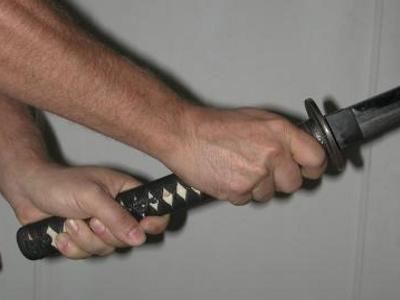
If your grip is strong and well placed it can cause a lot of pain and injury or death to your opponent. For this type of grip to work your wrist, elbow and shoulder must be free to move, not rigid. Your nails must lengthen out like a cats claws with the intent to pierce the skin. The two smallest fingers are actually the strongest part of one's grip for holding, but the two larger fingers combined with the thumb are often superior for piercing.

In Taijiquan the movement "Cai" or plucking is a type of very light grabbing used only when your opponent is already leaning. Cai uses the two larger fingers with the thumb to move you partner on a 45 degree angle toward the ground. It requires no strength training, just sensitivity and clear intention (yi).
Likewise, good grappling technique does not require strength, it is all about positioning and timing. If I get you in a hold it's because I'm sensitive and you've made yourself vulnerable; it can't be planned unless one is using a surprise attack. If I've got you in a hold I can increase the pain or brake the joint with little effort. If I don't have you in the hold, strength isn't going to help me get there.

Half grips are used a lot to suddenly jerk your opponent. Done well these can cause dislocations, but they don't require that you hold on to your opponent, so a light grip works fine.

Curved fingers are used for plucking tendons. This technique is like a grab but the hand doesn't usually close.

What is important about a grip is that it connects to your torso. Twisting a bundle of chopsticks is a good technique for developing this because you are effectively twisting one arm against the other and the two arms meet in the torso where the real power should come from. You can do a simular thing with two hands on a spear.

I also practice a light dynamic grip by using a jian (double edged sword) with a slippery handle.

To develop the ability to inflict pain, you need a willing partner who lets you know what really hurts and what doesn't. You can also practice on yourself to some extent.

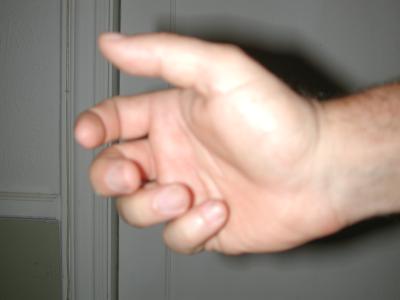
Making fists correctly will really develop your hands and improve your grabbing skills. If you don't practice making fists all day long, you're probably not a martial artist. It is painful to hold a solid, tightly packed fist for five minutes unless your technique is good. If it hurts, it is wrong (the spirits have left the body.)

Grabbing should be relaxed. When your hand closes it should feel like your whole torso is wrapping around something, all your organs and big muscles should support the movement. Developing Popeye forearms is a waste of time.

Compression Bands

It seems that all the big sports stars are wearing compression bands or straps. Why?

Moving an arm with a straight elbow is asking for a shoulder injury. Most athletes over develop their muscles and habitually straighten their joints. A straight elbow adds leverage to whatever torque one puts on the shoulder joint-- do this frequently and the shoulder will get lots of small rips and tears.

If you straighten your elbow in motion your shoulder muscles will get bigger to protect all the soft tissue from the regular damage you are doing. Keep it up and you will accumulate lots of scar tissue.

Compression bands stop one from straightening a joint and also help weaken over-developed muscles.

But I have to ask the question; why not just train right the first time?

Most martial artists know not to straighten their joints, but some schools are lax about it. Some schools even teach peoples to straighten their joints. I knew a taijiquan teacher who didn't speak English very well and was constantly telling students to straighten their fingers. The teacher probably meant lengthen.

Kinesio Taping

Taping is sometimes a good way to deal with injuries.  I haven't tried this type of taping myself but I like the idea.  The various websites dedicated to it have a lot of theory about how it works and I'm skeptical, but the method looks good.
The standard physical therapy method for dealing with lower back pain is to apply ice and strengthen the near by muscles, thus partially immobilize the injured area.  Taping seems like a better idea.  When an injury occurs it is usually important to reduce the student's range of motion while simultaneously increasing circulation and  sensitivity.  Building muscle usually causes inflammation, loss of sensitivity and inhibits circulation.

Taping seems like a big improvement.