More about Eyes

Ching Cheng ShanThere was a debate with in the Zen community a few years back about whether the eyes should be open or closed. In the Orthodox Daoist practice of jindan, the eyes change between being closed, open and half open. Some scholars have suggested that a method mentioned in the Zhuangzi called "fixed staring," is actually a form of meditation. In my opinion it could only be a form of trance, there is nothing "fixed" about the eyes or the focus in the practice of meditation.

The popular religion of China is a trance-medium tradition. There are many variations of this. In some places an individual within a locale, will be the only person who becomes possessed by the local deity. He or she may channel the voice of the deity, may physically embody the movement of the deity, or may violently black-out and then recount the visit from the deity after waking up.

Some mediums are also adept at channeling multiple deities. If a new person becomes possessed by a known deity, villages have a mechanism for determining if the possession is really the deity it claims to be or an impostor. Possession has always been one of the ways to challenge authority. One of the ways of determining the authenticity of a possession is to observe how the eyes are used.

Mediums were so pervasive in China that the government certified certain mediums to testify in court on behalf of the recently murdered. One of the first signs that a medium is going into trance is a change in the eyes.

The term Daoshi (sometimes translated Daoist Priest) is like so many Chinese terms in that it has more than one meaning. One of its meanings is, an expert at identifying the type of Qi involved in a trance, a possession or even an entire cult. Detailed descriptions of Deities, spirits, demons, and ancestors were collected into books called Registers.

At the risk of over simplifying, we could think of a collection of Registers as sort of a cross-referenced Deity phone book. A place where a Daoshi could look up all the characteristics associated with a trance and find a match. The sounds one hears, the claims made by the channel about the deity, colors and smells described by those present, the physicality of the movement, the emotion, and the look of the eyes, were all details which could be cross-referenced to figure out what type of deity was present, how powerful it was, how dangerous it was, how it could be controlled, negotiated with, or appeased.

Part of the training to be a Daoshi is to actually practice all the different ways of going into trance, but never falling into full on possession. It is again, a practice that teaches you what not to do. Obviously a key part of this training is learning all the different things that can potentially happen to your eyes, or your gaze, as you fall into trance.

This little bit of Daoism, is part of the teaching of each of the eight mother palms of Baguazhang.The Eyes are Key

Eyes

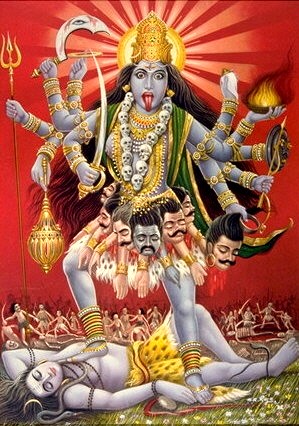
Kali looking embarrassed at stepping on ShivaI went to two parties after teaching all morning yesterday, so I haven't had time to edit all the comments in moderation. Sorry I'll get to it soon.
On the way home from one of the parties Sarah, the possible future mother of my possible future children, said people at the party were laughing about how I used my eyes. Apparently there was a certain woman I consciously, or unconsciously, did not want to talk to--and everyone knew this by looking at my eyes. Fortunately, this particular woman also had a sense of humor and made a lot of jokes about it.

George Xu once said that many fights are determined by the eyes before the fight even starts. Bing Gong taught me to begin a Shaolin form standing still, looking far into the distance, then drawing everything I see into my eyes, then down to my feet at which point I should lift my foot, stamp the ground and sink; this will bring the shen (spirit) to the top of the head.

It is a very effective way to start a performance.

Bing also taught me to relax and "soften" my focus while doing standing meditation and while doing the Guang Ping Yang Style Taijiquan form. This means that when something enters your field of vision, your eyes do not track or latch on to it.

Years ago, George Xu talked about developing "killer yi." Yi, which roughly translates as intentionality, can be partially read by looking into someones eyes. At the time I understood "killer yi" to mean your gaze should pierce your opponent very much in the literary sense of, "if looks could kill!"

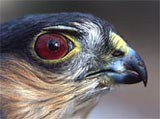
He now says, "Your eyes should drawn-in the distance the way a predator's eyes do.Mature Sharp Hawk When you move forward, you should have the feeling that objects- people, rocks, trees- are being drawn-in toward you, not that you are getting closer to them." (I'm paraphrasing here.)

I interviewed a street-level assassin once who was trying to get out of the business. He was beaten often as a child. He said that when he got involved in acts of violence he would remember the very beginning, entering a space, seeing a car pull up, and then he would remember surveying the carnage as he left. But he rarely remembered actually fighting or killing. He would in some sense black-out. His eyes were like deep pits. You could look into them but he neither appeared to be looking straight at you, nor did he appear to be avoiding your gaze.

It is clear to me that this brutalized gaze is what Chinese martial arts is, at its core, trying to avoid.

I learned eight distinct different uses of the eyes in my baguazhang training, which will be the subject of a future video and blog post.

What is a root (part 3)

  • Using sensitivity to attach to a forward moving opponent and then spinning them off of one's center.

This type of rooting is also pretty easy to teach. There are a few keys that make it easier like getting your weight to one foot, matching the pressure at all points of contact with the person pushing, and being careful not to lean.

  • Various types of dynamic integration which allow one to neutralize/dissolve or simply relax an opponent's attack.

This part of rooting is really infinite and there are many ways to do it. Both of the above methods are essentially about the relationship between two people and the ground. They can both be done while stepping. If you touch someone who is really good at this last type of "rooting" you will probably feel like there is no place to attack, but you will also feel like you have no way to attack.

The bigger problem however is that people try to use all of these types of rooting as a defensive strategy. A corollary of this problem is that people fight with their qi on their back instead of surrounding their opponent. Training the root is really practice for something you don't need to do.

Another way to put it is: It's a fun game which teaches you what not to do. In order to understand what not to do, you have to practice and develop a really good root!

What Demon Possessed me?

Here is an open thread to discuss blog/comment ethics...
If ever I repent of anything, it is very likely to be my good behavior; what demon possessed me that I behaved so well?-- Henry David Thoreau.

Kenny at Joanna's website wrote me an email and then posted a blog about it. I thought it was pretty funny and in good taste.

He brings up a good point, which is that if you don't get good at cooking in your thirties, your gongfu is going to suck in your 50's. Also, for you history buffs: The ubiquitous Chinese cooking implement known as the Wok, was originally a shield used by the military as a makeshift cooking pot.

As to sinking low enough to add a tag on the end of a certain person's comments, implying that the said person used a dictionary and found common ground with me. I have no regrets. If you bite, don't complain when the next blow comes in lower than you expected.

Challenges, disagreements, sarcasm, irony, modest rants, and even the occasional dig are all welcome in the comments section of my blog. But if you break "Queens Rules" and switch to "Rough-and-Tumble," that is, if you disregard my arguments and start ridiculing me, expect to have your comments edited to my pleasure.

"As thou soweth, so shall ye reap."

Update:  Now at the bottom of Kenny's blog Joanna has posted a few of the tamer comments she posted here claiming that I'm somehow afraid of her views, whatever.  I hesitate to say it... but (I'm already banned in China), anyone who is a Communist, as she claims to be, is almost certainly a liar too.

What is a root (part 2)


  • Sinking one's center of gravity.


Sinking one's center of gravity is often referred to a having a root. It can be done by actually taking a lower stance or by internally sinking, which is a process of relaxing while keeping one's alignment. This is not very hard to train. In some Asian countries, like Japan for instance, this ability is just considered normal. In English speaking countries we often hold up our chests which can make us a bit top heavy.

It is easy for even well trained martial artists to lose their root when they become upset (excessive anger will usually do it.) Trances associated with anger or jealousy usually involve forcefully exhaling from the chest through the mouth. This is called qi overflowing.

  • Aligning the basic structure of one's body so that if outside force is applied it will transfer to one of the feet.


This type of root is not internal. However many internal martial artists put great emphasis on perfecting it. It is part of basic Northern Shaolin. The student will hold a stance and the instructor will push on, or forward slap, the point at the end of an extended arm to make sure it transfers directly to a foot.

What is a root?

Burdock

From looking around the net, and fielding comments on Youtube, I've found that lot's of martial artists are obsessed with having a good root. Unfortunately that seems to mean lots of different things, so let's try to sort it out.

First there is using imagination to visualize and/or feel a tap-root-like shape descending downward into the earth (or the downstairs apartment if you live in a flat). Many people call this a spiritual root but I find that word annoying. The root can become huge, or spread like a tree, or keep going down infinitely.

Imagination is a necessary part of feeling. Feeling in some kind of pure sense, like when we are infants, is not very functional. To be able use our senses to comprehend and to continuously adjust or integrate with our surroundings requires an active imagination. It does not necessarily require any visualization. When you are running full speed and jump to catch a football, you don't "think" about the ground, but you feel where it is. In Chinese this use of the imagination to feel or sense goes by various names including qi, yi (intent), shen (spirit), jingshen, and shi (potential energy). This internal mechanism is natural, functioning at all times, and can be improved by training.

Other meanings of "root" that I will cover in the next few days are:

  • Sinking one's center of gravity.
  • Aligning the basic structure of one's body so that if outside force is applied it will transfer to the back foot.
  • Using sensitivity to attach to a forward moving opponent and then spinning them off of one's center.
  • Various types of dynamic integration which allow one to neutralize/dissolve or simply relax an opponent's attack.

The bigger problem however is that people try to use this "root" as a defensive strategy. A corollary of this problem is that people fight with their qi on their back instead of surrounding their opponent.

Zhuangzi (Chuang Tzu)

The third century B.C.E. text known as the Zhuangzi, is a fun read. It is considered one to the three founding texts of Daoism, along with the Laozi and the Leizi.

While it is central enough to be put on a Daoist altar, the aspects of it which are important to religious Daoism were later included in the Huainanzi, so as a text it does not actually play an important role in ritual.

It has however played a very important role in Chinese culture. I like to think of it as a retirement gift to people who have spent their lives caring for others and serving the state. It's central message, if it has one, is trust. Trust the way things are going, ride the wave and be at play with life's ups and downs, curves and straights.

The Zhuangzi is a collection of very readable prose. It is a funny book, funnier by far than any other book of comparable age. Historically the Zhuangzi itself has been part of a game in which people memorize the book, internalize it's voice(s) and then add their own chapter on the end. Because this game has been going on for more than 2000 years, scholars have separated it into the Inner Chapters (the oldest part said to be authored by a man named Zhuangzi) and the Outer Chapters (later inspirations).

In my opinion the best translation of the Inner Chapters was done by David Hinton. He boldly translates peoples names into English, like Gaptooth and Master Timid Magpie, and so brings out more of the book's natural humor.

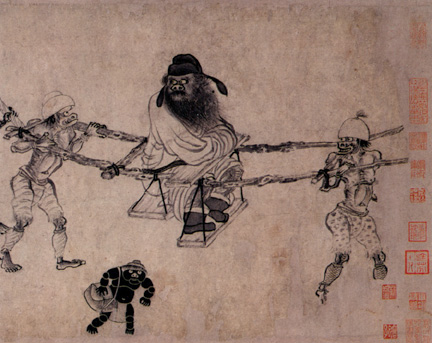
The best book of commentary on the Zhuangzi is Wandering at Ease in the Zhuangzi, edited by Roger T. Ames. All the essays in here are worth reading. My two favorites are "Just Say No to 'No Self' in the Zhuangzi," by Chris Jochim, and "Knowing in the Zhuangzi: 'From Here, on the Bridge, Over the River Hao.'"Zhong Kui

In "Just Say No..." Jochim joyfully jostles with the concepts of Self and No Self and whether or not they are in the original text at all.

In "From Here..." Ames uses as a jumping off point, an argument between Zhuangzi and his best friend Hui Shi about whether or not a group of fish are happy.

A Parade in India 15 Miles Long

I saw this video on Youtube and it reminded me of the huge culture shock my girlfriend and I got on our first night in India.

http://newsimg.bbc.co.uk/media/images/42031000/jpg/_42031300_sikhs_afp416.jpg

We checked into a hotel early in the AM and went to see sights around the capital Delhi. As we left the hotel we looked down the long road our hotel was on and saw some elephants coming our way in the distance. Wow, "We're in India," I thought, I guess elephants are normal here.

We tried to return in the early evening but inexplicably no one would take us back to our hotel, so we had to walk. As we got closer, the number of people in the streets started to multiply. As we got within a couple of blocks of our hotel, the streets were packed. A man with a turban, took

my arm and said, "Sir, I don't want you to get the wrong idea about my people, we are a good people." "What do you mean?" I asked. "Who are your people?" "I am of the Sikh religion, and I am a professor. This is why I am telling you." he said as he disappeared into the crowd.

As we got to the street where I hoped our hotel was we heard music, and singing; a lively parade was going down the street; it was now dark. The road was thick with people on foot but also elephants and cars and buses and flatbed trucks, all with people on them shrieking and throwing candy (ouch!).

Now, I knew, that it was a requirement that at all times, men of the Sikh religion are required to carry a knife. However, in this parade most people had something longer than a knife-- swords, spears, halberds, shields, I even saw a morning star.

I suppose it would have been less intense if we were just watching, but we really

wanted to find our hotel and with all the distraction is was really difficult. We went back and forth many times looking for the hotel sign, in the direction the parade was moving, and against the tide.

There was food stuff for sale in the shops along the sides, which in India spill out into the street, so it was really tough squeezing through, and no joke, some of the shops had vats of boiling oil we had to maneuver around! All this chaos meant that my girlfriend and I got separated several times.

I suppose even this would have seemed cute if the weapons weren't actually being used. But they were. People were dancing wildly with their swords, jousting with their spears (a la the video!) and playing various versions of what we used to call on the playground, "chicken." Except it was "armed" Chicken.

At one point I was walking with some guys with broad swords and one of them grabbed my arm and asked, "What religion are you?" My blood ran cold, "American," I said after hesitating. "But what religion?" he asked over and over, and each time I answered the same thing, "American." I pretended not to speak English and finally made a dash for my hotel.

I later learned that this was a 15 mile long parade with over a million Sikhs. It was explained to me that if someone swings a sword at you, naturally you duck, and if it misses this is because God has protected you. If not, not.

Ahhhhhh a little bit of warrior code, and a little bit of shamanic power.

The Shaolin Grandmasters' Text

When I saw a book titled, The Shaolin Grandmasters' Text, History, Philosophy, and Gung Fu of Shaolin Ch'an, I ordered it immediately. I've been totally unimpressed with the histories of Shaolin Temple that I've seen, so I was hopeful with this one.

It's not as scholarly as I'd like. What is fascinating about it is that the authors  claim to be part of an unbroken oral tradition and on this account it comes across as pretty convincing.

The authors claim that all the Abbots of Shaolin Temple fled China by 1910 and many of them rendezvoused in New York (yes, a knife a fork a bottle and cork.) They abandoned their robes, grew their hair out, and started teaching 'indoor' students. Wow.

The main part of their teaching was a unique lineage of Ch'an (Zen) Buddhism. But they also taught martial arts (yeah.)

They dis' a little on all the Shaolin circus clowns coming out of the Chinese "Temple" these days, which makes for good reading. I'm hugely pro-circus, so I think it's funny, but they seriously wish that "their" name was not used irresponsibly.

Anyway, the book goes into depth on the martial and religious code of Shaolin Ch'an. It dives into a full accounting of what was actually taught and when (remember "Oral" history here, not documented, but still fascinating.)

The short section on Philosophy was a bit of a yawn, and the authors sometimes sound preachy. However, I think their basic premise, that Shaolin is a religious tradition with martial arts as an historical side-car is correct.

If you do any kind of Shaolin Quan, you should own this book.

Musashi vs. Baiken the Last Great Warrior

KusarigamaThis is a continuation of my discussion of Warriors.
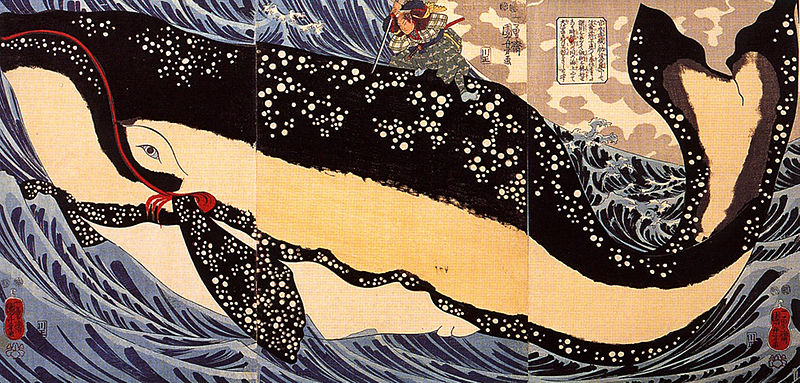
Miyamoto Musashi challenged Shishido Baiken to a duel.

Baiken represented the old order of Samurai who follow a strict code for which fearlessness and a willingness to die were necessary qualities. He was growing old and had never been defeated in a duel. Baiken's weapon of choice was a kusarigama, a short staff with a hooked chain. Musashi fought with his sword.

They met on a bridge near Edo and Baiken stuck first with his kusarigama the chain wrapped and then instantly dulled and bent Musashi's blade. As the gap between them closed, Musashi pulled out his short sword, used exclusively for suicide. Baiken, seeing this, did the honorable thing and hesitated so that Musashi could save face by doing himself in. In that split second, Musashi turned the blade around and stuck it in Baiken. As they stared into each others eyes Baiken smiled and said, "Thank you."

Musashi Dueling the Whale of Tradition
Painting of Musashi Dueling the Whale of Tradition.