
Rough and Tumble
/The first four American Colonies, starting in the 1600's, had some pretty serious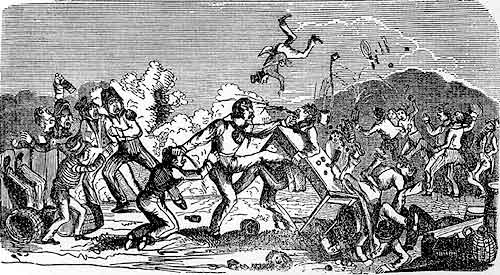 barehanded fighting that still influences how we think about fights today.
The first type of fighting was called a "Fair Fight" or sometimes "Queens Rules." It later became known as Kid-glove Boxing because of the soft goat skin gloves they wore.
The second was Wrestling, but it was pronounced "Wrasslin or "Russlin." Actually there were two types of wrestling practiced in early America. I quote from one of my favorite books Albian's Seed, Four British Folkways in America, by David Hackett Fischer:
 It was a throwing game. If any part of your body besides your feet touched the ground you lost the bout.
Then there was another type of 'wrestling' which would begin with "bragging and boasting" and usually a bit of heavy drinking beforehand:
Mixed Martial Arts..."is humanity itself compared with the Virginian mode of fighting," with its "biting, gouging and...you get the idea.
barehanded fighting that still influences how we think about fights today.The first type of fighting was called a "Fair Fight" or sometimes "Queens Rules." It later became known as Kid-glove Boxing because of the soft goat skin gloves they wore.
The second was Wrestling, but it was pronounced "Wrasslin or "Russlin." Actually there were two types of wrestling practiced in early America. I quote from one of my favorite books Albian's Seed, Four British Folkways in America, by David Hackett Fischer:
One was carefully regulated and elaborately staged in annual tournaments. The burly contestants commonly dressed in sleeveless vests, long tights tucked into stockings, and velvet trunks incongruously embroidered with delicate flowers.
It was a throwing game. If any part of your body besides your feet touched the ground you lost the bout.Then there was another type of 'wrestling' which would begin with "bragging and boasting" and usually a bit of heavy drinking beforehand:
The...sport of bragging and fighting was also introduced to the American backcountry, where it came to be called "rough and tumble." ....it was a savage combat between two or more males (occasionally females), which sometimes left the contestants permanently blinded or maimed. A graphic description of "rough and tumble" came from the Irish traveler Thomas Ashe, who described a fight between a West Virginian and a Kentuckian. A crowd gathered and arranged itself into an impromptu ring. The contestants were asked if they wished to "fight fair" or "rough and tumble." When the chose "rough and tumble," a roar of approval rose from the multitude. the two men entered the ring, and a few ordinary blows were exchanged in a tentative manner. Then suddenly the Virginian "contracted his whole form, drew his arms to his face," and "pitched himself into the bosom of his opponent," sinking his sharpened fingernails into the Kentuckian's head. "The Virinian," we are told, "never lost his hold...fixing his claws in his hair and his thumbs on his eyes, [he] have them a start from the sockets. The sufferer roared aloud, but uttered no complaint." Even after the eyes were gouged out, the struggle continued. The Virginian fastened his teeth on the Kentuckian's nose and bit it in two pieces. Then he tore off the Kentuckian's ears. At last, the "Kentuckian, deprived or eyes, ears, and nose, gave in." The victor, himself maimed and bleeding, was "chaired round the grounds," to the cheers of the crowd.(p. 737)
Mixed Martial Arts..."is humanity itself compared with the Virginian mode of fighting," with its "biting, gouging and...you get the idea.
 all). Practicing very slowly at first, have your partner use their arms to make contact with your arms on the outside of your ring. Keeping contact your partner then slowly moves their hands toward your neck. A small increase in the size of your ring will arrest their progress (once they are stopped they should not keep trying but instead break contact and start again). This un-trains the defensive response often called against the wall, meaning using your back muscles to pull your arms apart (a reflex we use to protect our head and neck when falling backwards).
 In the religious Daoist tradition stories are considered qi transmissions. To study personally with a great bagua or qigong teacher is of immeasurable value but we can receive qi transmissions in many different ways.

 What is it like watching most older people move? Is it a source of pity or sympathy, or perhaps a foreboding omen of what we can some day expect ourselves? If we were to study older peoples' movements with respectful inquisitiveness what might we learn?
 Some guy named Jerome Weng in Singapore responded to my Youtube video
  know eight palm changes which correspond to the eight trigrams, you can practice each hexagram too. Think of each hexagram as a transition between two trigrams and practice that transition. (So for example, hexagram 63 is li [fire] transitioning into kan [water].) On divination days, improvise!
 completing specialized functions automatically.
 All Traditional Chinese subjects have three types of teaching:
 Someone else who believes that gongfu is entirely about fighting are Brian Kennedy and Elizabeth Guo, authors of
  This
This