
How to use Taijiquan in a Fight
/Here is my latest video offering, enjoy.
North Star Martial Arts
In depth discussions of internal martial arts, theatricality, and Daoist ritual emptiness. Original martial arts ideas and Daoist education with a sense of humor and intelligence.
Books: TAI CHI, BAGUAZHANG AND THE GOLDEN ELIXIR, Internal Martial Arts Before the Boxer Uprising. By Scott Park Phillips. Paper ($30.00), Digital ($9.99)
Possible Origins, A Cultural History of Chinese Martial Arts, Theater and Religion, (2016) By Scott Park Phillips. Paper ($18.95), Digital ($9.99)
Watch Video: A Cultural History of Tai Chi
New Eastover Workshop, in Eastern Massachusetts, Italy, and France are in the works.
Daodejing Online - Learn Daoist Meditation through studying Daoism’s most sacred text Laozi’s Daodejing. You can join from anywhere in the world, $50. Email me if you are interesting in joining!
 What does quan mean? As in the terms taijiquan, xingyiquan, shaolin quan. The standard answer is that it literally means fist, but in context means boxing or art. Thus taijiquan means 'the taiji style of boxing' or 'the fighting art of taiji.' (For a definition of taiji see my previous entry.)
 As I've said elsewhere gongfu has many historic roots. The most important for explaining the meaning of quan is it's roots in village level trans-medium religion. There were cults to local deities, heroes, and ancestors. Each cult had a central shrine and an incense burner and as the cult grew, ashes from the original incense burner would be distributed to satellite shrines in other villages. Processional celebrations for each cult would travel between villages according to a ritual calender. This is one of the ways that villages renewed their ties of social order, commercial vigor, and mutual defense. Along a procession, depending on the nature of the particular cult, a village would sponsor a festival. These festivals were sometimes very complex and could last weeks. This created a kind of "unseen" or "celestial" extra-government or social order.
 Everyone interested in Chinese Martial Arts should have a copy of The Method of Chinese Wrestling by Tong Zhongyi, Translated by Tim Cartmell.
 The second reason is that it is material that helps to put internal arts in context. Shuijiao is a kind of gentrified form of Mongolian wrestling, stand up throws, with similarities to Judo take downs and Sumo too.
 What do daoists do? It can be divided up into three categories: Conduct, Hygiene, and Method.
 Practitioners of these so called "long-life" practices, reach their peak level of performance in their 60's and 70's.
Making fun of the traditional names of various Taijiquan movements is pretty common. Many of the names sound weird to an English speaking ear. The poetry and metaphors are mostly obscure. Recently a Taiwanese student of mine suggested a really great explanation for the name playing the Pipa (sometimes translated as playing the guitar). The pipa, as everyone knows, is a stringed instrument but pipa also means scapula. Breaking the scapula was a traditional punishment for fighting. The official administering the punishment would restrain the "fighter" and then slip one of his hands behind the scapula and use the other to chop, breaking it in half. This is just how the movement is done in Yang style taijiquan. Two broken scapulas would damage any fighting career for sometime, possibly forever.
Chinese law or jurisprudence, differs from jurisprudence in English speaking countries. An important difference is that they use different underlying metaphors for what constitutes a violation. In English speaking countries our metaphor is a line or a wall. If you cross this line, you have broken the law. The Chinese metaphor is more like a downward slope. For instance, if you have young children under you care and you are dueling, the punishment is likely to be much worse, because you are really risking other peoples lives. Fighting in this context can be more or less legal, depending on what the longer term outcomes could be. It is, of course, traditional to punish one s whole family because it is assumed that they must have seen you acting badly, bit by bit over time and done nothing to stop it.
 The term yangsheng, "nourishing life," is sometimes suggested as a precursor to qigong. But again, it means something different. The term has also been rendered into english as long-life practices, macrobiotics, or daoist hygiene. It is a more general term that refers to diet, bathing, movement, stillness, trance, calendrical observation, talisman, the ingesting of special foods, and purification for ritual.
Doctors (Zhongyi) traditionally practiced yangsheng. Elisabeth Hsu points out that it was the first part of the transmission of Chinese medical training in the first half of the 20th century. In the Dream of the Red Chamber, the 17th century Chinese epic novel, there is a fascinating scene where a famous doctor has been called to treat one of the ladies of the house. He comes in the evening, acknowledging the urgency of the situation but then says he can not make an accurate pulse diagnosis until the next morning after he has had time to regulate his own pulse.

 There is a common convention of Chinese culture in which the word Dao, meaning the way (or road), is applied to any field of study. The dao of archery, the dao of writing, the dao of mothering, even the dao of basketball. This expression refers to a way of knowing and embodying which is unique to each pursuit, and implies both ease and confidence. It is somewhat like saying in English, "She really has a knack for juggling." (Yet it implies that the activity itself transforms the person who does it, it is not just an act of doing. It also implies that there is a curriculum.)
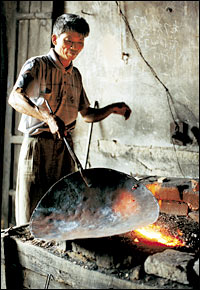 All traditional Chinese subjects had this "dao of" training; music, martial arts, medicine, weaving, etc….In traditional Chinese culture the physical process of acquiring knowledge is not subordinate to knowledge itself-- How one learns is, in a sense, given priority to what one learns. [Of course, the threat of violence was sometimes part of the teaching process, (I don’t want to create a fantasy playland out of Chinese history), but there was an emphasis on process nonetheless.]
 All of the major categories of Chinese religion have developed the notion of perfecting one’s self, though each in distinctly different ways. While each is a contributor, Confucianism is the obvious and most prominent origin of gongfu as a process of perfection. The Confucian approach is one of consistent vigilance in the refinement of a changing person in a changing world. The idea that one would practice the same routine everyday and thus constantly refine ones skill, while simultaneously adapting and applying that skill to ones ever changing duties, needs and circumstances is a Confucian idea. The result of such a practice would be a combination of embodied discipline, efficiency and flexibility. Confucians assert that Gongfu thus conceived does not need to be rewarded because the process of perfection is intrinsically rewarding.
A place to train and learn about traditional Chinese martial arts, which are a form of religious theater combined with martial skills.