How Fast is the Nervous System?

I just saw this article and I thought I'd post it.  It is about how fast the mind works.  There isn't much there but it serves to get the conversation going.  Many martial arts tricks and high-level techniques work by getting the "dupe" to respond on a slower nerve pathway then the "trickster" who triggered the reaction.  It can also work the other way, get the dupe to respond so fast they don't even realize they have already responded to the trickster creating an illusion of enormous power.  

Here is the wiki page explaining it:  https://en.wikipedia.org/wiki/Nerve_conduction_velocity

I also recommend the book The Illusion of Conscious Will, by Daniel Wengner, it covers this and many other similar subjects.  It is directly applicable to martial arts.  

Chicago this Weekend

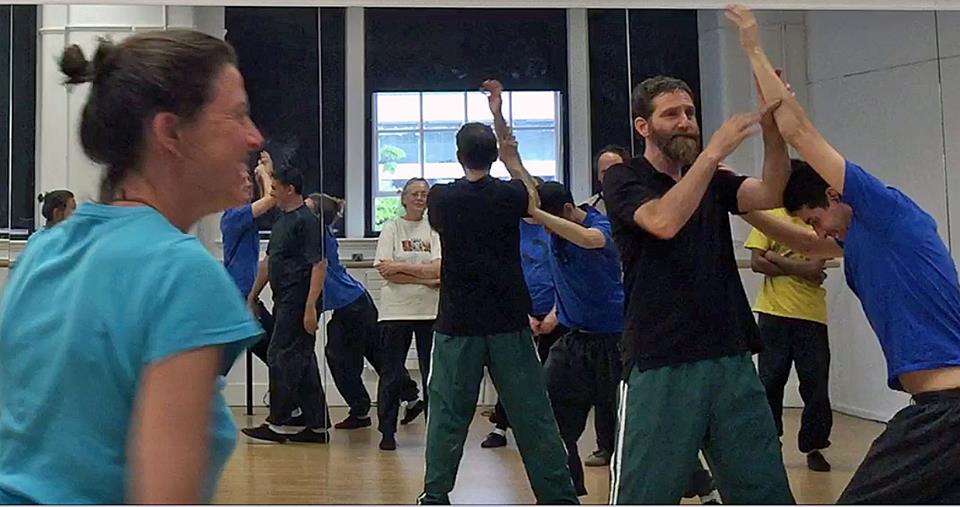
This weekend, I'm teaching again at an advanced year-long Shiatsu Program in Chicago run by Michael DeAgro.  This is exciting stuff, I get to translate ideas about bodywork into movement training and personal practice.  The conversations, the depth of knowledge, the spontaneous interactions, and the experience base of the students, is inspiring.    

I teach the mornings of July 10th, 11th, and 12th.  If anyone in the Chicago area would like to meet with me for a chat or for a private lesson in the afternoon of one of those days, please send me a message.  

Cardiff Keynotes

Here are some links to the Cardiff Martial Arts Conference Keynotes.

http://martialartsstudies.blogspot.co.uk/2015/06/martial-arts-studies-conference-keynote.html

Watching video lectures is hard for me personally, but they are all excellent!  If I had to pick a favorate it is the one by D. S. Farrer on the changes in anthropology.  Farrer has almost single handedly invented the field of Martial Arts Anthropology.  All of the lectures attempt to make bridges between different focuses of inquiry, showing broad possibilities for new ways of thinking about martial arts.  

Xilam a Martial Art from Mexico

One of the highlights of the Cardiff Martial Arts Studies Conference was the idea that martial arts are being used for identity transformation.  As I mentioned in an earlier post, this notion is being pioneered by women and is very exciting.  Since the early 20th Century people have been trying to change their identities.  The Boy Scouts come to mind, as do the less rigid journey-into-the-wilderness Outward Bound programs, created as New Age coming of age rituals. Psychotherapy, and psychology in general, have dabbled in this notion with limited success.  Psychedelic drugs are defended on this basis in some circles. But the notion that there are specific tools of culture conceived specifically for the purpose of transforming identity may be a new idea.  

Xilam is a new Mexican martial art created by Marisela Ugalde.  I learned about it in a video presentation by George Jennings (adademia.edu).  The name Xilam means removing the skin!

This art obviously draws on Asian martial arts, but it has been reconceived.  Watch this video on Vimeo.

Or this slightly longer one on Youtube:

Here is their website.  http://www.xilam.org/


Armor

This is Daniel Jaquet who I met at the Martial Arts Studies conference in Cardiff.  He smokes a pipe.  He got a $20,000 grant to have this armor made for him so he could do scholarly experiments.  In order to become at ease with the armor he wore it when he went out to Starbucks, out on walks, and to places like the library or to do his laundry.  This is the kind of alternative lifestyle that is available to people these days.  It is a great example of the freedom available to creative people in the world we live in today.  Daniel is one of the fascinating and exciting people I met at the conference who are investigating and practicing traditional Western martial arts.  They were a large contingent at the conference and have something fascinating to offer the world.  There is something very satisfying about being around people who dream big, the very nature of what we call art is changing.  We have a name for this already, it is called "the culture of makers" and it is changing the way we see, hear, and move.  It is changing what it means to learn and study.  

For the economists out there:  Speaking in historic monetary terms, at the time this sort of armor was worn by knights it cost the equivalent of a house, about half a million dollars.  

Here is Daniel Jaquet's academia.edu page.

Saturday Workshop Change

It looks like rain tomorrow, so the workshop has been moved:


The tai chi/martial arts event that was taking place from 2-4pm has been moved to a different (indoor) venue. If you'd like to attend this, (which is going to be pretty exciting and fun (see details here: http://www.meetup.com/Lishi-Chinese-Daoist-system-of-mind-body-spirit-training/events/223086052/)) let me know or RSVP to the event.

We are meeting for this at 1:45 PM at Bethnal Green Station and I will bring the tea for a tea break in the middle!

________________

And I'm excited about teaching Tuesday, Wednesday and Thursday:

https://www.facebook.com/events/1547093382219214/

@ Eastbourne House Arts Centre, Bullards Place, Bethnal Green, London

_______________

Had an awesome day, will report soon.

Cardiff-Amsterdam

A week ago I arrived in Cardiff, Wales, UK, for the first Martial Arts Studies Conference.  I went straight from there to teaching a two day workshop in Amsterdam with Alex Boyd.  Over the next week I hope to have some time for reflection.  Until then, here are some undigested bits of excitement.

Paul Bowman deserves enormous credit for organizing the conference, and doing a wonderful job of it.  I admit, I worried beforehand that we might have disagreements, but Paul gets my highest praise:  He is the kind of guy one can disagree with and feel the bonds of sworn-brotherhood grow deeper.  His character, thus set the tone for the entire conference.  This is the first academic conference I have attended where everyone present had the ability to kick me in the head.

This is a dream network.

I taught in Amsterdam at a converted shipyard with a vegetarian restaurant and artist studios, will post a video.  The students taking the workshop practice Lishi, a Chinese Daoist collection of martial movement and ideas--I'll post more on it later.  It is very worth researching.  It is connected to Daoist thunder rituals and was brought to the UK in the 1920's, so it is a window into the past as well.  Some excellent training, and orthodox Daoyin.  They were very open to what I have to share, it is a good fit.  (And Alex Boyd is a great teacher.)

Snibits:

Martial Arts Studies--will it become a discipline or not, how about an "indiscipline?"  I think the point here is that martial arts stretches the boundaries of many categories, and at the moment is in need of some working definitions.

Considerations of authenticity must be included in the definition of martial arts.

There is much support for the notion that dance and acting were closely related to western martial traditions. Dueling was expected to up hold standards of beauty.

Do we need a theory of history?  How do we know what questions to investigate?  Is it enough to follow what is intreging?  Probably not, we need to consider metaphors, and make lists of differing views, perspectives and conditions.  Yes, theory is dangerous, it can obscure or become an obsession.  Theory is powerful, we need to be able to put it down, it should not become part of our arm.  Sometimes great questions seem to come from nowhere.  

There are Japanese Kata, that tell stories.  I didn't know that before, a new subject to investigate.

We need more people from the "outer edge," (that's the sharpest bit of the sword).  So much of the work on Martial Arts Studies up until now has been outside of academia, those people need to be included and rewarded.  I suspect this field is going to explode now because there are people out there who have been sitting on research for more than 30 years.  Up until now, it has been career suicide for academics to seriously take up the study of Martial Arts.  The commercial world in film, religion, and sports is a huge potential source of funding and interest.  

Open minded enthusiasts can accomplish a lot.

Project:  Understanding what sovereignty is by looking at differences in notions of individual self-defense.  

Shiva, lord of the dance, is the destroyer of illusion.  In the South Asian world view, dance is closely related to destructive power (perhaps).  

"One should avoid making sweeping generalization."--a view held by people who don't seem to notice that they are in the habit of making sweeping generalizations.  Better, in my view, to do it, and know you are doing it.  It makes it easier to take it back later.  

Bruce Lee was defiantly killed by talismanic magic.

Plate steal armor was easy to move in, do flips and rolls, hop fences, climb, swing, and wrestle in.  It just requires wearing it a lot--some wise men tested this out.  I hope this means that we stop seeing people move like stiff robots when they wear armor in the movies.  And I hope we see more people wearing plate steal armor to the movies, driving google-cars and drinking coffee at Starbucks.

Zhang Sanfeng texted me several times during the conference to clarify his positions.

Anthropology has changed from representing (peoples, events, milieus) to making.  This was obvious when I was in college, and partially accounts for me dropping out.  

Martial arts is a very potent tool for identity transformation.  This position was promoted particularly by women at the conference, but I think there is a consensus

The desexualization of confined spaces.

One can not teach self-defense/counter-assault scenarios without acting, and the better the acting is--the better the training will be. 


Tickling and Enlightenment

Meditate as if you are being tickled, but don’t respond to the tickling, pretend you are immune.  If you’ve ever been the victim of tickling over an extended period of time, years in my case, you probably noticed at some point that it is possible to use Vulcan-mind-lock to feel the tickling, but not respond to it.  I developed this skill because I had to deal with my older sister tickling me.  She tickled me mainly because she hadn’t ever heard about water-boarding.  The basic goal of tickling is to get one’s sibling’s organs to explode.  

Once I developed the Vulcan-mind-lock skill, my sister quickly discovered that tickling me was boring, and she moved on to more sophisticated forms of torture.  

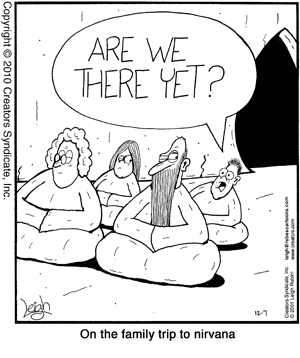
This is why people have trouble meditating.  Meditating is a lot like being tickled. People often think the tickling experience is going to stop when they get better at meditating.  When it doesn’t, they think they have failed, and quit.  If anything the tickling experience is likely to become more profound.    

Widespread confusion about meditation also explains why many people find the golden-elixir (jindan/neidan) practice so mystifying.  Judging by the number and variety of descriptions of neidan and jindan--and we are taking about tens of thousands before the twentieth century--I think it is fair to say neidan is an enlightenment practice invented by people with ADHD (Attention Deficit Hyperactivity Disorder)

A great direction for scientific inquiry in the next few years would be to explore the relationship between ADHD and tickling.  The mindfulness-meditation in the schools movement is great because it is directly addressing nervous system re-orientation problems. Basically, we can think of it as a way to trick disruptive kids into tickling themselves.  Very cool.  

Given all this, and my own self-induced ADHD, let me try (again) to explain jindan (the golden-elixir).  Once the experience of emptiness has been established by giving-in to the experience of being tickled all over one’s body for an hour every day for a year, then it is possible to transition to maximum explosive felt spatial imagination, called shenling (神靈), in Chinese.  Maximum-explosive-felt-imagination, that’s a lot of words strung together!  Well, if that doesn’t work, I give up. You may be on your own.  

Here is the monster in the room--people get good at meditating, standing or sitting, whatever; just like people get good at sitting in a chair in school and shutting off the learning hormones, known colloquially as playfulness.  Don’t get good at meditating!  That was the whole freaking point of Suzuki Roshi’s Zen Mind, Beginner's Mind.  Instead give-in to being tickled on every spot of your body, inside and outside, that is what perfection feels like.  Surrender, not retreat; in the moment, not in-control.  
Of course, I’m not pushing perfection.  Maybe you don’t want that?  Maybe it isn’t right for you?  Perhaps you like to walk around art galleries with your nose upturned sipping wine and nibbling cheese.  That’s cool.

It is a bit like insults.  I encourage students to insult each other early and often.  Complements too.  I also jibe my students towards mastery of the self insult and the self complement.  See, this is what enlightenment looks like when it is expressed and performed.  It isn’t neutral, dead, or boring.  It isn’t all blissed-out.  Daoist enlightenment, and I suspect most other types, too, identifies the fruition as: without preference.  

The practice of meditation is to experience the way things are without preference.  The expression of that experience is to act without preference.  I mean, how do you know a Buddha when you meet him?  He has gangly arms so long they touch his knees, he has been sitting still so long his hair is full of snails, his ear lobes are long enough to bat flies off of his shoulders, when he walks through mud, lotus flowers bloom in his footsteps.  

Seriously, if you want to be enlightened, start seeing these qualities in the people around you and commenting on them.  Why not start by telling the stranger sitting next to you on the airplane that you fart rainbows, and then ask them if they like being tickled?  Or perhaps enlightenment is just too creepy for you?

For my martial arts readers who don't practice meditation, think about it this way, there are two major obstacles to learning martial arts: 1) Fear of being hit; including fearfulness before, during and after being hit, and 2) Fear of hitting; also before, during and after.  Meditation is similar, there are two obstacles: 1) Fear of stillness, and 2) Fear of movement.  

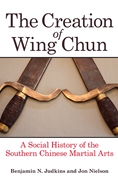
Pre-Order: The Creation of Wing Chun

I'm delighted to announce that Ben Judkins' book The Creation of Wing Chun,
A Social History of the Southern Chinese Martial Arts
, published by SUNY Press, is about to be released.  It is available for pre-order now.  Check it out.

I haven't read it yet, but I am very excited about it.  From reading Judkins' blog and talking to him, one of his most exciting discoveries, which I fully expect to be in the book, is the real story behind the burning of the Southern Shaolin Temple.  I dare say, I expect this book will rise to the top of martial artist's reading lists for years to come.