Taijiquan's Language of Exorcism
/ Long time readers know that the relationship of martial arts to exorcistic rituals is a pet topic of mine.
Wayne Hansen who comments at the Formosa Neijia site offered this wonderful linguistic explanation of peng, the most basic and pervasive form of taijiquan power (jin).
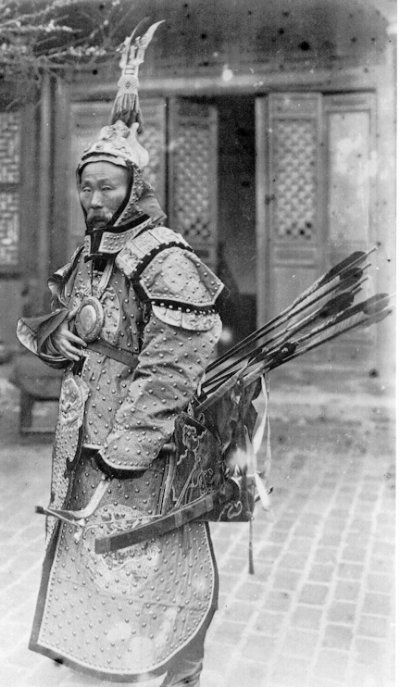
Peng is the lid on a quiver.
Imagine a cane laundry basket with the lid just caught in the lip at the top,by pressing the two sides the lid springs open. I am told this is how the Chinese quiver worked. With a press of the back muscles the top, which was covering the feathers from the rain, sprung open.
Peng jin works like that and so the name.
Archery competition now a days is mostly about accuracy at hitting a static target. But great archers had to be able to hit deadly moving targets and hit static targets while galloping on horseback. And perhaps even more importantly, they had to be able shoot arrows in rapid succession-- One arrow per second.
So popping the lid off of your quiver with a little rounding motion would have been a very threatening act. In fact you might translate it into words by saying, "Back off!" The standard translation of peng is "Ward-off."
To explain this difference, I imagine I'm riding along on a mountain path and I sense something threatening. My first instinct is to pop my quiver lid, which would in fact make a "pop" sound if it were water tight. Even if I haven't seen the actual threat, I can prepare myself, and I can let who ever is lurking know that I'm aware of them. This sort of communication could easily be translated as "ward-off."
Hold on because it gets better.
Common exorcist rituals begin with fire-crackers. The purpose? To ward-off ghosts. Ghosts and demons who are strong enough to need an exorcism, don't usually leave when they hear fire-crackers, but their groveling sidekicks and entourages do take to the hills. The fire-crackers are meant to give mediocre ghosts who are just lost a chance to get away. But particularly malicious demons, the ones that feed on chaos, will actually be attracted to explosive sounds in hope that they will find suffering and death.
The next ritual action would be the "offering of spirits." In both Chinese and African traditions this is done by drinking from a bowl of strong alcohol and then suddenly forcing it back through pursed lips to create a spraying effect which turns into a mist. The mist attracts mischievous spirits. Alcohol is spilled on the ground too.
In the beginning of the taijiquan form, peng leads directly into ji. Ji is a small quick burst of force, sometimes described metaphorically as liquid spraying out of the fingers. Ji by itself doesn't do much-- it can be used for a throw only if your attacker has uprooted themselves by first pushing against your peng. (Of course ji directly in the eye would hurt!) I was taught to project ji into the opponents "empty" spots, those places where they are unaware, because it will stir them to attack and thereby make themselves more vulnerable!
The opponent's attack naturally leads into lu, the next move in the taijiquan form. Lu is a gathering and a drawing-in of your opponent (usually translated "rollback"). Lu defuses the attacker's force.
After the "offering of spirits," the next ritual act is the drawing in and capturing of demonic forces. Offending demons are drawn into a pickle jar and then trapped there.
The final movement in the taijiquan beginning sequence is an. An is usually translated "press," or even "press down." It is very much like resting your hands on a rounded pickle jar lid and weighting them so that whatever is inside won't get out! The final ritual act is called "Applying the Seal." The seal is like a piece of tape that holds the lid on the jar and records the date the spirit was trapped, what type of spirit it is, and when it can be released. (It is considered ritually irresponsible to just leave them there. Some are starved to death, some are transformed in bi-annual rituals, others are freed after "serving time.") Michael also posted in the same thread I linked to above. He quoted the fabulous Louis Swaim
If the opponent wants to change hands in order to apply Push (an), I then extend and open my right hand, pulling it toward my thorax to the point where the two palms are facing in and diagonally intersect like an oblique cross-shaped sealing tape (fengtiao), preventing the opponent's hands from getting in. It is just like closing the door against a robber. This is why it is called 'like sealing'....The image used of sealing tape refers to fengtiao, which were strips of red paper pasted across parcels, doors, crime scenes etc..., as seals.
All those other uses of "seals" are historically derived from the exorcist's seal.
That ought to liven up your form!
Here is the best site on Chinese Archery
 Here is a cute
  I have a group of elementary school kids I have been teaching on Fridays after school. I turned down the job three times because I know from experience that kids lose their impulse control on Fridays after school and I didn't want to deal with that. But for some reason, I no longer remember, I said "yes" the fourth time they asked me.
 I woke up this morning with my arms crossed. Actually more than crossed, knotted-up would be a better description. One hand jutting past my armpit, the other arm wrapped around it twice and dangling between my ear and my shoulder. It took a minute to figure out which arm was which. My honey says I do gongfu in my sleep.
 Confucius said, "If I show the student(s) one corner of the square and he doesn't show me the other three, I change the subject."
 I don't look to criticise the student. I first reflect and then acknowledge that I'm not offering a teaching which meets the student where they are, at their learning level or interest. A good teacher will move on to a new subject or try a new approach.