A New Word

Yang Chenfu doing Play the PipaThe word orthodox is pretty common. It means a right way of thinking or a correct standard way of understanding.

When it comes to taijiquan and really any Chinese martial art there really isn't an orthodoxy. There are definitely lineages which transmit explanations and define concepts, but really it is the practice which holds to a standard, not the ideas.

A lineage holds together a list of practices. If you ask a teacher or a practitioner why they do a certain movement, or what it's function is, or even what one should try to accomplish with a particular aspect of practice--you'll get wildly different answers. And it's not just that different people in the same lineage will give you a different answer, ask the same person twice and you're likely to get a different answer the second time.

For instance, what a teacher says about the function of the movement "play the pipa," can vary tremendously-- one day it has some health or relaxation feature, another day it is a foot hook with a shove, another day it is a joint lock, another day it is a foot trap with a slap, another day it is a technique for breaking the neck, another day it is a throw from the hip, another day it is a throw from the neck, another day it is a way to catch the eyes............................................................................................Hey don't go thinking I'm a broken record (for you youngsters that's an old fashioned musical devise that sometimes repeats itself). I taught gongfu to kids for 4 hours today, at two different sites and adults for 3.5 hours at two different sites, and I had a business meeting at another site--all this in the rain...I am tired!...but my appetite for blogging is over powering my appetite for sleep. (See yesterday's blog below.)

Anyway I was telling you dear reader about a new word: Orthopraxy. Taijiquan is an orthopraxy. A martial arts lineage is an orthopraxy, it is a correct way of doing something. It is not a correct way of thinking about or explaining something. Get it?

I'm sure you get it. But immediately this raises another question.  I practice an orthoprax style of taijiquan, fine, but I've been innovating new movements with my xingyi, what do I call that? Not heterdox but heteroprax!

When you are just doing your own thing, we can now call that heteropraxy!The Guys Who Decide What is and is not a Word

Note to the Oxford English Dictionary: I suspect you will be including heteropraxy in your next addition. Please include my URL when you site me as an example of first uses. Thanks!

Fate

Well I took a nice long break from writing. Actually it took me six days to delete all the unopened emails in my box. I also went up north for a few days where I stayed close to a wood burning stove at a Hippy hostel called Jug-Handle Creek Farm. Even considering the conspiracy theorists we shared a fire with, it was pretty sweet.

Tuna CasoroleI would say my fate has been good, even princely perhaps. Most people don't want to believe in fate. They figure only silly people and Asians believe in fate. What is fate?

First of all I should point out that there are Daoist Precepts against predicting the future, and if that wasn't enough to convince you, there is a precept against making a living from fortune telling.

Let's start from what everybody has, a body. The body we get at birth is fate. Yes it may make a difference if your mother ate a lot of rocky-road ice cream during her pregnancy, but there are still some basic parameters that will determine your body type. True, it matters to some degree what we eat over 20 or 30 years. But we don't actually have direct control of our appetite.

Appetite is a key concept in understanding how fate relates to martial arts. Everybody gets hungry, everybody has an appetite, just like everybody gets angry, everybody has aggression that can explode.

Part of growing up is a process of refining our appetites. It's a touchy thing we don't have direct control over, but you can make yourself sick of even the most tasty dish by eating it every night for a week. Imagine how bad tuna casserole would be after eating it six times in a row. Likewise, if you deprive yourself of chocolate for a couple of months and then accidentally bump into a friend eating a bar of Scharfenberger's.... They'll be lucky if they get to keep half.
If you have a wide range of food choices and you understand the different qi qualities of those foods and how to combine them, you can really start to play with your appetite. The qi quality of a particular food refers to the categories of foods which have a similar effect on your body and your appetite. So cabbage and kale are pretty similar while chocolate is in a category by itself (Yes, I agree that carob is good, but it is not chocolate).

The body we have is pretty much fate. But it is a kind of flexible fate. Meaning it is unlikely that I'm ever going to have long sharp teeth, but if tattoos got old and teeth sharpening became like the new hip urban craze, I could at least sharpen my teeth. We do have some control over what we want to eat, but a lot of it is fate. If you are Polish and you haven't had black bread and sausage in like a year, just me saying this is going to make you jones for it. Polynesians and pineapple, Norwegians and lutefisk.

Martial arts work the same way. You have a body that wants certain kinds of movement, it wants certain kinds of stillness too. It's like an appetite. If you have a wide range of training options and you understand how they will effect your body, you can play with that. What you do everyday will actually change what your body wants. A great deal of it is just fate, but there is also room to play around.

Where we live, the kind of gongfu we practice, the languages we speak, what we eat for breakfast--as humans we have some flexibility up to a point, and no doubt you can move to a foreign country, learn a new language and forsake you grandmothers recipe toffee, but most of us, most of the time, have a fate, a rhythm, a set of patterns that make us feel comfortable.

A Golden Thread

Chu silk There is a common taijiquan metaphor that practice is like making silk brocade interwoven with golden threads.

Brocade has been found in tombs sealed airtight with clay and water dating back to the Fifth Century BCE (or there abouts) in what was then the Chu kingdom. Brocade is a type of woven fabric which can display different images depending on the angle of the light. See this Archeology PFD.

Probably the most widely practiced sinew lengthening routine is called 8 Silken Brocade. Following the metaphor, it has eight movements which reveal eight different images of what the human body can do.

The metaphor of the golden thread is absolutely key to understanding how to practice taijiquan. Each day when we practice we begin with some idea about what we are going to do. That idea may be very complex, or it may be as simple as "I'm going to make circles with my arm and try to make it look like it does when my teacher does it." But during practice, you happen upon some feeling that is new.

Perhaps on this particular day it is a feeling of connection, or a feeling of softness, it could be anything. The first time you feel it, it will feel subtle, even delicate, like a very fine golden thread. If you don't practice the next day, you will certainly have forgotten what the feeling was and how you got to it. Even if you do practice the next day, the feeling may elude you. Or you may refresh this new feeling for a few days, but then you have a wild night and the next morning you forget to look for that golden thread and by the next day it is gone. By the next week it is forgotten.
If you do manage to hang on to one of those new feelings (those subtle golden threads) for a few weeks of practice it will become less subtle and easier to reproduce.

To truly practice Taijiquan or any internal art is to look everyday for the golden thread you felt the day before and to slowly weave it day after day into the brocade that is your whole practice. Eventually these fine threads weave together into pictures that become so a part of you that they shimmer in and out of focus continuously like images on a flexible piece of brocade in changing light.

Historic Discovery

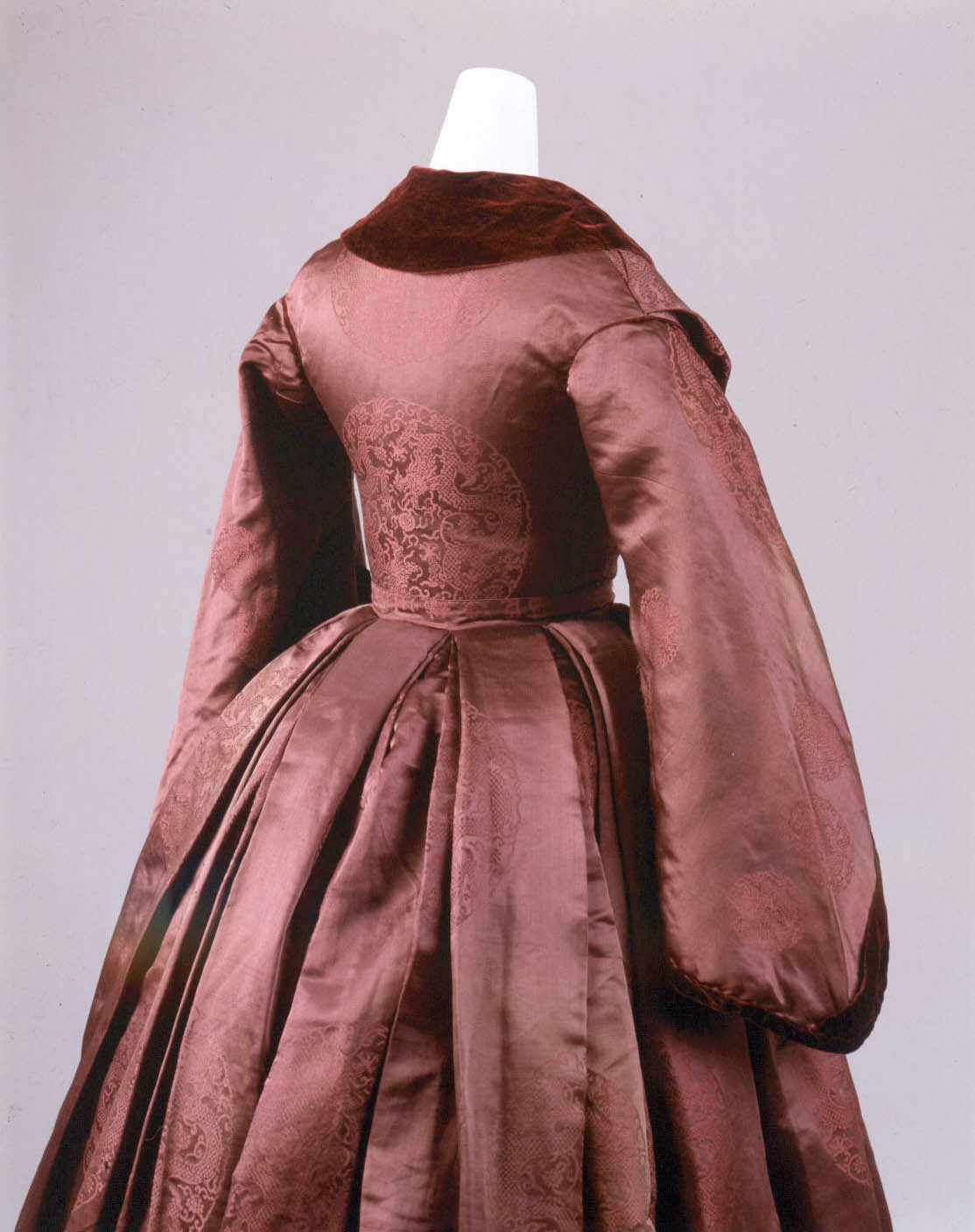
Metropolitan Museum of ArtI was delighted that Emlyn found these photos after reading my post on Daoist Shoes. There is no evidence that they were used by Daoists in ritual. But the more orthodox the ritual, the more private it is, so we will never know. But the shoes are used in theater and were widely worn by Manchu women.

They were understood to do at least two things: One, they gave a feeling of potency to the wearer. Two, they were an imitation of Han (Chinese) womens' esthetics, namely bound feet.

Bound feet, and the reason(s) behind them, is one of the most fascinating and disturbing pieces of Chinese culture. Manchu women were forbidden by the Manchu government (1650~1905) from binding their feet. The government was never happy about Han women doing it, but it was out of their control. Some scholars now say that foot binding was an act of female agency. Men showed their acceptance of subjugation to the Manchu rulers by wearing their hair in a cue (shaving the front and leaving a thin braid in the back). Han woman showed their disdain en mass for this act of subordination by binding their feet. This act conveyed stored potency, as if to say, "We will act at a later date! (This did in fact happen in 1911 when women whose feet were not bound were slaughtered.) (Hat tip to Alan Baumler at Frog in a Well, also scroll down the comments section where some heavy scholars go at it. )

The problem with this explanation is that binding ones feet seems to us like torture, perhaps it is even self-mortification for the misdeeds that led to being conquered by the Manchu. To understand foot binding as an act of potency one has to understand the difference between, what we call in Taijiquan, jin and shi.

Jin is power which manifests through the balls of the feet (peng & ji) or through the heels (lu & an). Shi is potential power which is stored up and does not manifest. It is the power of being able to manipulate the spin of a battlefield simply by ones position. It is not overwhelming force or shock troops. To develop shi, one must not use power from the balls of the feet or the heels.  The more common type of jin must be discarded to develop the "higher level" shi.

Shoe Blog

Thus, by pure accident I discovered that these shoes were actually meant to convey shi (potential power). I was using my memory/dream of them to convey something not well understood about taijiquan and stumbled on the debate about foot binding.

Here is the poem from Frog in a Well:
Get a carpenter’s adze to make the shoe-bottoms
Get a carpenter to make the outside of the shoes
Use a card of yarn
Eight lengths of fine cloth
Altogether it will take three years
To make a pair of embroidered shoes
Call a girl to try the shoes

Whether short or long
The girl stretches her foot
to fit the embroidered shoes
The shoe small the foot large
Constrained and uncomfortable
Awkwardly and crookedly to the back wall

The left foot crushing eight tigers
The right foot crushing nine wolves

Wow, I hope this is taught in the schools some day. (Perhaps they'll even mention my famous blog.)
The best book on foot binding to date seems to be Cinderella's Sisters. I haven't read it yet, I did read Dorothy Ko's earlier book on Chinese women and recommend it for those with a scholarly appetite.

http://www.footwearhistory.com/lotusconstruction.shtml

http://www.shoeblog.com/blog/friday-shoe-history-corner-2/
--For an alternate view of why these shoes convey potency, that may give a little bit of wiggle room to anyone caught with their pants down, read this.

Taiji means

TaijiFirst of all, since I slept most of the day, here is a repost from September about sleep and training.

Following on yesterday's word meanings, Taiji has a definition people don't often talk about.
Taiji is very close to Dao, at least as far as human experiences go. It is the source of inspiration (of Qi and breath). To practice Taijiquan is to continually return to the source of inspiration. It is the place or state of transition from which inspiration arises and where inspiration goes to die.

As a fighting art, taijiquan is the idea that you take your opponent with you to that place of inspiration.

Does he (your opponent) want to stay in the source of inspiration? (ie. became one with Dao at the moment of death) or does he want to come back with a new inspiration (think: attitude)! Does he want to go to his usual home, or back to his original home?  Let him decide.

Lian Gongfu

chainIn Chinese it's not correct to say "I am studying Taiji (or Tai Chi)." First of all Taiji is a cosmological principle, so it is like saying, "I'm studying the ocean." Yeah but what part of the ocean? The correct term is Taijiquan, which refers to the art, which is itself a type of gongfu (or kungfu). But the Chinese word for study xue, is not used when referring to types of gongfu. The correct term is liàn.

Gongfu, as I have said before, means meritorious action, or acts or merit. Liàn is often translated "practice or train," as in "I practice gongfu." The character for liàn is made up of the characters for "silk floss" and "card," implying a sorting out process. If we look at the homonyms for lian we see that it means to link together, chain, to connect, a continuous flow, ripples, to refine (and thus "lotus" because these flowers are purity that rises up from the muck), and to smelt ore.

Lian actually means is "to link together in one continuously unending process." "liàn gongfu" means to continuously link together acts of merit. The word liàn is used for all types of gongfu.

So next time someone says they are learning or studying Taijiquan, say: "You mean you are linking, sorting out, refining and smelting together acts of merit into one continuous flow?"

"Yo, that's fresh!"

Red or White?

red or witeGeorge Xu used to tell us stories about the Wild East. Often he was a character in these stories, and honestly I think they were true stories, but more often than not he seemed to be the cowboy with the white hat. (He was the good guy in morality tales that may or may not have been so black and white.)

One story he told us took place during the Cultural Revolution when he was on "The Farm" (forced re-education camp with inadequate food and shelter). Nearby "The Farm" there was a black-marketeer who dealt in cigarettes and alcohol and, among other nasty things, happened to be a rapist. He was a bad dude, with some kind of back up, and a tough-guy-name like "Black Face."Black and white

After some particularly cruel machinations by Black Face, George broke down his door looked him in the eye and said, "Which do you want red or white?"

Dropping his box of contraband cigarettes and shaking in his chair, Black Face asked indignantly, "What do you mean Red or White?"

George replied, "Red, I stop when I see blood. White...Death"

From that day forward Black Face was no longer a problem for the locals, (I think he chose red.)

Systems

HabitrailOne of the basic ideas of Systems Theory is that if you have a complex system and you speed up one part of that system, you will slow down the whole system.

Likewise, if you make one part of a system more efficient you will make the whole system less efficient.

In martial arts, if you have one joint that is looser than the adjacent joints, the body will tighten up somewhere else to compensate for the loose joint, which will make the whole body less efficient.

Likewise, if you have one muscle or one muscle group that is stronger than the adjacent muscles, the system will be weaker and less efficient.

Systems theory, by the way, is really just a collection of observations about how stuff works. An important observation that is practically a rule of industrial commerce, is that for any given output or product created by a system with multiple variables, there is a way to make the system more efficient. I posit that this is why we can always improve our martial arts skill.

If you want to speed up and improve the efficiency of a whole system the best way to do it is to confine the output, limit the product produced, and then run the whole system at different speeds, both fast and slow, to see where the weak links are. Then you can focus on efficiency in that one location or component. Games like Push-hands, sparring, boxing, sumo, and even MMA, all confine output. They all "run our systems" with confining rules that limit output and thus allow us to find the weak links.

________________________________________________________________

 Formosa Neijia responded to my last post with a post of his own.  Systems theory would suggest that strengthening or weakening any one region of the body is a losing strategy unless you have already shown that for a given output that region is the weak link.  In other words, whole body unity should be a priority--both the measure of any intermediate steps, and the final fruition.

Why Sit-ups Make You Fat

Many people want to know why sit-ups make them fat.

The first reason is that building up muscle on your belly will make your belly bigger.

The second reason is that when you stop doing sit-ups, the muscle will turn to fat.

Some people start doing sit-ups because they are trying to get their belly to go away. If your belly is big because of a curve in your spine you will be effectively compressing your spine in order to make your belly look smaller. This compression leads to a bigger curve so it is a self-defeating process. (Also known as "pooching syndrome.")

Another possibility is that your belly is big because you are over-eating. If you are over-eating and you do sit-ups, the extra exercise will "tonify" your appetite causing you to want to eat more! Yum, yum. (This is often conflated with edema or bloating which can have a variety of causes, none of which are helped by sit-ups.)

Another possibility is that you do sit-ups to make your back rigid so that you won't feel a chronic injury. This sort of works but the problem is that it makes you insensitive so you are more likely to injure yourself again in the future (and more likely to over-eat).

Making one's belly and back rigid is popular with some athletes because they are always getting injured from direct impact. If two balls of equal mass collide, the denser of the two will survive and the less dense body will disperse. (This is known on the school yard as the Blamo effect!) For instance, football players often disperse (detach) their retinas this way.
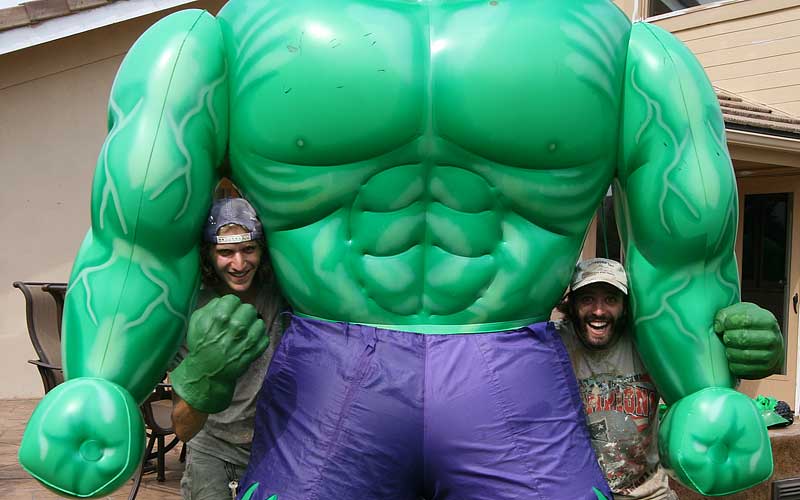
The Blamo effect always works! Its physics! The denser you are the better. Unfortunately there is no art in this. The quickest way to make your body dense is to fall really hard onto a surface like ice or concrete. (A couple times a day and you'll be lookin' like Schwarzenegger in record time. Warning: This may effect your brain.)

Some people like to wear their armor on the inside. Rather than picking up some leather or even chain-mail from the local Walgreens which has the benefit of being effective against sharpened steel, they have decided that they want armor 24/7. Yes, even in the shower! These fighter-exemplars are in constant fear of a surprise attack; they need not worry about over-eating because they are too scared to eat.

There is a group of martial artists who think that making the area between the ribs and the hips rigid will give them more power. The logic here, if we can call it logic, is that a rigid body moves as a single piece and is therefore able to use its whole weight for fighting. If by fighting they mean World Wrestling Federation body-slams, than they are indeed correct. However if your idea of fighting involves mobility, and the possibility of generating explosive power from all the soft tissue in your body, tight abdominal muscles will totally break your power.

Tight muscles reduce movement range and sensitivity. They cut off the flow of power from one part of the body to another and they require constant maintenance. The more alive your whole torso is, the more power and flexibility you will have.

Future Blog: Why are/were some famous Taijiquan masters fat?

More in the News

Here is one of those cutesy articles that the New York Times Magazine likes to print. It is called The Newest Mandarins. The article is optimistic about one of darkest subjects in history: Is it possible for people to think for themselves.  (I tend to be more negative on this account.)
On the word yong (courage), Lei Bo cited chapter seven of The Analects, where Confucius told a disciple that if he “were to lead the Three Armies of his state,� he “would not take anyone who would try to wrestle a tiger with his bare hands and walk across a river [because there is not a boat]. If I take anyone, it would have to be someone who is wary when faced with a task and who is good at planning and capable of successful execution.� No one ever put Confucius in charge of an army, said Lei Bo, and Confucius never thought that he would be asked, but being a professional, he could expect a career either in the military or in government. And his insight about courage in battle and in all matters of life and death pertains to a man’s interior: his judgment and awareness, his skills and integrity. This was how Lei Bo explored the word “courage�: he located it in its early life before it was set apart from ideas like wisdom, humaneness and trust. He tried to describe the whole sense of the word. The business students and their teacher were hooked. They wanted Lei Bo back every week for as long as they were reading “The Art of War.�

The one thing I have to add to the this discussion is that in my mind "courage" is related to "compassion." This is important because the word Compassion is a key concept, and a key precept, in Daoism.  The word compassion in Chinese is made up of the  characters for roughness and heart.  The Daoist idea of compassion is that it is natural courage, the courage a mother tiger uses to defend her cubs.Yikes