Internal martial arts, theatricality, Chinese religion, and The Golden Elixir.
Books: TAI CHI, BAGUAZHANG AND THE GOLDEN ELIXIR, Internal Martial Arts Before the Boxer Uprising. By Scott Park Phillips. Paper ($30.00), Digital ($9.99)
Possible Origins, A Cultural History of Chinese Martial Arts, Theater and Religion, (2016) By Scott Park Phillips. Paper ($18.95), Digital ($9.99)
Watch Video: A Cultural History of Tai Chi
New Eastover Workshop, in Eastern Massachusetts, Italy, and France are in the works.
Daodejing Online - Learn Daoist Meditation through studying Daoism’s most sacred text Laozi’s Daodejing. You can join from anywhere in the world, $50. Email me if you are interesting in joining!
Baguazhang in Tainan
/Meeting Master Lin Miaohua I was immediately struck by his long neck relaxed shoulders and open chest. He had the same drum I use in his house and he had a lot of weapons. Next door was his painting studio, all traditional, lots of great looking flower scrolls and calligraphy. He is 71 years old.
He took us to the park and we did a little warm up. Then he demonstrated his Baguazhang. He is a student of Zhang Cilong who was a student of Sun Lutang (1861-1933). So this was great stuff to see. Sun Lutang was famous for his fighting ability, for creating a synthesis of Baguazhang, Xingyiquan and Taijiquan. He taught with "Yang Shao-hou, Yang Shao-hou, Yang Ch'eng-fu, and Wu Chien-ch'üan on the faculty of the Physical Education Research Institute where they taught T'ai Chi to the public after 1914. Sun taught there until 1928, a seminal period in the development of modern Yang, Wu and Sun style T'ai Chi Ch'uan. (quote from Wikipedia) Man, even I’d go back to school for that!
Master Lin is a master of hard and soft. Feeling him attack is like fighting with an electric switch. If he touches you he is sure to give you a shock. He specializes in two legs off the ground fajing explosive power. He has shaking power too. He showed me a whole bunch of forms including some Shaolin and a low ground fighting system called Diliang (I think, it means lay down on the ground). His baguazhang uses small steps and focuses on explosive power. The key to his power is in making the torso like a vacuum which can suddenly suck in the limbs and then cause them to pop out like a fire cracker. Here is a quick video with more to come.
Wood Carving and Food
/This guy appears to be carving Zhenwu (Perfected Warrior) or perhaps Xuande (Mysterious Virtue). He has the wide braid down his back, incredible armor with animals at the joints and bare feet, with the left foot sticking out to the side showing that you don't need to be perfect to be "Perfected."
I also saw a guy making a giant puppet. After being in Taiwan for a few weeks I finally gave in and started carrying my video camera around. Check it out.
Then I had a Gebao. A simple steamed wheat bun sliced in half with tongue, pickled vegetables, and sesame sauce, served with broth on the side. The tongue was in honor of my late grandfather (it being father’s day) who could never pass up an opportunity to eat tongue.
The other night I slept through dinner so I was walking around looking for a late night place to eat. A lot of restaurants are actually storefronts in which everyone sits out on the sidewalk. I found one with pictures of goats everywhere. I asked for some noodle soup and he boiled me up some vegetables and some lamb which he put on top of some fine rice noodles. Then he was like what else do you want? So I said stock. There were two stocks boiling away, a dark one and a light one. I pointed to the dark one but he was like, "No way I’m giving that one to you." I asked what the name of each stock was and he said the dark one was Dangui. He insisted I take the other one. Which he called Ji, which means chicken but I must have that wrong because it was really good lamb stock. When I finished the delicious meal, I pleaded with him to just give me a taste of the Dangui, he relented. Dangui is a potent herb that I know makes qi rise up to my head so I avoid it, but it was great tasting stock.
Who can do Daoism?
/Most Taiwanese have little idea where they would get knowledge about Daoism if they wanted it. He Jing-Han's sources like writer Nan Huai Jin have put a filter on access to that knowledge. In effect they appear to stop most people from further inquiry.
Daoism does not have an open door. But that doesn't mean no one ever comes in or out of the door. If He would have accepted some of my earlier definitions of Jing he might have accepted my declaration that the story of the Eight Immortals (Ba Xian) is precisely to let people know that there are as many ways to cultivate Dao as there are people. The point of the Talisman (fu) of the 60 Cloud Fates is the same, that there are many ways to become an immortal. Everyone has Jing. Every being's jing is already pure and perfect. It is reproduced by our healthy habits, and it also reproduces us. The differentiation of Jing and Qi happens in stillness, it has no special requirements, it requires no effort.
Han Wudi, was known as the Martial Emperor and he lived during the last part of the first half of the Han Dynasty (2000 years ago). He was said to have a solid gold practice room, and Xiguanmu (The Queen Mother of the West) as his private tutor. Yet he was unable to cultivate Dao because he was haunted by the ghosts of all the people he had killed in the process of expanding and then consolidating the Empire.
The point? If you deal with your ghosts you can cultivate Dao. If you don't, even a solid gold practice room and Xiguanmu as a teacher will not be enough. Conflating the process of Cultivating Dao with Purification leads to elitism, an Earthly Hierarchy--and there are no true earthly hierarchies. Hierarchy is a process of imagination--thus the only true hierarchies are of Heaven.
I know this can sound obscure, but it's not that hard to get. The most basic act of Chinese religion is to make sacrifice. The sacrifice to Heaven, as a totality, was always performed by the emperor. Everyone else sacrified to their little piece of heaven, that is, their ancestors and their local gods. Hierarchies are maintained by acts of subordination and dominance, which are made real through ritual.
Daoist Priests are forbiden by precept to subordinate. Every other choice will eventually lead to freedom, it just takes longer. Daoism is a short cut. Freedom has a physiology. That physiology is our true nature and it is revealed through the cultivation of weakness, stillness, openness, and lacking pretence.
Between Theorizing and Storytelling
/I'm in Tainan, which is the old capital of Taiwan, meaning it was a place of early settlement. I get the sense that governance was not universal until about halfway into the Japanese occupation, say 1920.
My first night here I met up with a friend of Professor Hsieh named Sharon Lee, who generously offered to translate for me. We went to Luzhu to meet a Qigong master who was treating people for free at a steel bolt factory. Sharon is getting regular treatments from him. I watched him treat several people with a minute long vigorous painful massage which was heavy on the vibratory poking side of things. We then sat in an office and drank tea for over an hour. The tea was good. I got to ask a lot of questions, but there were about 10 people in the room and most of them were asking questions too.
If I got the story right, he did begin studying with a Daoist teacher in the forest but he then went on to do his own practice which is a sitting still practice of some sort. At a certain point he realized he could heal people and so naturally he started studying Buddhism as that is the biggest cult here which has a doctrine of compassion that involves fixing/curing people.
However, he side stepped Buddhism too, after realized that he found it impossible to memorize Sutras. At some point after he had been treating people he looked into Chinese Herbal medicine and found it easy to understand. He soon began writing long herbal prescriptions. Interestingly he doesn't actually write the prescriptions himself, he channels Yao Wang (Medicine King) a Tang Dynasty God who does the prescriptions for him.
A Standard "Nuggie"But besides this, he said no gods are involved in his healing ceremonies. He is a vegetarian and encourages others to be also, he often tells people to skip dinner, and he does not allow payment for healings. He does drive a fancy German car however, so he has some big donors. While he says he can not teach what he does, he holds ceremonies for an inner circle at his home, which has some sort of altar. At these ceremonies he has other people read the Heart Sutra.
He said I have a kidney problem which is manifesting in my chest. He is clearly from what I would call the "Structure School" of Chinese medicine. I don't know if he thought my problem was acute or chronic, but that's how he operates. The heat in Southern Taiwan undoubtedly has given me an acute kidney problem, but I recover instantly in the presence of air conditioning, which by the way he says is bad for everyone's health. He didn't give me a full one minute treatment, I got only the 15 second version on my sternum, but that was three days ago and I can still feel it. Last time I had a treatment like this I think I was 13. Back then we called in a chest "nuggie."
My long time readers know that I call this kind of guy a Qi Jock, and I'm generally not impressed. But as a student of religion I think he has an interesting take on what a body is. He refused to be pinned down on any definitions of things like jing, qi and shen. He does have the idea that in stillness jing and qi differentiate and that leads to an extraordinary type of freedom. I think he is fulfilling a real need in people's lives.
The orthodox Daoist in me says don't get in the way of other people subordinating themselves with the idea that they need extraordinary powers of healing. I can make this point very simple. At the end of the day, after violating the most basic of Daoist precepts--"don't waste jing and qi"--a person wants to give in to something. Some people rent "Die Hard 3" and fantasize about being Bruce Willis, others go and get a Qigong treatment. Which is more effective is a question of perspective and circumstance.
UPDATE: I must have temporarily blocked this out. In addition to saying I had a kidney problem he said, "Ni shi tai peng." (You're too fat.)
Coffee Cerimony
/
On my first day in Kaohsiung when I was nearly dying of heat stroke, before thick rains drenched me, I was walking along a bicycle path and noticed a guy making coffee out of a two wheeled cart. At the moment he was making a cup of coffee for a woman on a bicycle who had a very cute dog in her basket. The feeling was almost yuppie, but the guy making coffee was more urban cool. Anyway he had an elaborate ritual, clearly influenced by tea ceremony. He was using an Yixing pot to adjust the water temperature. His implements were urban rustic, for the most part plastic, his coffee filter holder was even chipped. He had a pot of continuously boiling water. First he would have you pick your selection of beans from down below and then he would grind them, while he was doing that he would clean everything with hot water rinsing and re-rinsing each implement. Then he put a coffee filter in the filter holder and rinsed it so that it was wet. Then he poured the ground coffee in the filter and moved and shifted it around in there. He did several more pourings before rinsing the ground coffee itself, obviously following tea theory that the very first bit of water which touches the thing to be brewed will be 'dusty.' After cleaning the grounds he then put them over a plastic container and added water to the grounds in a circular motion. He really got the grounds to bubble up high! Then he poured the coffee into a paper cup and gave it to me. It was about 75 cents.I suppose you are wondering how the coffee tasted, or felt in my stomach or smelled or something. Unfortunately I was to overwhelmed to remember these details.
Matching Punches
/
I just wanted to describe a method of fighting. It’s called matching. Whatever my opponent does I do exactly the same technique. However, I vary the timing and the distance. If my opponent throws a hook punch, I throw one also, but I adjust the distance and angles so that I strike while my opponent misses. I don’t know how well it works in “real life” but in training drills it seems effective. It is particularly good for practicing a single technique over and over again with a partner doing the same thing.I bring this up just to tell a story about my father. He has been going to Japan every year since the 1970’s and at one point he decided to learn Go, the famously difficult strategy game.
So he made some inquiries and he found a Go master who spoke no English but was willing to teach a foreigner. The lesson took place at the master’s house and he began by simply setting up a board and beginning a game.* My father got no instructions. Not being able to ask questions in Japanese and not knowing anything about how to play the game he simply looked at what the master did and tried to match it. He played exactly the same moves as the master.
At the end of the game (or perhaps near the end because I’m not sure my father knew enough to identify the end) the master sat there just staring at the board. Then he got really angry! Obviously my father had been playing Go for many years and was trying to humiliate the master by playing dumb. Raging in Japanese, he threw my father out. And that was the last time my father tried to learn Go.
In martial arts we have another name for this. It’s called Wild Man Beats the Master. Sometimes an opponent can be totally unpredictable because he actually makes the worst possible choices. This is perhaps related to Isiah Berlin’s problem of the Fox and the Hedgehog. The fox knows a little about many things and the hedgehog knows a lot about one thing. Foxes are better at making predictions. Too much expertise may not be such a good thing.
This is one of the things that I’ve always found troubling about careers in general. Once someone finds their niche, it’s very hard to change. Am I heading down a dangerous road? Have I become an expert at weakness?
*(My father never actually learned how to play Go, so he probably wouldn’t have noticed if the master gave him a 9 stone advantage at the beginning; however, that wouldn’t have made as good a story--and frankly it shouldn’t matter-- when I tried to learn Go, I lost for two months straight, even with a 9 stone advantage. I finally won a game when the guy who was teaching me said if I didn’t win that one, I was going to have to buy everyone in the club a beer [about 20 people]. I’m pretty sure he let me win because he felt sorry for me. I found another hobby.)
Fighting in Space
/
I recently heard that some astronauts spent 6 hours trying to loosen a bolt on a space station. It’s extremely hard to get leverage in space. This led me to asking, just how much fighting is gravity dependent?The answer is, almost all of it. In space if you try to poke someone in the eye, you will both spin away from each other. However I think you could poke a persons eye if you were simultaneously pulling them towards you by the neck. Anyway nearly all strikes, kicks and throws are gravity dependent. Probably about 70% of joint locks are too. Most of them would be impossible to get on a resisting partner in space. Even hair pulling is out. We are left with squeezing grabs to the groin and neck--and head locks.
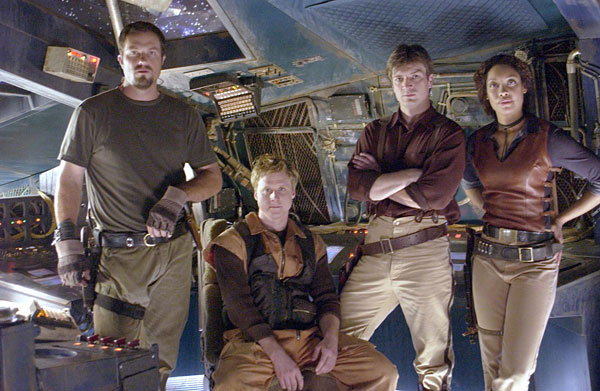
Since everyone knows, space is the next wild, wild west (Firefly fans?), I think we should start training for zero gravity fighting.
It’s also a good way to explain why relaxation is superior to tension in a fight. Almost everything we do in a fight is gravity dependent. The best fighting methods force an opponent to carry not only their own weight but your weight too, at the worst possible angles. Even with throws in which the opponent is picked up into the air, momentum is used in combination with a destabilized base to create a circular force around a center of gravity and a gravity dependent still point--ending of course with a smack down. (I just wanted to say smack down.)
So start analyzing fighting methods in terms of gravity and they will become more effective. As long as you are controlling the exchanges of momentum, your opponent should be carrying as much of your mass as possible. So, for example, if you punch someone you want all of your weight to hit them with momentum. If you do it right, strength is completely irrelevant.
A Challenge
/So, I immediately tried to describe what I wanted to see, at his convenience of course-I was expecting to come back another day. What I didn't realize was that he had something on the order of a thousand videos of folk rituals in his personal collection. He took me into another room to show me the scale of what he had, and perhaps to make it clear I didn't have any idea how to ask for something specific.
Anyway, we got off to a bad start. While I was talking to him there was an American graduate student in Green Engineering sitting in, he was there to get some directions actually but he stayed for the first part of our talk. After about 20 minutes, Professor Yeh looked over at the other students and said he could tell I didn't know the field and he called me Carlos Castaneda. I retorted that Castaneda was insane. But Yeh said, no, he was just a practitioner--who lacked rigor and perspective--he just wanted to tell his own story.
He said there is another writer he could compare me to if I didn't like Castaneda. I wouldn't have heard of her because her book was published in Hong Kong or something...HAh, he turned out to be talking about Margret Chen! He called her work worthless to scholars like himself, shallow! a nice coffee table picture book perhaps. I read her book in the two months before coming to Taiwan. For me it was a marvelous source of information on Tangki Spirit Mediums in Singapore. But one of the reasons I didn't review it was that her comments about Daoism and the early history of Chinese religion where poorly informed.
Yeh seemed momentarily charmed by knowledge of the book and by my assertion that I also abhor shallowness. But he quickly went back on the attack. If I wanted to do this kind of research I would have to know Chinese cosmology really well. My reaction was, go ahead, test me! He started listing cosmological ideas, and then we got stuck on a translation. He was saying ganzhi (stem and branch) which is a way of calculating auspices, so when I figured out what he meant I said, of course I am familiar with the tongshu (the complete almanac of cosmological calculations, also the oldest continuously published book on earth.)
So he pulled one out, then he showed me a drawer full of tongshu from previous years. As I flipped through the tongshu, I had to admit that although I had spent 7 years following various indicators from the tongshu and observing a few dozen commemorative days each year, most of the tongshu was totally over my head and outside my ability to comprehend.
Having made his point, he gestured toward his collection of Clifford Geertz books. Did I know of him? Yes, actually, I've read a few of his books (later I revealed that my father had interviewed him on the radio). OK, he said, have you eaten? I don't think the kind of work you are proposing is of any use, but lets continue this conversation over some dumplings.
Over the next four hours we argued. At one point I fired back that perhaps his work wasn't of much use because as a non-practitioner, he lacked fundamental experience! I think he liked that. He offered many challenges. Here are some of them:
- Gods do not teach people to fight.
- When people in trance possession cults fight, they are not possessed, they are just fighting.
- The Chinese literature on the subject does not use the term trance in a continuum the way I do. Generally trance means a specific deity is present.
- No one else has proposed that there are different types of trance for different types of deities (Professor Chang also said this). In other words it could be good that I'm proposing a new direction of thought but the people who belong to these cults don't make such distinctions. So I'm dangerously close to making stuff up. (My argument is that it is implicit in the different ways trance is invoked and in the different types of movement deities use. Also, in Daoist ritual all the deities are invoked through the visualization/embodiment of the eight generals.)
By the time I left four hours later, I had learned a lot, and he had conceded a few points too. I also got asked to help him with a letter to the Louvre (you know that museum in Paris) and he showed me a bunch of videos! I'll be back!
Dead Martial Artists Society
/I believe I have said elsewhere that we can graph trance on a continuum from:
An image in the mind ---------to------- Total possession by a deity
With language, dance, music, routine, altered states of consciousness, and perhaps emotions; all falling somewhere on this line.
(Perhaps we could say trance is the physicality of desire. A terrified or enraged fighter is likely to be possessed by her desires--in a very physical way. While we may have evolved this way through random selection because it improved our ability to survive, it seems illogical for us to fall deeper into trance the more we desire something. That's why Vulcans are so cool, they are an intelligent design.)
If we want to add another axis to our graph we could add will power:
Autonomic Nervious System------to------- Fine motor control.
Gross motor control would be somewhere in the middle, with panic, involuntary, and reflexive movement all falling somewhere near the beginning.
(Of course there is the notion from Mencius that the will of Heaven and the will of Man can be aligned. And a saying from the Daodejing, "If heaven has a reason, nobody knows it.")
And if we want to add a third axis to this graph we could add awareness:
Unconsciousness------to------ Seeing things as they actually are.
I suspect an increase in ones ability to remember could almost run parallel to this last axis. Which is interesting mainly because the inability to remember is often cited as a marker of a true deity possession.
I've been thinking using these three continuum's for years, and I sometimes forget that most people don't think this way. Perhaps even farther afield is the Daoist idea that our humanness can be defined by our appetites. This can also be viewed as a continuum from:
Spontaneous adaptable human-----to---- Blood thirsty demonic vampire-zombie-king.
With predictable vanilla ice cream humans and robots falling somewhere in the middle.
NOW, in keeping with the Dead Poets movie, if you don't think these graphs can help you understand martial arts, or history, or human nature you can now rip up this page...oops, I guess you can't, this is the internet.