Wang Xiangzhai

Wang XiangzhaiWang Xiangzhai, the founder of the Yiquan gongfu system is a huge figure in 20th Century Chinese martial arts. He is perhaps best known for saying traditional teachers are too secretive, and that students should attempt to circumvent them so that the arts are not lost.

He himself studied with many teachers. He assumed that each teacher was keeping secrets but that if he studied with enough of them he would get the secrets. This is because each individual teacher wouldn't know which secrets his other various teachers were keeping, and so there would be an overlap of material. Since what one teacher taught openly another teacher kept secret, he would eventually capture all the secrets in the overlap of material-- and this would be faster than waiting in subordination for one teacher to give up all his secrets.
I guess it worked.

I have heard that he summed up his martial arts knowledge into just a few phrases. One of them is: Xing bu po ti, li bu chu jian

神�外溢,��露形,形�破体,力�出尖。
Is anybody willing to venture a translation?

Update: the Chinese is now correct.

Kuo Lien-ying

Kuo and Bing in Golden Gate ParkMy first teaches teacher was Kuo Lien-ying. He was born in Tibet, and move to Beijing as a small boy at the beginning of the 20th Century. He was one of the first Chinese martial artists to teach in the West, beginning in the 1960's.

He had a long life and there are lots of great stories about him. Everybody and there uncle tells stories about how beyond great their teacher's teacher was, so I'm not going to do that even though I think it's true.

He was a performer of Beijing Opera in his early days, playing the lead roll of Monkey King. He was also a serious contender in matched fights and as the story goes, he quit because people were sneaking up to him in the middle of crowds trying to get close enough to slice one of his tendons with a razor blade.

He studied baguazhang with the second generation. He also studied with Wang Shengzhai during his early days. After the war he fled with the Kuomintang. He taught Northern Shaolin, Yiquan, Xingyi, Guanping Yang Taijiquan, lots of weapons, a little Bagua, and one person learned a little monkey gongfu, but he has since forgotten it.

He work as a bodyguard in Shanghai, and had extraordinary skills with a rope dart. He kept the rope tied around his body and was capable of throwing it without the use of his hands. Several of his students have described being quickly tied up against their will. I ran into Kimo the other day, one of his students from 40 years ago, and he told the story of how he, Kuo and my teacher Bing Gong, were performing at the old Emporium in San Francisco, which had high cavernous ceilings with wooden beams. Apparently he laid his rope dart on the ground (the dart was made out of a piece of a tire iron) and then kicked it straight up in to one of the high beams, where it stuck.

It seems he taught less than half of what he knew. Why?

He clearly had something of the secrecy that verges on paranoia common to many "masters." When he began his studies it was still illegal to publish a book on martial arts; the Boxer Rebellion, the civil war in the 1880's, the collapse of an empire, these all may have played a part in his thinking.

But he was ahead of his time in deciding to teach Westerners, so he was also open to new ideas. It is possible that he simply felt he had no qualified students; that even his Chinese students had not even a glimpse of what it required to learn gongfu in his day.

If his students had been only interested in fighting he would have taught them even less.

A Non-Epiphany Art

Pure LightChinese Martial arts and Qigong from a Daoist point of view are non-transcendent traditions.

These arts are primarily about revealing the way things actually are, they are not self-help or self-improvement regimes.

However, most people are on a transcendent path. We want to improve ourselves. We want to heal. Or we want to get a 'leg up' on the next guy, spiritually, morally, physically, or intellectually. So most of us regularly, and all of us sometimes, practice these arts in a transcendent way. We try to get better!

The basic Daoist outlook is that life is not a struggle, we're alright the way we are. We're nice enough, strong enough, smart enough, and we have enough qi. Practice is just a way of tuning our appetites for exercise, stillness, sleep, fighting, nutrition, contact with other people, etc.... We are naturally disciplined and curious.

This outlook is sometimes framed in a quasi-transcendent way as a simplification process, a letting go, a returning to our original nature(s).

Thus, epiphanies are really not part of the tradition. Now and then we learn a trick, or discover something cool, and we get excited. But it's not like most Yoga classes, where people brag about being filled with the glorious pure light of the universe everyday, before knocking back a double soy latte, jumping in the hybrid for an hour commute and then punching the clock.72 year old woman pulls car with teeth!

Anyway, in almost 30 years of practice I've actually had two epiphanies.

1. After years of practicing with very low stances and yet constantly hearing "sink your tail-bone," "go lower," and "song;" one day I did just that, I sank my tail-bone. I simply understood on a kinesthetic level what my teachers had been trying to teach, and from then on I did it correctly.

2. After doing a couple years of chansijin (taijiquan silk reeling exercises), one day my chest just relaxed. For a week after that my appetite for food dropped to about half a meal a day. Presumably I was using so much effort keeping my chest up, that when I stopped my body had some reserves left to run on. After a week my appetite came back, but it's been a little smaller ever since that day.

Baguazhang: Please don't hurt me!

Dr. Her Yue WongI hope this blog riles some people up.

The basic circle walking style with the hands out to the side and fingers open is utterly unique to baguazhang. Unique of course unless you're an actor and you've had to play a sneaky, frightened character who is trying to get around the outside of a fight in order to make off with the money, (like mister Pink at the end of Quentin Tarantino's Reservoir Dogs).

In Capoeira there is an idea called poison and honey. Here is how it works. One tries to appear submissive and vulnerable in such a way that it will draw an attacker into a trap. For example, it looks like you could step on my leg, but when you try to do so you get kicked or swept by my other leg.

We all know that Baguazhangs's open and extended fingers  are used to develop a type of power training. But they really look like an enticement to grab that will perhaps trap the attacker. Even so, the side walking with hands out is pretty much what anyone trying to walk around someone else's fight would do.

Hunch up like a turtle or a rabbit while doing the walk and you'll really look scared and pathetic. Is this part of the tradition? Could it be that the original inventors of Baguazhang were trying to synthesize the qualities of a frightened body with the qualities of a fearless body? (Here I'm talking about before Dong Haichuan, since I don't find the single inventor story all that credible.)

P.S. The great picture above is of Dr. Her Yue Wong founder of the Ching Yi Kung Fu Acadamy.

P.P.S. Capoeira Science has great videos!

What does "Song" Mean?

The term song (the "o" is pronounced like the "o" in soot) is most often translated sink or relax. It is for sure the most common thing that Taijiquan teachers say to their students.
Louis Swaim has this to say about it:
Etymologically the term song is base on the character for "long hair that hangs down"--that is, hair that is loosened and expanded, not "drawn up." Therefore, "loosened" and "loosen" are more accurate renderings for song and fang song. The phonetic element that gives the character song its pronunciation means, by itself, "a pine tree," which carries an associated imagery of "longevity," much as evergreens are associated with ongoing vitality in the West. This may provide a clue to the Taijiquan usage of this term, which must not be confused with total relaxation, but it closer to an optimal state of the condition referred to as tonus in English anatomical parlance; that is, the partial contraction of the musculature, which allows one to maintain equilibrium and upright posture. The aligned equilibrium that is prescribed in Taijiquan is associated with imagery of being "suspended" from the crown of the head. One can, therefore, draw upon the available imagery of both something that is loosened and hangs down, and that of the upright pine, whose limbs do not droop down, but are buoyant and lively.

Man with cue (queue)Understanding the cultural and historic significance of hair in China will really help give meaning to the underlying metaphors of song.

Even going quite far back in Chinese history, hair styles were always regulated by the government. The way you wore your hair told everyone your status and rank. Hair was worn in a top knot with a pin. The Chinese concept of "pulling the pin" has some resenance in English because it is like our concept of "letting your hair down."

To "pull out the pin" meant to 'drop out,' to resign, to retire, it meant to give up your status and rank, thus dropping in status. Thus by inference, song means to sink. But it also means to discard worrying about what you think you should be doing- or even what other people think of you.
Another important reference comes from the fact that from 1644-to 1911 China was ruled by the Manchu, an eastern Mongolian ethnic group called Jurchen allied with other Mongolian and Tibetan groups. AllZhenwu (the dark lord) Han (ethnic Chinese) males were forced to wear their hair in a cue as a form of national humiliation. If you cut your cue the penalty was death. Historically the cue was used at night by the Jurchen people to tie their slaves to a post. So the term song could easily be understood as harboring some revolutionary bravado.

zhang_0001Gods also have hair styles. Zhenwu, or Ziwei, is the Chinese god of fate and the central deity of the Chinese pantheon. He is the North Star, the point on the top of your head, and the perfected warrior. He represents the physicality of fearlessness, the perfect mix of pure discipline and extraordinary spontaneity that is the basis for Daoist meditation. In his iconography his hair is song, part of it is tied back in a loose braid with silk and chain to protect his neck from sharp blades, the rest is long and hanging loosely about his shoulders. His hair is a throwback (I couldn't resist) to ancient shaman-warriors who showed their utter lack of concern for status by letting their hair go wild.

Does this sound like what you're doing?

UPDATE: George Xu and I were talking about "song" and he said it is like a pine cone opening. A simultaneous spreading out into space and letting go.

Peng: The First Movement of Taijiquan (Continued)

Zhang SanfengThe key Taijiquan term peng has generally been translated 'ward-off.' I think that was a good start, after all, in Chinese it is only one word, but it has a really specific meaning so I'm going to try to render it into English.

But before I do that let me say something about the various ways peng is taught. Often a teacher will push on a student and say, 'buhao'--no good-- until the student by luck or accident, responds in almost the right way. Then the teacher says 'hao.' (Or perhaps they yawn and look up at the sky as if to say, "What have the heavens brought me?") Then the teacher has you push on them and you try to feel how they respond to your push. (Actually the word is not feel in Chinese, it is tingjin, which means: try to sense the inner processes you feel and translate those feelings into your own body, as if you are listening to a piece of music and wish to grasp the sentiment behind it.)
Peng is primarily taught, not by words, but by feeling, it is transmitted through touch from generation to generation. In taijiquan lingo--it is a qi transmission.

If you have older siblings, who were in the habit of poking you in the stomach, you probably already have some 'peng' skills.

When an older sibling pokes you, several responses become available: 1. Run to mommy. 2. Try to hurt them back. 3. With a smile, and with speed, nudge their hand away from your centerline before it hurts you, being careful not to provoke them further. Obviously number 1 is ineffective in the long run. Number 2 means getting beat up. So we get good at number 3.
Peng is an aggressive act, but it is a mild aggressive act. We could say it is a small beginning that hopes not to grow into a full possession.

When we are possessed by desire, we see only the desired manifest. Daodejing

To correctly practice peng, is also, fundamentally, to admit that we do not have control over the future.

Here goes:

Stand upright, slightly bend your knees, relax all of your joints and lengthen the top ofChen Manching doing one hand peng, (so it looks different than the description your head upwards and your tail bone downwards. Relax your abdominal muscles so that your breathing no longer moves your ribs, but instead moves your lower-back region (mingmen).
Simultaniously do all of the following:

1. Gently begin closing all of your joints, drawing your limbs inward towards the center of your body, like an amoeba shrinking. The distance between each of your bones should shrink as the sinovial fluid sack in each joint changes shape.

2. Gently wist all the tissue on your limbs in an outward direction, moving the bones as little as possible so as not to change the alignment of the knees or elbows.

3. Gently wrap the tissue of your torso, internal organs, and generally anything you can feel, in an outward direction. Be particularly carefully not to arch your spine or collapse your chest.

4. Using the least possible effort move your writs (upward and forward) at a perfect 45 degree angle.

5. Shift your weight very slightly forwards from the center of your feet, so that if someone were pushing you from the front while you are shrinking, you would move almost imperceptibly underneath them.

OK that's the underlying structure: the jing component. Here are the qi and shen components.

Update 7/29/07

1.  If your alignment is correct you will feel something rising from the ball of the foot, bubbling well point, which travels up your legs, then up your back, through your arms and then out the wrists.

2.  Fill your whole body with the feeling of steam, so that circulation to every part of your body is robust.

3.  Feel clouds circling around the surface of your body in the direction of the twisting and wrapping.

4.  Draw up a thick heavy black goop from the earth.  (This one is not universal, there are versions of it that use water or sand.  Others connect to heavenly bodies, or spontaneously plan routes out into the distance.  This is known as the jingshen component and can be invented.)
5.  Sense outward in all directions.
Is this what you do?

By the way the picture is of Chen Manching doing one handed peng, so it is a little different than the description, but internally the same.

Belief

Scott in Sichuan 2001If you get a chance to read this article about my trip to China in 2001 you'll see I ask people lots of questions about religion. At that time, if the subject of religion, TCM, or qi was raised, 95% of the time I would be asked, "Xin bu xin?" Xin is one of those Chinese words that means lots of things. Here it means, "do you believe or do you not believe (in qi, TCM, or religion)?" But the word xin, like our word faith, could also mean trust. (It's a little creepy being ask this all the time.)

This pervasive question is new to Chinese culture. As far as I know, it does not get asked in Taiwan. Where did it come from?

Marxism, since Raymond Aron first pointed it out, has been exposed as having the trappings of a religion. One of the characteristics of Marxism is that it takes its definition of religion from Christianity. Thus despite the fact that Marxism claims to be anti-religion, it defines religion only in Christian terms.

"Do you believe in God? and that...." is a Christian question. Jews, for instance, do not frame religion this way (to Jews it is a series of laws). Neither do Muslims (to Muslims it is an act of submission). Certainly the world's Animists don't focus on this question either.

Chinese Communists use this "do you believe...?" question to subvert all other forms of authority. Chinese religious traditions do not require belief. Use of the term qi does not require belief. The practice and efficacy of any type of medicine does not require belief.Zhang Daoling

The practice of martial arts, particularly, has absolutely nothing to do with belief. I'll even go further. There is really no such thing as theory. All we have are lists of experiments and protocols for achieving results. The best that can be said about theory is that it is a tool for inventing new experiments. It doesn't have any real world existance.

By the way, everything I have just said is completely compatible with Orthodox Daoism, except that perhaps I've violated the precept "be uncontentious," or another one, "do not comment on the veracity of claims made by (other) cults."

The Chinese world view was first articulated by the founder of Religious Daoism, Zhang Daoling. A thousand years later, during the Song Dynasty it was adopted by the Chinese Government as Orthodoxy. This world view posits that all things and events are mutually self-recreating, there is no external agency. The source of all inspiration and the process by which all inspiration comes into being, is constantly available.

The role of belief in such a world view does not survive Occam's Razor. I bring all this up because it is a constantly reoccurring issue. People often think that belief in qi will somehow improve their Acupuncture treatments. If it works on animals and small children, I think it is fair to say, belief is not a factor.

Warriors, Artists and Technicians #2

What is the difference between warriors, martial artists, and skilled fighters? (Continued)

Tibetian Warrior's armorThe time when Confucius lived and taught in China was just before the Warring States Era. It seems likely that his codes of conduct and visions of social order were inspired by an earlier era when wars were fought by a class of warriors. The story goes that Confucius was born into a warrior class but his group or lineage was defeated before he came of age. So he had the warrior training (he was the greatest archer of his time), and the warriorcode (extraordinary discipline), but he no longer had the status of a warrior. The warrior era was waning.

During the Warring States Era, hundreds of thousands of people were brought on to the fields of battle. These were not warriors; they were farmers, artisans, and convicts given weapons and conscripted to fight for generals, princes and kings.

At the end of the Warring States Era the first Emperor of the Qin (Qinshihuangdi), mostly finished off the warrior class. By the time of Han Wudi, there was none left in China.

In Ancient Greece warriors invented democracy. The recent movie "300" isGreek Warriors about a last stand of a group of warriors against a conscript army. Alexander the Great and later the Romans, fielded huge well-disciplined armies, but when not at war, men were considered "citizens" not warriors.
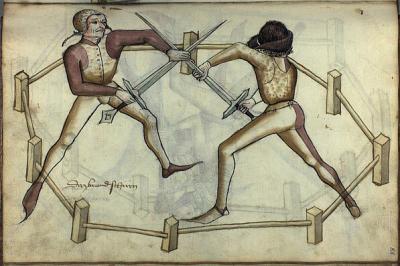
In Europe around 1000 years ago, various kings called together every man who had a horse and sent them into battle. They carved up the land in to kingdoms. Those men, whose contribution was their horse and their bravado, were made noble. They became "gentlemen" "landlords," and "knights." They developed a very strict warrior code, which we have come to think of as Honor. With in this code, if someone called you a liar, or insulted someone beneath you in the hierarchy, you had to fight them. If the offender was also a gentleman, you had to duel with them. In this world, people were not free to disagree. The expression "I beg to differ," is a holdover from these times. If you opened a shop and started selling stuff, you lost your status as a gentleman.

Fortunately this code of honor is mostly gone today. But it does linger. This aristocracy was very weak at the beginning of the 20th Century, and they died in disproportionate numbers during WWI.

A very tough form of Warrior Honor developed on the border between England and Scotland. These two countries were at war for 1000 years, so long that the landlords in the borderlands collected their taxes by something they called Blackmail. They lived in small rough houses, abducted their wives, and sharpened their thumbs for plucking out eyes. In 1650 or so, when England and Scotland made peace, better-organized landlords came in and slaughtered the boarder people. The survivors fled briefly to Northern Ireland and then came to America. They are known formally as the Scots-Irish, but they have always called themselves 'rednecks.'

So it is fair to say that tiny hints of Warrior Honor exist in the US Military today, but it is a volunteer army most citizens (and some non-citizens) can qualify to join.

In Japan, to be a warrior, you had to be born into the Samurai class. (I believe a Samurai could also adopt you at any age.) Only SamuraiSamurai were allowed to own swords, on penalty of death. Before Musashi, there was some training, mostly match fighting, grappling, throwing and wrestling. The code of a Samurai was very strict. It emphasized fearlessness and a willingness to die with out hesitation. Musashi was a real man, but as a myth he is credited with destroying the Warrior Code by using and teaching technique to win. Like the Europeans who considered it a violation of the code to practice shooting or fencing before a duel, the Samurai code valued pure fearlessness, pure willingness to die, not skill.

Part 3: Art vs. Skill

Warriors, Artists, and Technicians #1

Nuwa and FuxiWhat is the difference between a warrior, a martial artist, and a skilled expert?

A warrior is a member of a class, generally it is a privilege of birth. The warrior is not a universal concept but variants of it exist world wide. The first warriors could also be called shaman-kings. Most likely they developed from hunter-gather groups that occupied mountains, jungles or dry plains. These hunter-groups, often at war with each other, were in the habit of raiding the first agricultural settlements. At some point, these settlements probably got the idea that they could offer the hunter-groups ruler-ship in exchange for protection. They thus became the first warrior classes.

These warrior shaman's most powerful weapon was inspiring fear. Chinese historians record this kind of shaman-commander charging off into battle with a poisonous snake in each hand, wild Donn F. Draegerhair, animal skins, horns and a terrifying mask. After countless generations, these shaman-warriors morphed into warriors with a strict code. The warriors of neighboring kingdoms fought each other on designatied fields of battle, with codes of conduct and rules about how to kill, whom to kill, and what to do with captured enemies.

In China, this was the time when the Zhouyi was written. The Zhouyi eventual developed into the Yijing (I Ching) or the book of changes. Richard Rutt's translation and commentary sheds really interesting light on this era of warrior inspired codes that used divination and both mass animal and human sacrifice as a toolsBurma for staying in power.

This is not just history. The warrior-shaman-kings are still around in isolated parts of Indonesia. (See Don F. Draeger's beautiful book the The Weapons & Fighting Arts of Indonesia.) The Lords Army in the Congo, would also qualify. As would The Terror Twins in the Burma-Thai boarder region.

Part two: Warrior Codes